Essential oils are one of the most popular — and most misunderstood — corners of natural wellness. Used well, they are a simple, affordable way to support calm, clearer breathing, soothed skin, and an easier stomach. Used carelessly, they can irritate skin or do nothing at all. This guide is your starting point: what the research actually supports, how to use oils safely, which oil suits which concern, and where to go deeper for your specific need.
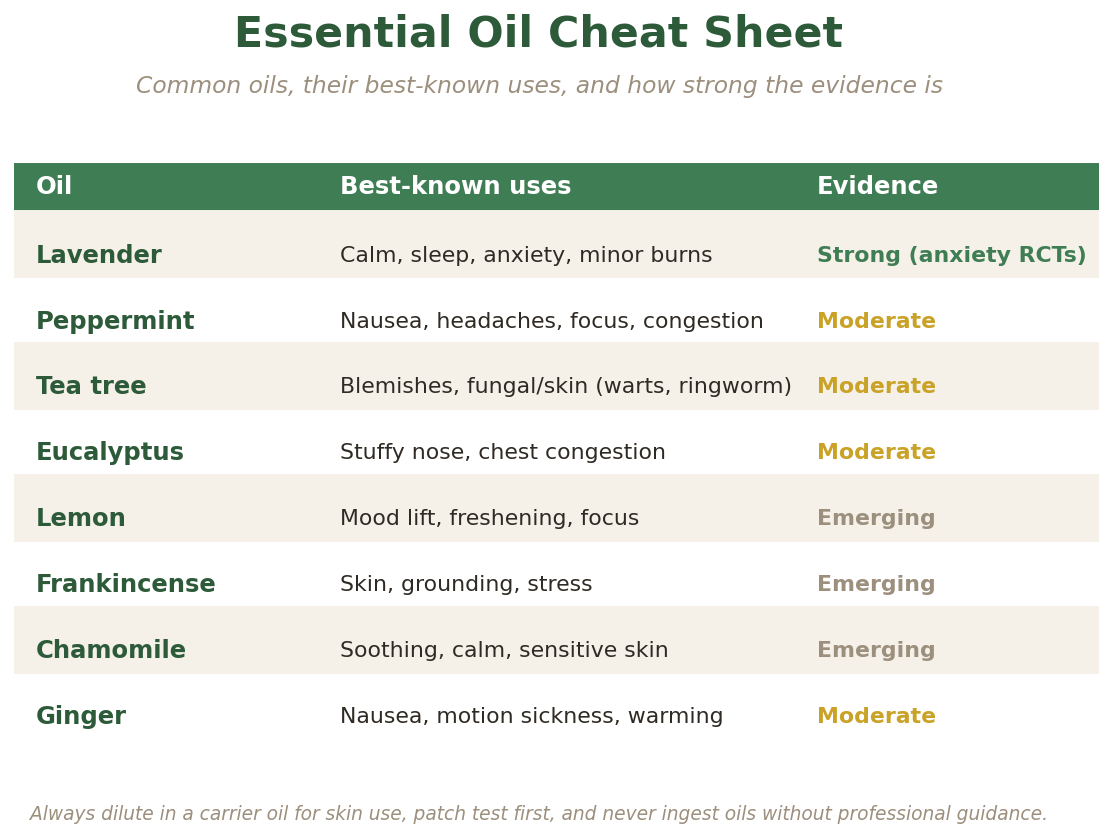
Reaching for oils again and again for the same symptom?
Find Your Essential Oil Match
What are essential oils?
Essential oils are concentrated plant extracts that capture the natural aroma and active compounds of a plant — the lavender in lavender oil, the menthol in peppermint, the cineole in eucalyptus. They are made by steam-distilling or cold-pressing flowers, leaves, bark, or peel. Because they are so concentrated, a single drop is potent, which is exactly why how you use them matters as much as which one you choose.
How to use essential oils (3 safe methods)
- Aromatically (diffuse or inhale). The simplest and safest method. Add 3–5 drops to a diffuser, or put a drop on a tissue or in a personal inhaler and breathe it in. Great for mood, calm, focus, and congestion.
- Topically (always diluted). Mix a few drops into a carrier oil — fractionated coconut, jojoba, or sweet almond — before applying to skin. A typical dilution is about 2–3% (roughly 12–18 drops per ounce of carrier). Patch test first.
- Around the home. A few drops in unscented cleaners, laundry, or a room spray freshen your space without synthetic fragrance — a nice swap for reducing your everyday chemical load.
Essential oil safety: the non-negotiables
- Always dilute oils in a carrier before applying to skin — undiluted “neat” use is a common cause of irritation.
- Patch test on your inner arm for 24 hours before using a new oil more broadly.
- Mind the sun with citrus oils. Lemon, lime, bergamot, and other citrus oils can be photosensitizing — avoid sun on treated skin for 12+ hours.
- Do not ingest essential oils unless guided by a qualified professional. Keep away from eyes and inner ears.
- Take extra care with children, pregnancy, nursing, and pets. Many oils (including peppermint and eucalyptus for young children, and tea tree for pets) need special caution — check with your provider first.
What the research actually says about essential oils
Essential oils sit somewhere between folk tradition and emerging science — and the picture is encouraging in specific areas. The strongest evidence is for calm and anxiety. According to research indexed on PubMed, a network meta-analysis of 44 randomized controlled trials (3,419 participants) found that essential oils significantly reduced both state and trait anxiety, and even modestly lowered blood pressure and heart rate — with lavender ranking among the most effective (Tan et al., 2023, Frontiers in Public Health, DOI). A separate meta-analysis found aromatherapy effective for relieving anxiety in people with cancer, especially lavender-based aromatic massage (Li et al., 2022, Frontiers in Public Health, DOI), and a review of 33 studies found aromatherapy helped reduce labor pain and anxiety (Tabatabaeichehr & Mortazavi, 2020, Ethiopian Journal of Health Sciences, DOI).
Bentonite, charcoal, chelation, cilantro, mercury chasing — these protocols all assume heavy metals are your dominant toxic load. For some people they are. Plenty of others land in this kind of work suspecting metals when adrenal exhaustion, parasites, or mold are actually doing more of the damage, and the protocols look very different depending which one is yours. If you want to sort it out before committing to weeks of binders, the 2-minute What's Draining Your Brain Tool places you in one of four root cause types so the next thing you try has a real chance of working.
The bottom line: for stress, relaxation, and aroma-driven comfort, essential oils have real, growing support. For many other uses — skin, nausea, congestion — the tradition is strong and the early evidence is promising, but oils are best seen as gentle, complementary support rather than a cure. Use them to feel better day to day, and pair them with the deeper habits that actually move the needle on health.
Essential oils by concern: your in-depth guides
Have a specific concern? We have a detailed, complete guide for each — with the best oils, how to use them, and safety notes:
- Calm & sleep: Calming Essential Oils to Find Your Zen
- Nausea & upset stomach: Essential Oils for Nausea
- Stuffy nose & congestion: The Essential Oil Inhaler
- Bug bites: Essential Oils for Bug Bites
- Warts: Best Essential Oils for Warts
- Ringworm: Best Essential Oils for Ringworm
- Bruises: Essential Oils for Bruises
- Fever comfort: Essential Oils to Cool Down a Fever
- Fresh breath: Peppermint Oil vs. Gum
- Candle & soap making: Fragrance Load Calculator
A great oil to start with
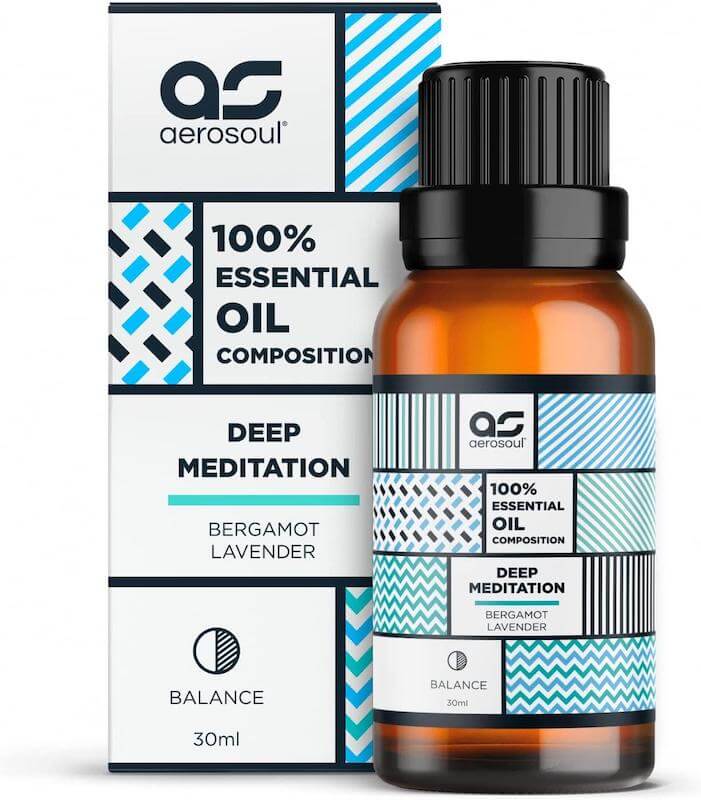
If you are buying your first bottle, start with lavender — it is the most versatile and best-researched oil, lovely for calm, sleep, and soothing skin. Look for a pure, therapeutic-grade oil in dark glass:
Pure Lavender Essential Oil
Pair it with a simple carrier oil (fractionated coconut or jojoba) for safe topical use, and you have everything you need to begin.
Frequently asked questions about essential oils
How do you use essential oils for beginners?
Start with diffusing or inhaling — it is the safest, easiest method. Add 3 to 5 drops to a diffuser, or a drop on a tissue, and breathe. For skin, always dilute a few drops in a carrier oil and patch test first. Lavender, peppermint, and lemon make a perfect, versatile starter trio.
Are essential oils safe?
Used correctly, yes — for most healthy adults they are safe for aromatic and properly diluted topical use. The main risks come from using them undiluted, getting them in the eyes, ingesting them, or sun exposure after citrus oils. Take extra care with children, pets, and during pregnancy or nursing.
Can you put essential oils directly on your skin?
Almost never undiluted. Essential oils are highly concentrated and can irritate or sensitize skin when applied “neat.” Dilute a few drops in a carrier oil (about 2 to 3%) and patch test. A small number of oils, like lavender and tea tree, are sometimes spot-applied diluted, but diluting is always the safer default.
Can you ingest essential oils?
Not without guidance from a qualified professional. Essential oils are extremely concentrated, and ingesting them can be harmful. For everyday wellness at home, stick to aromatic and properly diluted topical use.
When You Keep Reaching For The Same Oil, Listen To The Pattern
The links used on thewellthieone.com are affiliate links, which may provide a small commission. This does not increase the price of the goods for the consumer whatsoever. What it does is ensure that useful content like this can continue to be produced. Thank-you for enjoying our content and allowing us to continue to provide more.