
An ingrown toenail catches the corner of the nail digging into the soft skin of the nail fold. What begins as mild irritation can progress to swelling, infection, and tissue overgrowth — sometimes in days. The good news is that most early-stage ingrown toenails respond to a simple Epsom salt soak protocol you can do at home. This guide walks through exactly what to do, when soaking is enough, and when to stop and see a podiatrist.
Find Your Ingrown Toenail Soak Plan
Three taps. Personalized protocol. See exactly what to do tonight – and when to stop and see a podiatrist.
Why Epsom salt works for ingrown toenails
According to PubMed
A 2019 review in American Family Physician on ingrown toenail management documents that nonsurgical treatments — including warm soaks (the foundation of Epsom salt protocols), proper footwear, and gutter splint techniques — are first-line therapy for mild to moderate cases. Surgical approaches (partial nail avulsion with matrixectomy) have higher recurrence prevention but are reserved for severe or recurrent ingrown nails. Hyperhidrosis and onychomycosis (managed by Epsom soaks) are common contributors that warm-water + magnesium-sulfate protocols address directly.
Bentonite, charcoal, chelation, cilantro, mercury chasing — these protocols all assume heavy metals are your dominant toxic load. For some people they are. Plenty of others land in this kind of work suspecting metals when adrenal exhaustion, parasites, or mold are actually doing more of the damage, and the protocols look very different depending which one is yours. If you want to sort it out before committing to weeks of binders, the 2-minute What's Draining Your Brain Tool places you in one of four root cause types so the next thing you try has a real chance of working.
Mayeaux EJ, Carter C, Murphy TE. Ingrown Toenail Management. American Family Physician 2019. PMID 31361106
Epsom salt (magnesium sulfate) does three useful things in a warm soak. First, the warmth softens the nail plate and the skin of the nail fold, which loosens the grip the nail has on the surrounding tissue. Second, the hypertonic salt solution draws fluid out of the inflamed area through osmosis, reducing local swelling. Third, magnesium itself has mild anti-inflammatory action when absorbed through skin (absorption is modest but measurable in studies of Epsom baths).


What Epsom does not do is kill infection. It does not contain antibiotics. If the toenail has pus, red streaking, or visible tissue overgrowth, soaking alone will not resolve it.
Find My Ingrown Toenail Stage
Recurrent Skin + Nail Issues Often Trace To Toxic Load
Ingrown toenails that keep returning, slow-to-heal skin, and recurrent foot infections often point to overall immune function under strain — commonly from heavy metals, mold, parasites, or chronic cortisol. The 90 second Toxic Load Tool finds which one is driving yours.
Use The Toxic Load ToolThe 5-step ingrown toenail soak protocol
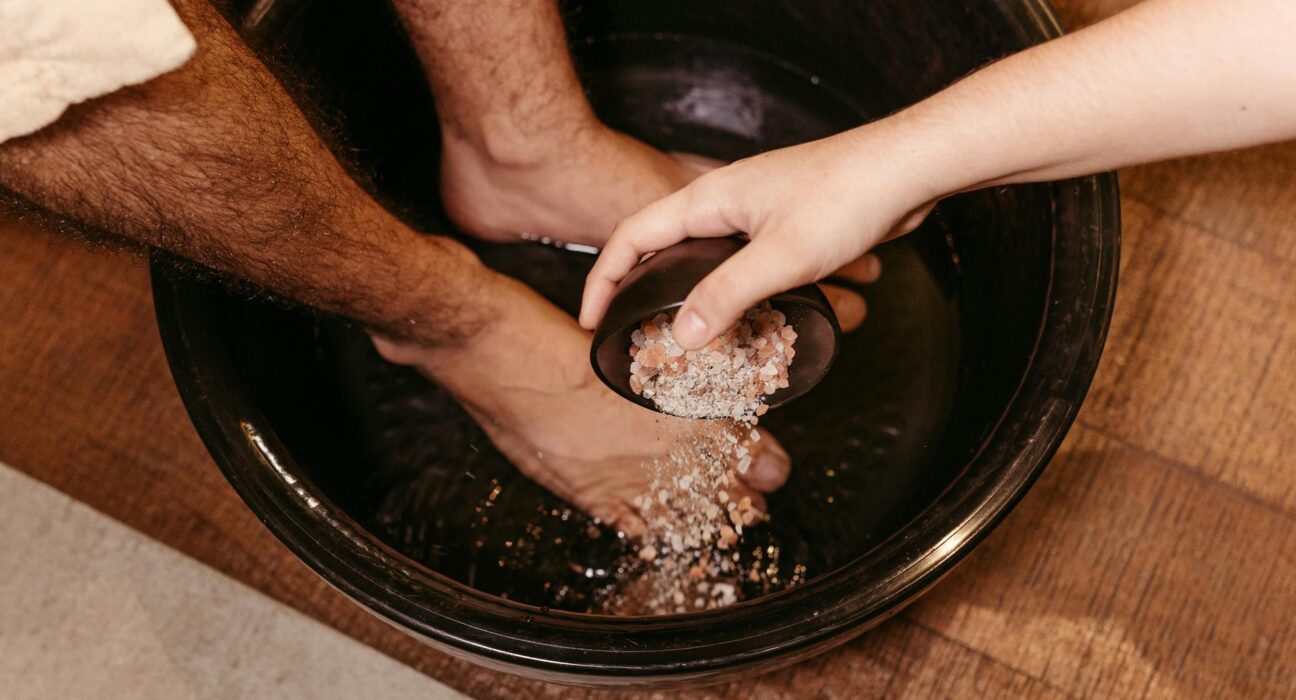
Step 1: Prepare the soak
One cup of Epsom salt per gallon of warm (not hot) water. The temperature should be comfortable for 15-20 minutes — about the temperature of a bath. Use a small foot tub or basin that fully submerges the affected toe. A collapsible foot-soak basin is the practical choice if you don’t have a regular bathroom basin available.
Step 2: Soak 15-20 minutes, 2-3 times daily
Frequency matters more than duration. Three short soaks beat one long soak. During each soak, you can gently massage the area around (not directly on) the inflamed skin to encourage drainage if pressure has built up.
Step 3: Lift the nail edge — do not cut
After the soak, the nail plate is soft and pliable. Take a clean wisp of cotton or dental floss and gently slide it under the nail edge that is digging into the skin. This creates space between the nail and the skin. Replace the cotton daily until the nail grows out past the nail fold.
Do NOT try to cut, dig out, or extract the nail edge with clippers. Home surgery on an ingrown toenail is the most common reason a Stage 1 case becomes a Stage 3 infection.
Step 4: Topical care between soaks
After drying the foot, apply a thin layer of diluted tea tree oil (4-5 drops in a teaspoon of carrier oil) around the nail fold. Tea tree has documented antibacterial activity that helps prevent the soak environment from becoming an infection environment. If skin is already broken, switch to a triple antibiotic ointment instead.
Step 5: Footwear matters more than people think
Tight, narrow-toe shoes are the single most common contributor to ingrown toenails. While the toenail heals, switch to wide-toe-box shoes or sandals. After healing, audit your everyday shoes — if you can’t wiggle all five toes comfortably, the shoes are too narrow for your foot.
Red flags — when to stop soaking and see a podiatrist
Home care has limits. See a podiatrist or urgent care the same day if you notice any of these:
- Fever, chills, or feeling unwell — infection has spread systemically
- Red streaking moving up the foot from the toe
- Visible pus or yellow drainage
- Granulation tissue — pink/red overgrowth around the nail edge
- Diabetes, peripheral vascular disease, or immune suppression — these conditions make ingrown toenails risky to self-treat at any stage
- No improvement after 5-7 days of consistent home care
Why nail-cutting technique determines whether it comes back
Most recurrent ingrown toenails trace back to one of two habits: cutting the nail too short, or curving the corners. The correct technique is straight-across cuts, with the nail length flush to the tip of the toe or just slightly longer. The corners should stay slightly above the skin line — they need to “lead” the nail growth so the nail plate emerges over the skin, not under it. A straight-edge podiatry clipper makes the technique much easier than standard curved clippers.
When it keeps coming back — the matrixectomy question
If you’ve had three or more ingrown toenail episodes on the same toe in a year, the nail itself has an unfavorable shape (often genetic). Repeated home soaks won’t fix the structural cause. A minor in-office procedure called a partial matrixectomy permanently removes the strip of nail tissue (the “matrix”) that grows the problem edge. It takes about 30 minutes under local anesthesia, has a high success rate, and is covered by most insurance.
Frequently asked questions
Can I use regular table salt instead of Epsom?
Yes, in a pinch — a saltwater soak (1 tbsp salt per quart warm water) provides the antibacterial and drying effect. Epsom is preferred because the magnesium adds an anti-inflammatory benefit and is gentler on the skin during repeated daily use.
How quickly should an Epsom soak start helping?
Most Stage 1 ingrown toenails feel meaningfully better within 48 hours of consistent 2-3x daily soaks. If yours feels worse after 48 hours, it’s progressing past what home care can manage — call a podiatrist.
Is it OK to soak both feet at once?
Yes — full foot submersion is even better because the magnesium absorption is broader. Just make sure the affected toe is fully covered.
Educational content, not individualized medical advice. If you have diabetes, circulation problems, or immune-system concerns, ingrown toenails should be evaluated by a podiatrist regardless of stage.


