

The Eisenhower matrix for daily decisions is one of the simplest, oldest, and quietly most effective ways to figure out what to do today and what to leave alone. It comes from a quote attributed to President Dwight Eisenhower: what is important is seldom urgent, and what is urgent is seldom important. From that single observation comes a tiny 2 by 2 grid that can rescue your week.
I came back to this method during a stretch where my to-do list looked like a circus and my actual progress on anything that mattered was zero. I was answering the loudest tasks instead of the most meaningful ones. The Eisenhower matrix is what got me out of that loop. After two weeks of running every new task through the grid, the right things finally started getting done.
This guide walks you through how the matrix actually works, the mistakes most people make on day one, the simplest way to use it without overengineering, and three clean tools that make it stick.
Key Takeaways
- The Eisenhower matrix sorts every task into four quadrants by urgency and importance, so you stop reacting to whatever is loudest.
- Quadrant 2 (important, not urgent) is where your real life happens. Most people accidentally live in Quadrant 1 and 3.
- Use it as a 5-minute morning ritual, not a complex software system. Paper, sticky notes, or a simple notepad is enough.
- Pair the matrix with a single-task focus block to actually move Quadrant 2 forward, not just label it.
What you will learn in this video:
- The four quadrants of the matrix and what each one really means in plain language
- How to handle the urgency trap when everything starts to feel like a fire
- Practical examples of sorting tasks if you are using the method for the first time
The Two Words That Run the Whole System
Every task in your day is either urgent or not, and either important or not. That is the whole framework. Two yes-or-no questions, four possible combinations.
Urgent means it has a hard deadline or a consequence if you do not act soon. The dentist appointment, the email reply your boss is waiting on, the dishwasher that is leaking onto the floor.
Important means it moves something that matters in your life forward. Your health, your relationships, your finances, the project that will actually change your career. Important things rarely scream at you. That is why they get pushed.
The Eisenhower matrix forces you to answer both questions about every task. Once you do, you can place each task in one of four quadrants and act accordingly.

The Four Quadrants in Plain Language
Here is what each quadrant means and what to do with the tasks you find there.
Quadrant 1: Urgent and Important (Do)
True emergencies and tight deadlines. A sick child, a broken pipe, a tax filing due tomorrow, a real client crisis. Do these now. The trap is convincing yourself that everything belongs here.
Quadrant 2: Important but Not Urgent (Schedule)
Exercise, meal planning, learning a new skill, saving for retirement, working on the book you have wanted to write for two years, sleep, deep relationships, preventive health. None of these scream at you. They are also the only things that actually move your life forward. Schedule time for them on the calendar before the week fills up.
Quadrant 3: Urgent but Not Important (Delegate or Decline)
Most other people’s emergencies. Pings, requests, interruptions, tasks that feel pressing because someone else made them feel that way. Many people spend most of their day here and call it being productive. Delegate them, batch them, or politely decline.
Quadrant 4: Not Urgent and Not Important (Eliminate)
Mindless scrolling, low-stakes meetings you could skip, busywork, the news cycle, bargain shopping you do not need. These steal time and energy without giving anything back. Cut them with a clean conscience.
Why This Method Beats a Standard To-Do List
A regular to-do list is just a flat pile of stuff. There is no signal about which item matters more. So we do what humans do under pressure: we pick the easiest tasks first to feel productive, or we react to whatever is shouting loudest. Both moves keep us locked in Quadrants 1 and 3, where life is reactive and exhausting.
The matrix introduces a hierarchy. It pulls Quadrant 2 forward into the day instead of letting it slip to “someday.” Studies on time management consistently show that proactive scheduling of important non-urgent work is the single biggest predictor of meaningful progress. Harvard Business Review has covered the delegation discipline the matrix relies on, and the data is clear: people who actively triage what NOT to do are the ones who get more done.
If you have been struggling to make consistent progress on goals that matter, this is the missing layer. Pair the matrix with a calmer mind by exploring our guide on how to do a brain dump for stress relief. A clear mind sorts tasks faster than a cluttered one.
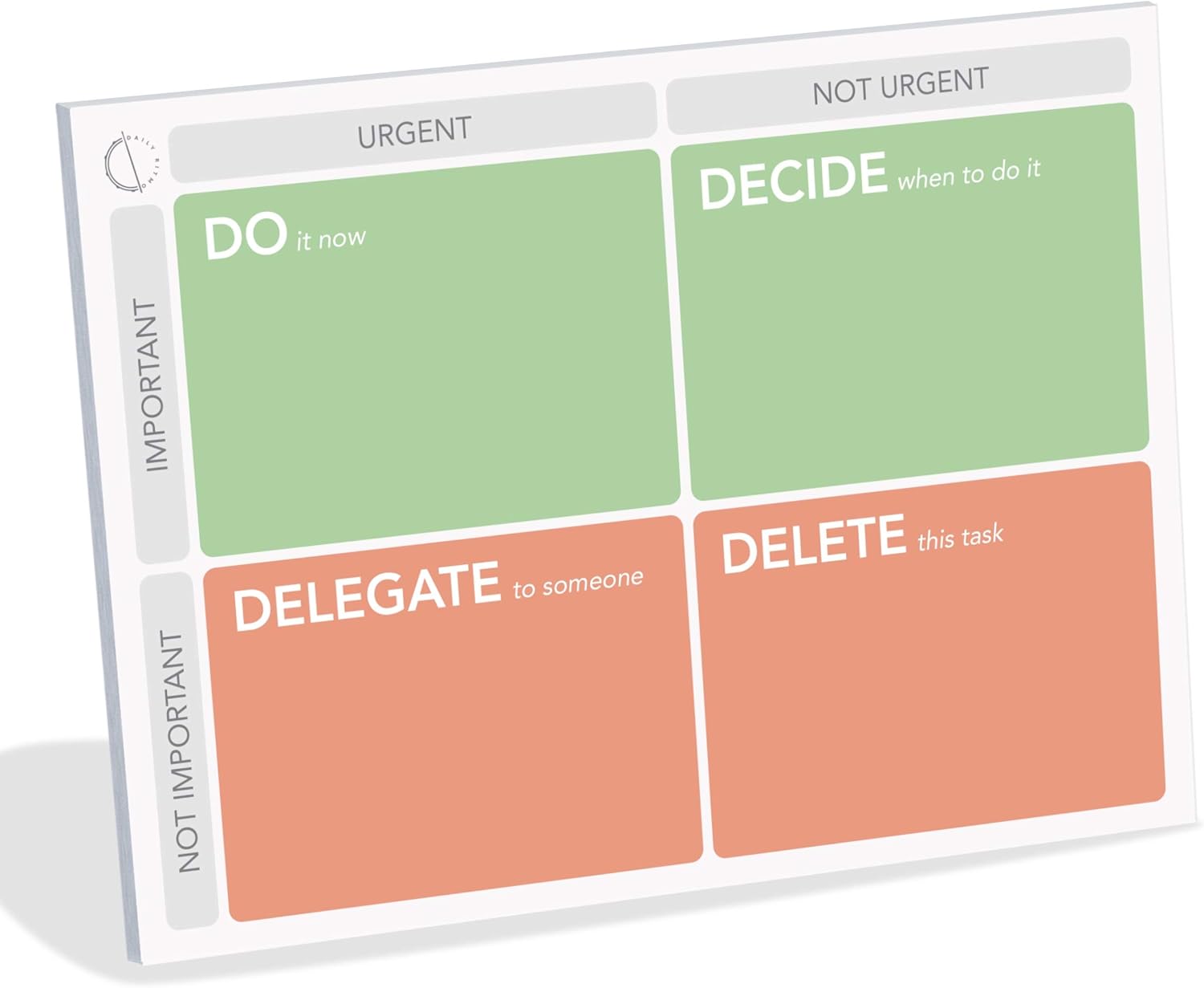
DAILY RITMO Eisenhower Matrix Sticky Notes
Source: amazon.com
50 large 8×6 inch sticky pages pre-printed with the four quadrants. Tear, stick, fill in, repeat.
The Wellthie One Review
If you have ever lost steam on a productivity habit because you had to set up a fancy app first, these sticky notes are the answer. The grid is already drawn. You write your tasks, stick the page on your wall or notebook, and you are done. I keep one on the corner of my desk and start every Monday with a fresh sheet. Best for people who think on paper better than on screens.
DAILY RITMO Sticky Notes Attributes
- Pre-printed Eisenhower matrix grid on each sticky page
- 50 large pages, 8×6 inches, easy to write on
- Repositionable adhesive that does not damage walls or notebooks
- Made of recycled paper

The 5-Minute Morning Ritual That Makes It Stick
Most people abandon the matrix because they try to sort their entire life into it on day one. Skip that. Here is the small daily version that works.
- Brain dump for 90 seconds. List every task on your mind for today. No filtering, no sorting, just dump.
- Tag each task U or N (urgent or not). A real deadline today equals U. Anything else is N.
- Tag each task I or N (important or not). If you would still care about this in a month, it is I.
- Place each task in a quadrant. Four piles based on the two tags.
- Decide and act. Quadrant 1 first, in order. Block calendar time for one Quadrant 2 task. Delegate or decline Quadrant 3. Cross out Quadrant 4.
Total time: about 5 minutes after a few practice rounds. Do it with your morning coffee, before you open email or Slack. Email and Slack are full of other people’s Quadrant 1 problems, and once you open them, your day belongs to them, not you.
The Quadrant 2 Discipline (Where Your Life Actually Lives)
If you only take one thing from the matrix, take this. Quadrant 2 is where the meaningful work of your life sits. It is also the quadrant the world will never push you toward. Nobody is going to email you saying, “It’s time to walk for 30 minutes today.” Nobody will text you, “Have you written one paragraph of your book this week?”
You have to be the one to schedule Quadrant 2. Block a 60 to 90 minute window on the calendar each day for one Quadrant 2 task. Treat it as immovable as a doctor’s appointment. Protect it from Quadrant 3 invasions. This is the single highest-leverage discipline in time management.
Pair this block with a focused single-task practice instead of multitasking. Our guide on the Ivy Lee method for daily productivity walks through a similar single-tasking system that pairs beautifully with the matrix.
Full Focus Planner by Michael Hyatt

Source: amazon.com
Hardcover daily planner with weekly review sections, big 3 priorities, and quarterly goal tracking.
The Wellthie One Review
If you want a more structured planner that builds the matrix into a wider weekly and quarterly system, this one is excellent. It pushes you to identify your “big 3” tasks each day, which is essentially a Quadrant 2 lock-in. The hardcover quality is worth the price if you want a planner you will actually use for a year. Best for people who want planning to feel like a professional habit rather than a quick triage.
Full Focus Planner Attributes
- Hardcover daily planner with 90-day quarterly format
- Weekly review pages for reflection and reset
- “Big 3” daily priority structure (a strong Quadrant 2 anchor)
- Goal-setting framework built in
Common Mistakes People Make With the Eisenhower Matrix
The system is simple. Where people stumble is in how they apply it. Here are the four traps to avoid.
Treating everything as urgent
If your matrix shows Quadrant 1 stuffed and Quadrant 2 empty, you are using urgency as a mood, not a fact. Re-ask: is there a real deadline today? Will anything bad actually happen if I do this on Thursday instead?
Treating everything as important
If you cannot bring yourself to put anything in Quadrant 4, you have a hoarding problem. Almost every adult has tasks that should die quietly. Cut them.
Not blocking calendar time for Quadrant 2
Sorting tasks into Quadrant 2 without scheduling them is just labeling. The action that turns intention into reality is blocking the calendar.
Skipping the matrix on busy days
The busiest days are the ones where the matrix matters most. If your day is on fire, 5 minutes of triage will save the next 3 hours of wasted reactivity.

Frequently Asked Questions
How long should it take to fill out the matrix each day?
Around 5 minutes once you are in the rhythm. The first few days take longer because you are negotiating with yourself about what is really important. That gets faster with practice.
Should I use a digital tool or paper?
Whichever you will actually open every morning. Most people I know stick with the habit longer using paper or sticky notes because there is no app to forget about. Apps are powerful but only if you use them.
How do I handle tasks that feel like they belong in two quadrants?
Pick the dominant one. If you are torn between Quadrant 1 and Quadrant 2, ask yourself if there is a true deadline today. If yes, it is Q1. If no, it is Q2. The matrix forces clean decisions, which is the whole point.
What if my whole day is reactive (Quadrant 3 work)?
Then your job design or the boundaries you have set are the real problem, not your task list. Use the matrix to flag this pattern. After a week of seeing your day live in Q3, you have evidence to renegotiate workload, delegate more, or shift roles.
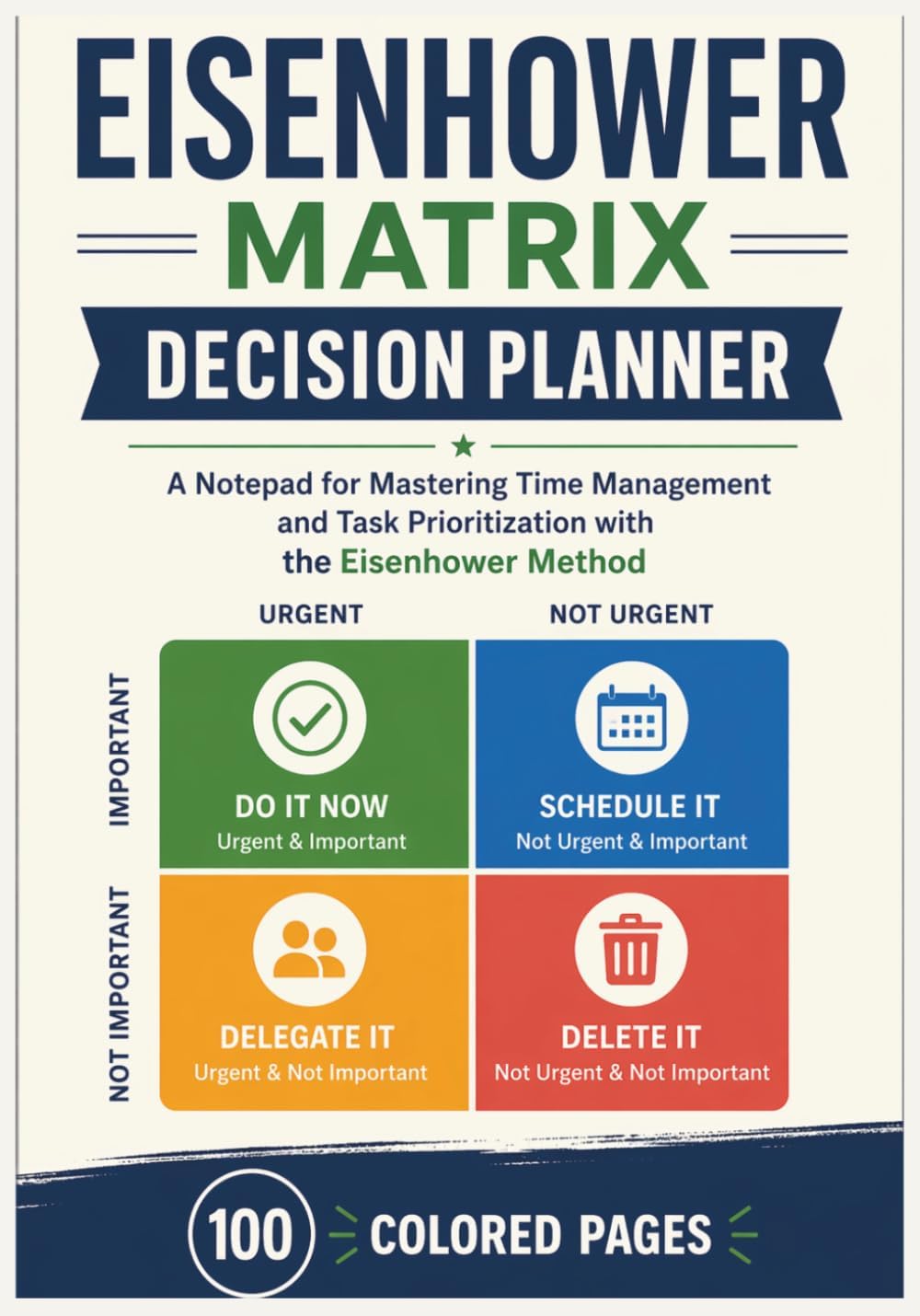
Eisenhower Matrix Decision Planner Notepad
Source: amazon.com
100-page tear-off notepad with the Eisenhower grid printed on every page. No setup required.
The Wellthie One Review
This is the most barebones option for someone who just wants the four boxes on a page each day with no extras. Tear off, fill in, move on. The 100-page count gives you about three months of daily use, which is enough time for the habit to stick. Best for people who want to test the matrix for a season before committing to a bigger planner system.
Eisenhower Matrix Decision Planner Attributes
- 100 tear-off pages with the matrix grid
- Compact size, fits on a desk or in a small bag
- Date and notes space on each page
- Lowest cost option for testing the method
Bringing It All Together
The Eisenhower matrix for daily decisions is not a magic system. It is a forcing function. Five minutes of honest sorting in the morning replaces hours of reactive scrambling later. The trick is that it makes you confront what is actually important rather than what is loudest, and that confrontation is the whole point.
Start with paper, sticky notes, or one of the planners above. Run the morning ritual for two weeks. Watch what shifts in how your days end. The most common feedback I hear from friends who try this is, “I got the right things done for the first time in months.” That is what an old grid and a sharp question can do.
For an even simpler daily list, the 1-3-5 rule for daily productivity caps you at one big, three medium, and five small tasks.
This post may contain affiliate links, which means we may receive a small commission, at no cost to you, if you make a purchase through a link.


