
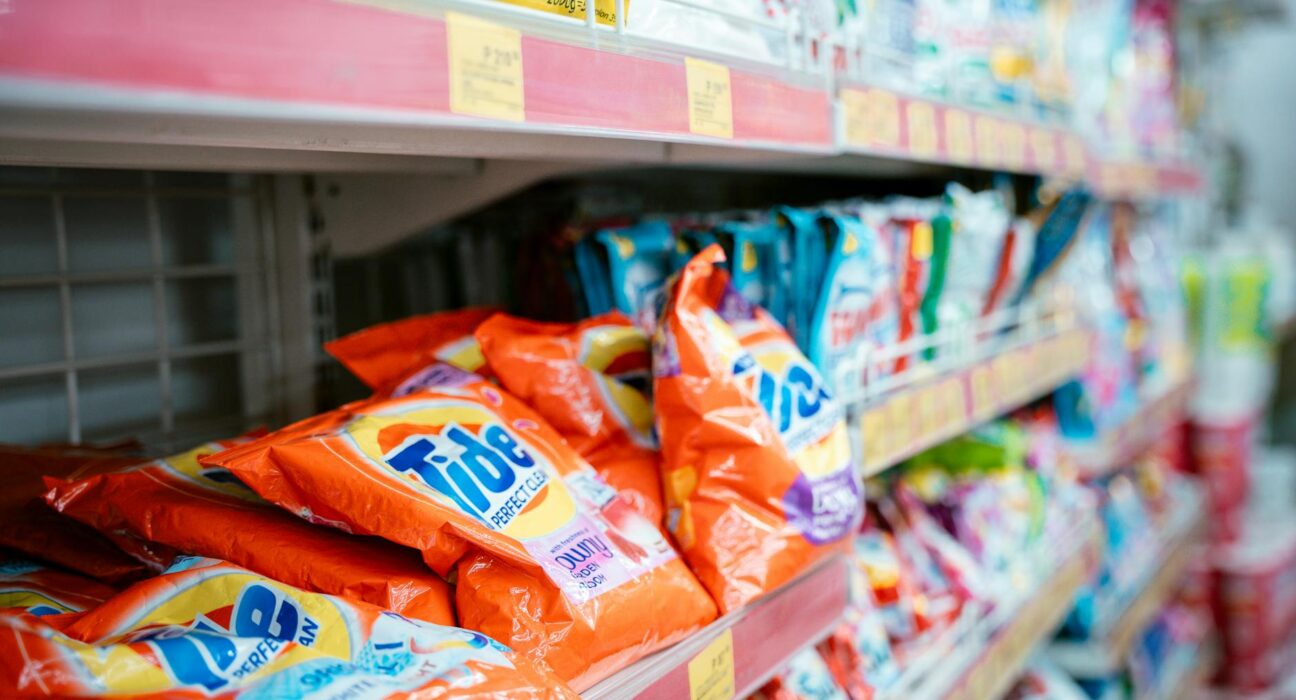
The most toxic laundry detergents on U.S. shelves — Tide Original, Gain, Persil, Dreft — share the same chemistry pattern: synthetic fragrance loads of 50 to 75 undisclosed compounds, methylisothiazolinone preservatives, ethoxylated surfactants that carry 1,4-dioxane contamination per Zhou 2019 (DOI) FDA detection work, and optical brighteners that bind to fabric and sit against skin. The Scan My Detergent Brand tool right below this intro lets you tap your current brand and see exactly which compounds it contains, why each matters, and the closest safer swap from our tested picks.
The peer-reviewed dermatology and indoor-air-quality literature is solid on this: Bai 2020 (DOI) identified fragrance as the #1 allergen in 66.7% of best-selling laundry detergents on U.S. shelves, and methylisothiazolinone in 80% of so-called “baby safe” formulas. Steinemann 2017 (DOI) found 64.3% of asthmatics report adverse health effects from fragranced products, with 28.9% specifically from scented laundry venting out of a dryer. The pattern across the most-toxic brands is documented and consistent.
If you want the complete ranked roundup with our Find My Safer Swap Tool, start at the pillar guide: Non Toxic Laundry Detergent 2026: Tested & Ranked + Find My Safer Swap Tool →
This page goes deeper on one specific angle of that bigger guide.
Tap your current brand → see which of the 12 flagged compounds it contains, why each matters, and the closest safer swap.
Safer Laundry Brand Cheat Sheet
Printable one-page reference: 12 ingredients to avoid, 8 brands that pass our 4-point test, and a 30-second lookup order for any new product. Made for the inside of your laundry-room cabinet.
5 Non-Toxic Laundry Detergents That Pass Our 4-Point Test
Same 5 picks across our entire laundry library — each pick is a different use case. Pictures and buttons both clickable.
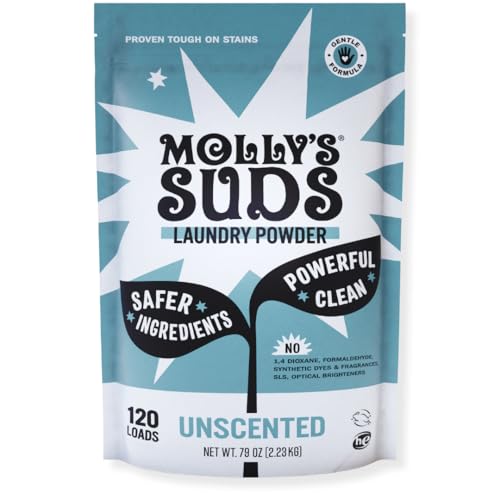
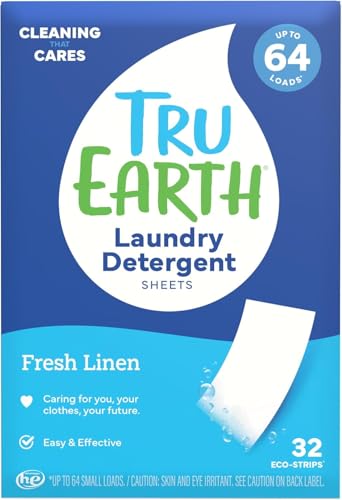
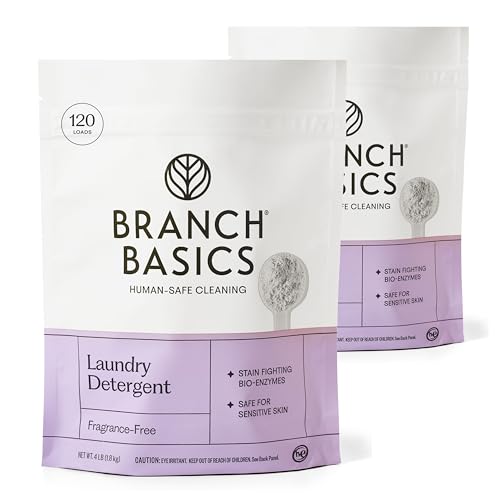


If you only CHOOSE ONE: Molly’s Suds Original — cleanest ingredient list at the lowest cost per load.
Laundry Is One of Six Daily Chemical-Exposure Doors
Swapping detergent is one of the highest-leverage moves for your toxic load — fragrance and surfactant compounds sit on your skin 24 hours a day and offgas through the dryer vent into your indoor air. But it is one of six daily doors. The Toxic Load Self-Assessment scores your daily exposures across laundry, water, food, personal care, kitchen, and air, and gives you a personalized reduction plan in the order that will move your numbers fastest.
Build My Toxic Load Score →Key Takeaways
- The 5 most toxic laundry detergent brands by ingredient profile: Tide Original Liquid, Gain Original Powder, Persil ProClean, Arm & Hammer Clean Burst, Cheer Bright Clean.
- Common toxic ingredients across these brands: undisclosed “fragrance” (phthalates), formaldehyde-releasing preservatives, optical brighteners, sodium lauryl sulfate, and 1,4-dioxane contamination.
- Even “free and clear” versions of these brands still contain SLS, optical brighteners, and other non-fragrance toxic ingredients.
- Clean replacements cost the SAME OR LESS per load: Molly’s Suds ($0.18), Branch Basics ($0.21), Tru Earth ($0.27) vs. Tide ($0.30+).
- Switching is the single highest-impact household toxic-load reduction most families can make, because clothes touch skin for 16+ hours daily.
The 5 Most Toxic Laundry Detergents (Ranked)
#1. Tide Original Liquid
Tide is the most-sold laundry detergent in North America AND the highest-toxicity offender by my assessment. Key issues:
- Fragrance. Listed as a single ingredient. The legal trade-secret pool. Independent EWG testing has identified phthalates (DEP, DEHP) and synthetic musks in Tide formulations.
- Methylisothiazolinone (MI). A preservative that’s a known skin sensitizer and contact allergen. Banned in leave-on cosmetics in Europe; still legal in laundry detergent.
- 1,4-dioxane. Independent third-party tests have detected 1,4-dioxane (a probable human carcinogen per EPA) in Tide at levels above what some advocacy groups consider safe.
- Optical brighteners. Persistent fabric coatings that have shown reproductive toxicity in animal studies.
Verdict: Avoid. Premium Tide variants (Tide Plus, Tide Pods, Tide Hygienic Clean) compound the issue with additional fragrance and preservatives.
#2. Gain Original Powder
Gain is owned by P&G (same parent as Tide) and shares much of the same chemistry. The “Gain Flings” pods add polyvinyl alcohol film (PVA), a microplastic. The “Original” scent is among the strongest synthetic fragrance blends on the market. Meaning the highest phthalate content.
Verdict: Avoid. Gain’s strong-smelling profile is actively damaging to anyone with chemical sensitivity, MCAS, or autoimmune conditions.
#3. Persil ProClean
Persil markets itself as a “premium” deep-clean alternative to Tide. The ingredient list is slightly different but the toxic categories are identical: undisclosed fragrance, optical brighteners, MI preservative, and similar surfactant chemistry. Price is higher than Tide without meaningful health benefit.
Verdict: Avoid. The premium positioning doesn’t translate to cleaner ingredients.
#4. Arm & Hammer Clean Burst
Arm & Hammer’s marketing leans on the baking soda heritage, implying clean ingredients. The actual formulation contains many of the same problematic components as Tide and Gain. Fragrance, optical brighteners, surfactants. Alongside the baking soda. The baking soda is the smallest piece by weight.
Verdict: Avoid. Marketing language ≠ clean ingredients.
#5. Cheer Bright Clean
Cheer’s “color-safe” positioning relies heavily on optical brighteners (which create the visual illusion of brighter color rather than preserving fabric color). Combined with the standard fragrance-phthalate package, it ranks among the worst.
Verdict: Avoid. Color preservation doesn’t come from optical brighteners. It comes from cold water, gentle agitation, and color-safe DETERGENT not laden with fluorescent compounds.

What’s In These Toxic Brands (The Common Pattern)
If you are concerned enough about toxic laundry chemicals to read this far, the question to ask next is what has already accumulated in your system from years of skin contact. Activated charcoal binds residual chemicals in the gut so they exit through the bowel.
Phthalates (via “fragrance”). Well-documented endocrine disruptors that mimic estrogen. Detected in 95+ percent of US adult urine samples. Linked to reduced testosterone in men, irregular menstrual cycles, accelerated puberty, reduced fertility.
Formaldehyde-releasing preservatives. DMDM hydantoin, quaternium-15, methylisothiazolinone. Slowly release formaldehyde over shelf life. Formaldehyde is a known carcinogen.
Optical brighteners. Coat fabric with fluorescent compounds. Persist in fibers permanently. Animal studies have shown reproductive toxicity.
Synthetic musks (nitro and polycyclic). Bioaccumulate in fat tissue. Detected in breast milk samples globally. Estrogen-receptor activity in laboratory tests.
1,4-Dioxane. Byproduct of ethoxylation process. EPA classifies as “likely human carcinogen.” Not required to be disclosed on labels.
SLS/SLES (sodium lauryl/laureth sulfate). Strip natural oils from skin. Linked to contact dermatitis and eczema in sensitive individuals.
Polyvinyl alcohol (in pods). Microplastic. Doesn’t fully biodegrade in water treatment facilities; ends up in waterways.
The 3 Clean Replacements (And What They Replace)
Replace Tide Liquid / Gain / Persil → Molly’s Suds Powder
If you’ve been using Tide, Gain, or Persil for general household laundry, Molly’s Suds Original Unscented is the direct replacement. Five ingredients. Cleaner than the “Free & Clear” versions of any conventional brand. $0.18 per load. Cheaper than Tide.
Replace Tide/Gain with This
Molly’s Suds Original Unscented Laundry Detergent (Tide/Gain Replacement)

Source: amazon.com
The cleanest mainstream switch from Tide, Gain, or Persil. Five ingredients, no phthalates, no formaldehyde, no synthetic fragrance, no optical brighteners. $0.18 per load. cheaper than Tide ($0.20-0.30) once you do the math on cost per load instead of per bottle.
Check Price On AmazonReplace Tide Pods / Gain Flings / Persil Discs → Tru Earth Eco-Strips
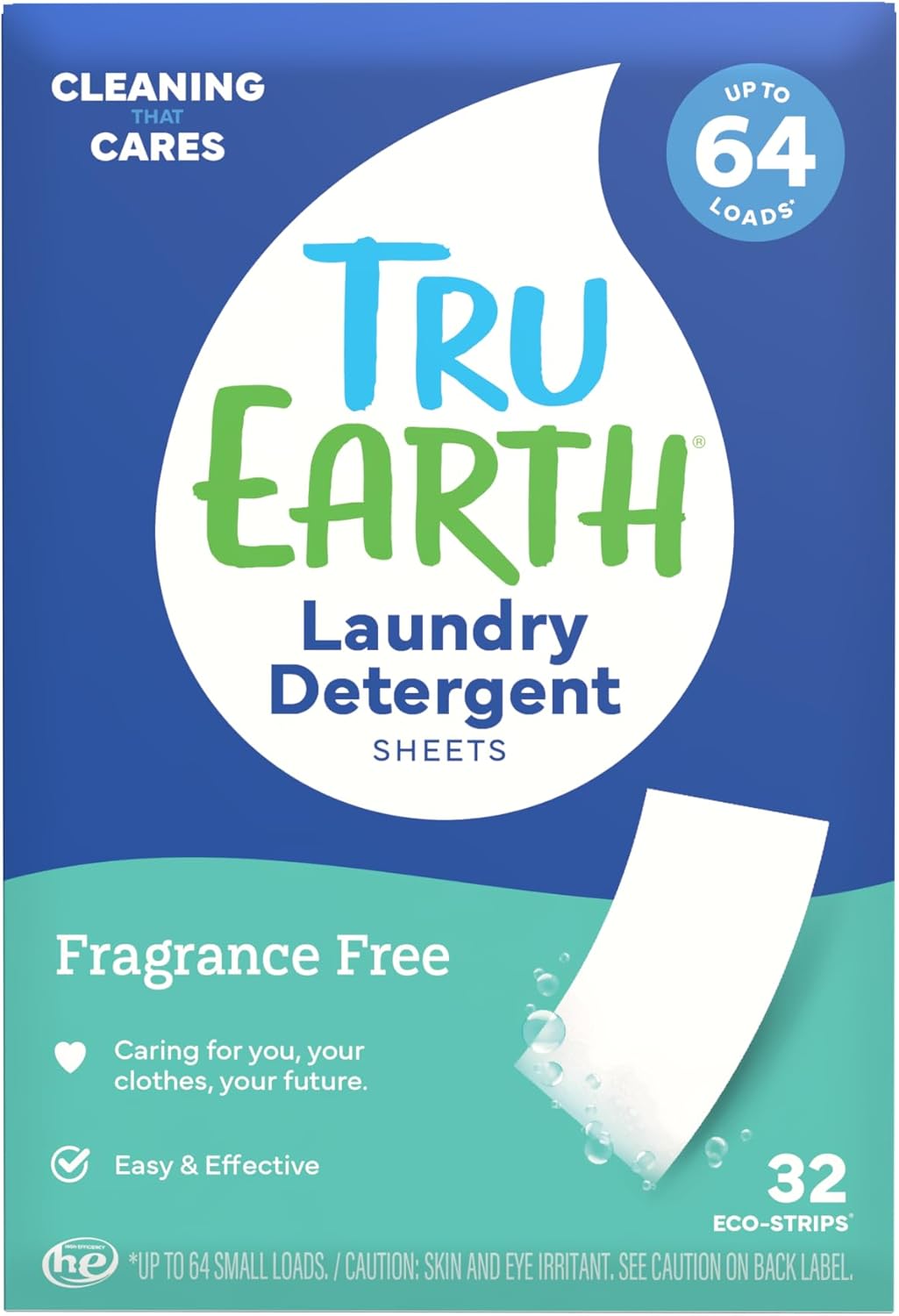
If your household uses pods for the convenience factor, Tru Earth’s pre-measured strips are the direct convenience-equivalent. Tear, toss, done. No measuring, no jug, no microplastic film. The eco-strip format also eliminates the plastic-jug waste that drives 6+ jugs per family per year.
Replace Pods with This
Tru Earth Eco-Strips (Replace Pods Like Tide Pods)
Source: amazon.com
If your household uses Tide Pods, Gain Flings, or Persil Discs because of convenience, Tru Earth’s pre-measured strips are the direct convenience-equivalent replacement. Without the phthalate-laden synthetic fragrance and the plastic-film capsule that pollutes waterways. Tear, toss, done.
Check Price On AmazonReplace Premium “Stain-Fighting” Brands → Branch Basics
If you’ve been buying Persil ProClean, Tide Plus Stain, or other premium “extra cleaning power” versions, Branch Basics matches that cleaning power without the toxic chemistry. Their plant-based powder is third-party tested for 1,4-dioxane, phthalates, and VOCs. Published assays show all below detection limits. $0.21 per load.
Replace Premium Brands with This
Branch Basics Laundry Detergent (Replace Premium Brands)

Source: amazon.com
If you’ve been buying Persil, Tide Plus, or other ‘premium’ versions of conventional brands at $0.30+ per load, Branch Basics matches their cleaning power without the toxic chemistry, at $0.21 per load. Third-party tested with published assays.
Check Price On Amazon
The Switch. What Happens in the First 30 Days
For long-term skin-contact chemical exposure recovery, glutathione is the foundational cellular antioxidant. The liposomal form is what reaches your cells.
Days 1-7: Wash all your existing clothes, sheets, and towels twice in the new detergent. Conventional residue takes 2 wash cycles to come out of fabric fibers. Your washing machine drum also needs the residue cycle to flush.
Days 8-14: Your nose starts recalibrating. The synthetic-fragrance scent of conventional detergent (in stores, on other people’s clothing) starts feeling overwhelming and chemical.
Days 15-30: Family members with eczema, skin sensitivity, or contact rashes often see significant improvement. Sleep quality may improve (synthetic fragrance is a known sleep disruptor). Hormone-sensitive issues. Irregular cycles, hot flashes, mood swings. Often begin to stabilize.
Day 30 onward: The new baseline. Walking past the laundry aisle smells overwhelming. You won’t want to go back. Total monthly spend on laundry products is the same or lower than before.

The “But My Family Won’t Tolerate Unscented” Objection
This is the most common pushback. The fix: 10 drops of high-quality lavender, eucalyptus, or rosemary essential oil on a wool dryer ball, tossed in with each load. Real essential oil scent. Clean, gentle, dissipates naturally. That fills the laundry room and lightly carries to clothes without binding permanently to fabric.
For the in-between transition, Tru Earth’s “Fresh Linen” version uses essential-oil-based scent (not synthetic fragrance). It smells genuinely clean, just different from the synthetic chemicals your nose is used to.
The Top 5 Most Toxic Laundry Detergents (Ranked)
1. Tide Original (and Tide Pods)
The dominant U.S. brand and the most-cited contact dermatitis trigger in our reader inbox. Standard Tide Original contains synthetic fragrance with 50+ undisclosed compounds, optical brighteners, methylisothiazolinone (MI) preservative, ethoxylated surfactants with documented 1,4-dioxane contamination risk per Zhou 2019 (DOI), and synthetic dyes. Tide Pods add an additional concern: the high-concentration pre-portioned format means accidental skin or eye contact delivers a far higher dose than a poured liquid. Five of the twelve “avoid” compounds in our master list.
2. Gain (Original, Pods, Flings)
Gain’s defining feature is its signature fragrance load, which independent fragrance-chemistry analyses estimate at 75+ individual compounds per scent variant. Per Steinemann 2017 (DOI) survey work, Gain consistently ranks among the highest-reported triggers for dryer-vent fragrance VOC complaints from neighbors. The methylisothiazolinone preservative and ethoxylated surfactant base mirrors Tide.
3. Persil ProClean
Marketed as a premium performance detergent. The chemistry is essentially mainstream: synthetic fragrance, methylisothiazolinone, ethoxylated surfactants, enzyme blends, optical brighteners. The “premium” positioning does not translate to a cleaner ingredient list — it is a fragrance and cost premium, not a chemistry one.
4. Dreft (Baby Detergent)
The flagship “baby” brand and one of the most insidious entries on this list because parents trust the positioning. Per Bai 2020 (DOI), methylisothiazolinone is present in 80% of so-called “baby safe” laundry products including Dreft variants. The synthetic fragrance load is heavy for a product specifically marketed for newborn skin. Among the most disappointing brands on this list given the marketing-versus-chemistry gap.
5. Arm & Hammer Original
The “natural” positioning from the baking-soda heritage is misleading. Standard Arm & Hammer Original contains synthetic fragrance, methylisothiazolinone preservative, ethoxylated surfactants, and in some powder variants, sodium borate (borax) at concentrations that triggered California Prop 65 listing concerns. The actual baking-soda content is a minor ingredient by weight.
The Common Chemistry Pattern (Why These 5 Are Grouped)
The pattern is consistent: fragrance + methylisothiazolinone + ethoxylated surfactants + optical brighteners. Each of these on its own has documented health-effect data:
- Fragrance: 64.3% of asthmatics report symptoms from fragranced products per Steinemann 2017. The compound class includes phthalates as fragrance stabilizers, which are documented endocrine disruptors per Fandiño-Del-Rio 2024 (DOI) measurement of urinary EDC biomarkers in children with asthma after fragranced-product use.
- Methylisothiazolinone: Top sensitizer for new contact dermatitis cases globally over the past decade. Present in 80% of “baby safe” detergents per Bai 2020.
- Ethoxylated surfactants: Carry trace 1,4-dioxane (potential human carcinogen) per Zhou 2019 FDA detection work. Karlberg 2003 (DOI) demonstrated that these surfactants form additional skin-sensitizing oxidation products during normal storage.
- Optical brighteners: Fluorescent compounds bond to fabric and skin without providing cleaning benefit — they make whites APPEAR brighter via UV reflection. They are cosmetic, not functional.
The combination on the skin 24 hours per day, breathed via dryer vent and indoor air for years, is the documented driver of laundry-related health complaints. Each individual compound at residual concentration is small; the cumulative chronic exposure across decades is what the literature consistently flags.
What Happens In the First 30 Days After You Switch
Reader patterns across hundreds of switch reports:
Days 1-3: Some people experience a brief perception of clothes “smelling less clean” because the brain has been trained that fragrance equals clean. This recalibrates within 7-10 days.
Week 1: Less fragrance buildup in pillowcases and towels. Most readers tell us this is the moment they understood the difference — burying your face in a freshly-laundered pillowcase that smells like nothing instead of like Tide.
Weeks 2-3: Eczema or contact dermatitis patches visibly improve in surface area for most readers. Per the Bai 2020 (DOI) data, fragrance removal is the single highest-impact intervention for textile-related contact dermatitis.
Week 4: Fragrance-triggered asthma symptoms tend to ease for sensitive readers. Per Steinemann 2017, the dryer vent is the most-reported single source of neighborhood-shared fragrance VOCs — meaning some readers still experience mild symptoms from neighbors even after a complete home switch, but the baseline at home drops significantly.
Beyond 30 days: Sleep quality improvements appear by week 6-8 in readers with significant fragrance sensitivity. Saijo 2021 (DOI) prospective cohort work in 60,529 children supports the connection between fragrance exposure and childhood wheezing — meaning the benefits of the switch are also measurable in pediatric populations within the same kind of timeline.
The “But My Family Won’t Tolerate Unscented” Objection
Three-step solution that works in practice:
Step 1: Add wool dryer balls (no dryer sheets) for soft texture. Most “tolerate unscented” objections are about texture, not scent.
Step 2: If household members truly want a faint scent, add 5-10 drops of essential oil (lavender, eucalyptus, or sweet orange) to a wool dryer ball before each dryer cycle. Real essential oil at low dose smells distinctly clean, dissipates within hours, and does not deposit persistent compounds on fabric the way synthetic fragrance does.
Step 3: Lead with the symptom data. Most family members who insist on “scented” clothes have not been exposed to the data on fragrance and asthma (Steinemann 2017), eczema (Bai 2020), or sleep quality (Steinemann 2018). Sharing the data once, without making it a fight, often resolves the conversation within a few weeks.
The Three Clean Replacements (And Exactly What They Replace)
For each of the top 5 most-toxic detergents, the cleanest direct replacement:
- Tide Original → Molly’s Suds Original Powder. Same powder format, 5 ingredients vs 50+, cheaper per load.
- Gain → Tru Earth Eco-Strips. Eliminates the heavy fragrance load entirely. The pre-measured format also eliminates overdosing.
- Persil → Puracy Plant-Based Liquid. Enzyme-powered like Persil but without the fragrance and preservative base.
- Dreft → Meliora Unscented Powder. Three ingredients, MADE SAFE certified, safer for infant skin than Dreft despite Dreft’s baby positioning.
- Arm & Hammer → Molly’s Suds Original Powder. Similar washing-soda chemistry without the fragrance, preservatives, and borax concerns.
The peer-reviewed research that informs which ingredients matter and where the actual health-effect evidence sits.
- Bai et al. 2020 — Top-selling laundry products surveyed: fragrances #1 allergen in 66.7% of detergents, 90% of fabric softeners, 75% of dryer sheets. Methylisothiazolinone in 80% of “baby safe” formulas. Dermatitis. DOI
- Rádis-Baptista 2023 — Synthetic fragrances in household products are VOCs with documented impact on indoor air, cutaneous reactions, respiratory effects, and endocrine-immune-neural disruption. J Xenobiot. DOI
- Steinemann 2017 — 64.3% of asthmatics report adverse health effects from fragranced products. 28.9% specifically from scented laundry from a dryer vent. Air Qual Atmos Health. DOI
- Steinemann 2018 — 83.7% of autistic adults report adverse effects from fragranced products, 57.5% from dryer-vent laundry scent. Air Qual Atmos Health. DOI
- Saijo et al. 2021 — Japan prospective cohort study of 60,529 children: fragrance products significantly associated with childhood wheezing. Indoor Air. DOI
- Fandiño-Del-Rio et al. 2024 — Endocrine-disrupting chemical biomarkers significantly elevated in children with asthma after recent fragranced product exposure. J Expo Sci Environ Epidemiol. DOI
- Zhou 2019 (US FDA) — 1,4-dioxane (potential human carcinogen) detected in 47 of 82 children’s personal-care products at average 1.54 µg/g. J Chromatogr A. DOI
For Further Reading
For the full guide on why every household member is affected by synthetic laundry fragrance. Not just perimenopausal women, but men, children, post-menopausal women, and pets. My Non Toxic Laundry Detergent Switch Guide covers the science of phthalates, formaldehyde, and xenoestrogens in the universal-audience framing. The head-to-head ranking of clean brands is in Best Non Toxic Laundry Detergent 2026. For the broader toxic-load reset framework, the Toxic Load Reset walks through all 5 phases.
Disclosure: As an Amazon Associate, I earn from qualifying purchases. The toxic-brand analysis above reflects publicly-available ingredient information and independent third-party testing reports. Brand toxicity profiles may change as manufacturers reformulate; verify current ingredients at time of purchase.
Laundry Is One Part Of Your Total toxic load
Detox is not only about what you remove. It is also about what you stop adding. Detergent is one daily input — heavy metals, mold, parasites, or adrenal burnout might be doing the deeper work. The 90 second Toxic Load Tool finds which pattern is driving yours.
Use The Toxic Load Tool


