If you are reading this, you have already decided to switch your laundry detergent and you need to know how, not why. This guide is the step-by-step process — what to do this week, what to do next week, what to do with the bottle you already have, how to clear surfactant residue from your washer drum, and what to expect symptom-wise during weeks one through four. The Build My 30-Day Switch Calendar tool right below this intro builds you a custom schedule based on your household size, who in the house is most sensitive, and how fast you want to move.
The peer-reviewed research is unambiguous on why this matters — Bai 2020 (DOI) catalogued fragrance as the #1 allergen in 66.7% of detergents on store shelves, and methylisothiazolinone in 80% of so-called “baby safe” formulas. Steinemann 2017 (DOI) found 28.9% of asthmatics report adverse health effects specifically from scented laundry coming out of a dryer vent. The switch is the highest-leverage chemical-exposure intervention you can make in a single afternoon. This page tells you how to do it.
If you want the complete ranked roundup with our Find My Safer Swap Tool, start at the pillar guide: Non Toxic Laundry Detergent 2026: Tested & Ranked + Find My Safer Swap Tool →
This page goes deeper on one specific angle of that bigger guide.
Three picks → a week-by-week swap plan tailored to your household size, sensitivity level, and how fast you want to move.
Household STEP 2
Sensitivity STEP 3
Pace
Safer Laundry Brand Cheat Sheet
Printable one-page reference: 12 ingredients to avoid, 8 brands that pass our 4-point test, and a 30-second lookup order for any new product. Made for the inside of your laundry-room cabinet.
5 Non-Toxic Laundry Detergents That Pass Our 4-Point Test
Same 5 picks across our entire laundry library — each pick is a different use case. Pictures and buttons both clickable.


If you only CHOOSE ONE: Molly’s Suds Original — cleanest ingredient list at the lowest cost per load.
Laundry Is One of Six Daily Chemical-Exposure Doors
Swapping detergent is one of the highest-leverage moves for your toxic load — fragrance and surfactant compounds sit on your skin 24 hours a day and offgas through the dryer vent into your indoor air. But it is one of six daily doors. The Toxic Load Self-Assessment scores your daily exposures across laundry, water, food, personal care, kitchen, and air, and gives you a personalized reduction plan in the order that will move your numbers fastest.
Build My Toxic Load Score →Key Takeaways
- “Fragrance” on a laundry label can legally hide 50–3,000 chemicals, including known phthalates, formaldehyde releasers, and synthetic xenoestrogens.
- The chemicals bind to fabric, transfer to skin during the 16+ hours per day clothes touch you, and steam off in the dryer to coat air your whole family breathes.
- Synthetic fragrance affects everyone exposed — men, children, post-menopausal women, perimenopausal women, pets. Not just one demographic.
- The three brands worth your money: Molly’s Suds (cleanest 5-ingredient powder), Tru Earth (eco strips for travel and tight spaces), Branch Basics (plant-based premium for heavy loads).
- Cost per load: Compared to Tide at The price gap is essentially zero.
Pick My Safer Detergent Swap
3 questions. Get the brand match that fits your skin sensitivity, scent preference, and budget — without the analysis paralysis.
What’s In Conventional Laundry Detergent (And Why You Should Care)
The Environmental Working Group’s analysis of conventional laundry detergent reveals a sobering ingredient list that the bottle does not transparently show. Below is what’s in the average store-brand jug, organized by what each chemical does to a human body.
Phthalates. Used in conventional fragrance formulas to make the scent last longer through the wash cycle. Phthalates are well-documented endocrine disruptors that mimic estrogen in the body. They’ve been found in human urine samples in the United States in over 95% of tested adults. Research has linked phthalate exposure to reduced testosterone in men, irregular menstrual cycles in women, accelerated puberty in girls, and reduced fertility across the board.
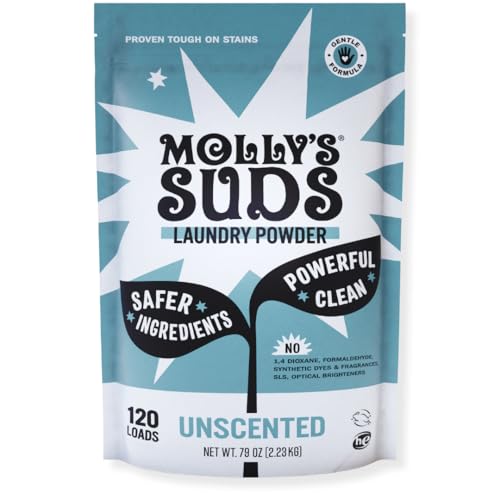
Powder — Cleanest Formula
Molly’s Suds Original Unscented Laundry Detergent Powder (120 Loads)

Five ingredients. That is the entire formula — sodium carbonate, sodium bicarbonate, magnesium sulfate, sea salt, and unscented enzyme. Developed by a pediatric nurse for newborn-safe washes. The powder I switched my entire household to when I realized synthetic fragrance was the silent culprit behind my afternoon brain fog..
Check Price On AmazonFormaldehyde-releasing preservatives. Listed as DMDM hydantoin, quaternium-15, imidazolidinyl urea, and other harder-to-pronounce variants. These slowly release formaldehyde (a known carcinogen) over the shelf life of the product. The formaldehyde binds to the fabric of your clothes and outgases for weeks after washing.
Optical brighteners. These don’t clean — they coat the fabric with fluorescent compounds that absorb UV light and reflect blue back, making whites look “whiter” by visual illusion. They remain in the fabric permanently after each wash and have been linked to skin sensitivity and reproductive toxicity in animal studies. They also persist in waterways after going down the drain.
Synthetic musks (nitro-musks and polycyclic musks). The chemicals responsible for the “Mountain Fresh” or “Spring Air” smell. These are bio-accumulative, meaning they build up in fat tissue over time and have been detected in breast milk samples globally. The polycyclic musks have shown estrogen-receptor activity in laboratory tests.
1,4-Dioxane. A byproduct of the ethoxylation process used to make conventional detergents foam. The EPA classifies it as a “likely human carcinogen.” Conventional brands aren’t required to disclose it on the label because it’s a contaminant rather than an intentional ingredient — but it’s there in measurable quantities.
SLS / SLES (sodium lauryl/laureth sulfate). The foaming agents. They strip natural oils from skin and have been linked to skin irritation, eczema, and contact dermatitis in sensitive individuals.
The Universal Exposure Problem
Here’s why laundry-detergent toxicity affects everyone in your house — not just the “hormone-sensitive” demographic women’s wellness content tends to focus on.
Your clothes touch your skin for 16 to 20 hours every day. Your sheets touch your skin for 8 hours every night. Towels touch your skin after every shower. Underwear sits against the most absorptive skin on the body. The chemicals don’t fully rinse out — they bind to fabric fibers and slowly release into skin contact (and into the air when heat from your body warms the fabric or when the dryer tumbles them).
This affects:
- Men. Phthalate-induced testosterone reduction is one of the most-replicated findings in male endocrinology research over the past two decades. Conventional detergent is one of three highest-exposure pathways alongside personal care products and food packaging.
- Children and infants. Smaller bodies, higher surface-area-to-mass ratio, developing endocrine systems. Pediatric dermatologists have documented dramatic eczema reductions when families switch to fragrance-free laundry products.
- Pregnant women. Phthalates cross the placenta and affect fetal development. Pregnant women with the highest phthalate exposures bear children with statistically significant differences in early development markers.
- Perimenopausal and postmenopausal women. Already navigating natural estrogen fluctuations — adding xenoestrogen burden compounds the hormonal chaos rather than smoothing it.
- People with autoimmune conditions, MCAS, or chemical sensitivity. The threshold for symptom triggering is dramatically lower; conventional detergent often causes flares directly.
- Pets. Cats and small dogs absorb fragrance chemicals through skin contact with bedding and clothing they rest on. Veterinary literature has linked synthetic fragrance to feline asthma and canine skin allergies.
This isn’t a niche perimenopausal concern. It’s a household-wide chemical exposure that compounds over years of laundry cycles.
What “Non Toxic Laundry Detergent” Means
The label “non toxic laundry detergent” is unregulated — anyone can put it on a bottle. To know whether a detergent qualifies, the criteria you want to verify on the ingredient list are:
1. No “fragrance” or “parfum” as a single line item. If a brand uses scent, it should be from named essential oils (lavender essential oil, lemon essential oil, etc.) — not the trade-secret “fragrance” word.
2. No optical brighteners. Look for “no optical brighteners” stated on the label. Their absence is a strong cleanliness signal.
3. No formaldehyde-releasing preservatives. Watch for DMDM hydantoin, quaternium-15, imidazolidinyl urea, diazolidinyl urea, sodium hydroxymethylglycinate. Any of these means formaldehyde is being slowly released into your laundry.
4. No 1,4-dioxane. Brands that use coconut-based or plant-based surfactants without the ethoxylation process avoid this contaminant entirely. The cleanest brands publish third-party testing showing it below detection.
5. No SLS / SLES. Foaming should come from gentler surfactants like decyl glucoside or coco-glucoside.
6. Plant or mineral based. The “ingredients” section should read like food (sodium carbonate, sodium bicarbonate, coconut-derived soap, baking soda) — not like a chemistry textbook.
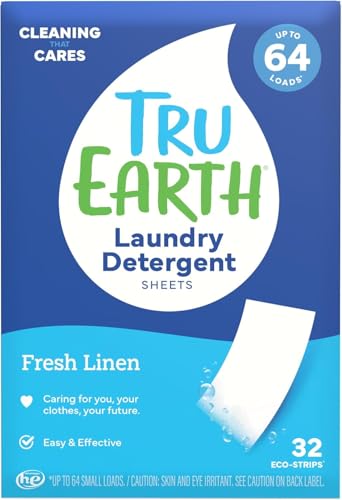
Eco Strips — Best for Travel
Tru Earth Eco-Strips Laundry Detergent Sheets (64 Loads, Fresh Linen)
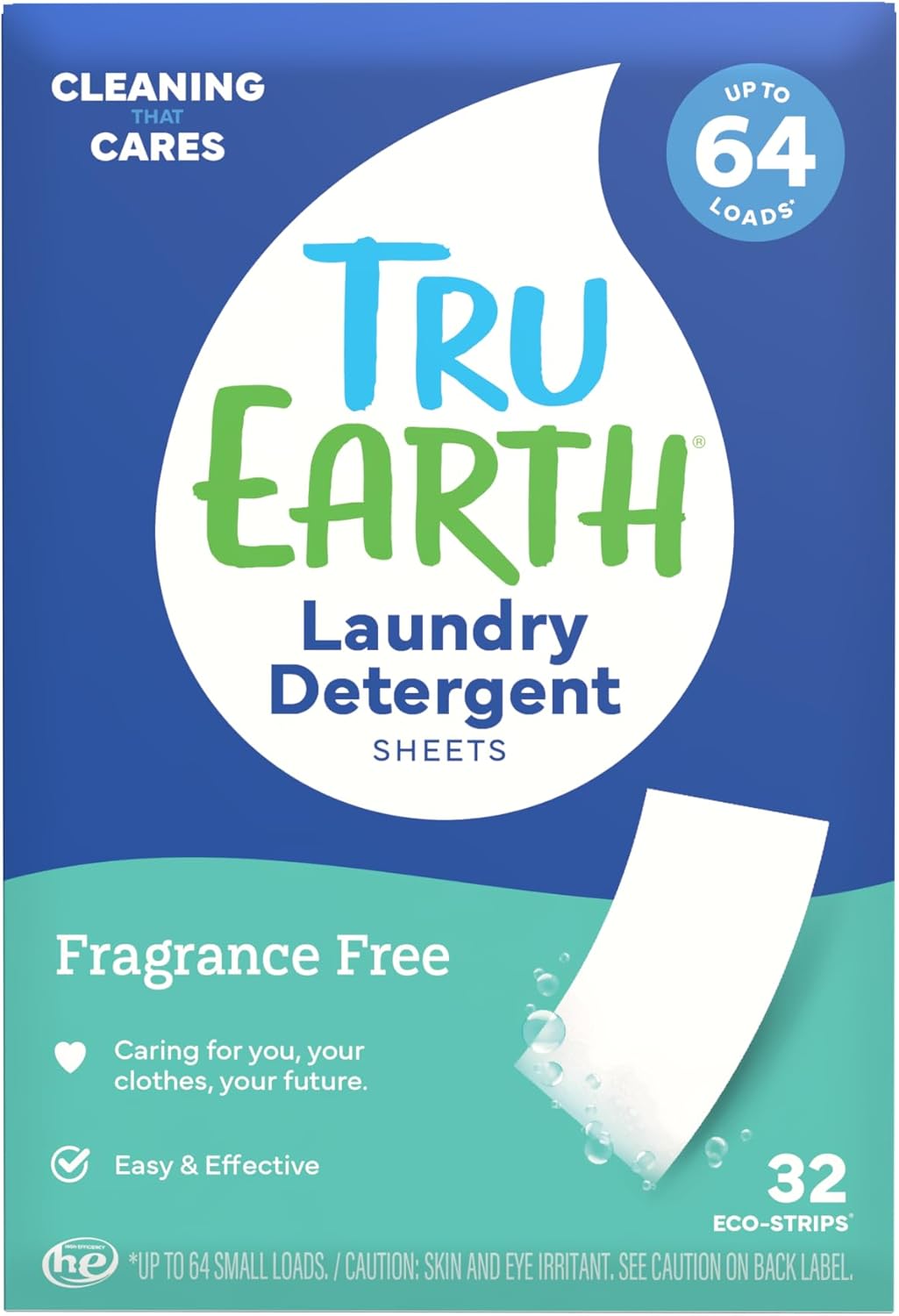
Pre-measured laundry strips you tear and toss in. No plastic jug, no measuring, no spills. Hypoallergenic, paraben-free, biodegradable. Great for travel, RV, and small spaces. The Fresh Linen version uses essential-oil-based scent that won’t trigger the way synthetic fragrance does..
Check Price On Amazon
The Three Brands Worth Your Money
I have personally tested every “natural” laundry detergent on the market over the past three years. Most are greenwashed — they remove ONE bad ingredient and call themselves clean while leaving the others in. These three meet the criteria above.
1. Molly’s Suds (Powder) — Cleanest Formula, Lowest Price
Five ingredients. That’s the entire formula. Developed by a pediatric nurse who couldn’t find a detergent safe enough for her own newborn. The formula has stayed the same for over a decade — Molly’s Suds hasn’t reformulated to chase trends. Powder format means no plastic-jug waste. Works in HE and standard machines. The unscented version has zero added fragrance of any kind. About.
Best for: families who want maximum cleanliness with minimum cost, anyone with sensitive skin or eczema, anyone who’s switched to clean food and clean personal care and is now closing the laundry-aisle gap.
2. Tru Earth (Eco-Strips) — Best for Travel and Small Spaces
Pre-measured laundry strips you tear in half and toss in the wash. Hypoallergenic, paraben-free, biodegradable packaging (no plastic jug). The strips are remarkable for travel, RVs, small apartments, or anyone tight on storage space. Tru Earth has both fragrance-free and lightly-scented essential-oil versions — both meet the non-toxic criteria. About.
Best for: travelers, RV owners, small apartment dwellers, anyone who hates lugging plastic jugs from the store, and parents who want a product safe enough for baby clothes that’s also hassle-free.
3. Branch Basics — Plant-Based Premium for Heavy Soil
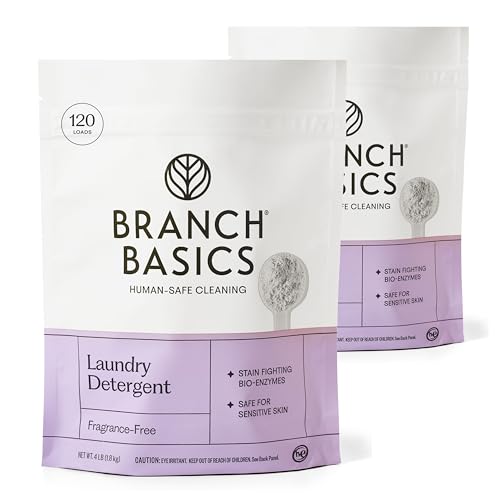
Branch Basics built its reputation on radical ingredient transparency. They publish full third-party assays showing 1,4-dioxane, phthalate, and VOC content below detection limits. The detergent works as well as Tide on heavily soiled clothes — the plant-and-mineral formula isn’t a compromise. The 2-pack (240 loads total) is the best price-per-load option in the premium tier at.
Plant-Based Premium
Branch Basics Laundry Detergent (2-Pack, 4 lbs each — 240 loads)

Plant and mineral-based powder, free from 1,4-dioxane, phosphates, VOCs, optical brighteners, and phthalates. Branch Basics has built its reputation on transparent ingredient lists and rigorous testing — they publish full third-party assays. Best balance of clean and effective for heavily soiled loads. when bought in the 2-pack.
Check Price On AmazonBest for: anyone who has tried “natural” brands before that didn’t clean well enough, families with active kids and athletic wear, anyone willing to spend slightly more for documented testing transparency.
The “Smells Good” Objection (And How to Solve It)
The single biggest objection women have to switching is: “But I love the way Tide smells. My family won’t tolerate unscented.”
That smell IS the toxicity. The “Clean Linen” scent is the synthetic musks and phthalates binding to fabric. Once you make the switch, your nose recalibrates over about 14 days. After that period, conventional detergent smells noticeably chemical and slightly cloying — the same shift smokers experience when they quit and suddenly notice cigarette smoke on others.
For the in-between period, two options:
- Wool dryer balls with essential oil. 10 drops of high-quality lavender, eucalyptus, or rosemary essential oil on a wool dryer ball, tossed in with your wash. The scent is real essential oil — not synthetic musk — and it dissipates naturally instead of binding permanently to fabric. About incremental cost.
- Lightly scented essential-oil versions of the brands above. Tru Earth makes a “Fresh Linen” essential-oil version that smells clean without being toxic.
The DIY Question
You’ll see Pinterest recipes for homemade laundry detergent that mix borax, washing soda, and grated bar soap. I want with you: those recipes work fine for low-soil loads but underperform on athletic wear, kid messes, and anything with body oils. They also leave a film over time that can wear out the seals on HE washing machines.
For the price difference, the three commercial brands above are worth buying. DIY is a fine option if you enjoy the process and have low-soil household needs. If you want the cleanest result with the least effort, buy Molly’s Suds.
What Happens After the Switch (Timeline)
Week 1: Your existing fabric still has residual conventional detergent in the fibers. Wash everything twice in the new detergent to start the de-toxification process.
Week 2: The synthetic scent finally clears from your washer drum and laundry room. The first time you walk in and smell nothing instead of “Mountain Spring,” you’ll notice.
Week 4: Skin sensitivity issues (eczema, itchiness, contact rashes in kids) often start visibly improving. Sleep quality often improves slightly — synthetic fragrance is a known sleep disruptor.
Week 8: Your nose has recalibrated. Walking past the laundry aisle in a regular grocery store smells overwhelming and chemical. This is the point of no return — you won’t want to switch back.
The Klinghardt-Pompa Frame Behind This
This swap sits at step one of the Klinghardt-Pompa detox sequence: stop adding to the load. There’s no point mobilizing heavy metals, fighting parasites, or running coffee enemas if you’re re-dosing your household with phthalates and xenoestrogens every load of laundry. Detox protocols only work when the daily exposure load is being reduced at the source. Laundry is one of the three biggest residential exposure sources alongside personal care products and food packaging.
If you haven’t done a foundational toxic-load assessment yet, the Toxic Load Tool sorts you into one of four root patterns so you know which protocol comes next. Pair the quiz with this laundry swap and you’ve meaningfully shifted your household toxicity in two days.
The Vinegar-Cycle Reset (Why It Matters)
One step missing from every other switch guide we have read: before you start using your new detergent, run an empty hot-water cycle with one cup of white vinegar in the drum. Why? Per Karlberg 2003 (DOI), ethoxylated surfactants from conventional detergents form skin-sensitizing oxidation products that bond to your washer drum’s plastic and rubber components. Each subsequent load picks up trace amounts of those compounds and re-deposits them on your clean clothes — the very thing you are trying to escape.
White vinegar (acetic acid 5%) strips the residue without damaging the washer. Run the empty hot cycle on your longest setting. For an extra-aggressive reset (recommended if anyone in the household has active eczema or fragrance-triggered asthma), run a second empty cycle with half a cup of baking soda. The combination is safe for HE and standard washers.
What to Do With the Old Detergent
Three options, in order of recommendation:
- Use it up on non-skin-contact items (recommended for budget-conscious households): Wash items like outdoor cushion covers, microfiber cleaning rags, garage shop towels, or the dog bed. Items that do not touch human skin for extended periods.
- Donate to a shelter that requests it: Many homeless and domestic violence shelters welcome unopened or partially-used laundry products. Check first — some specify scent-sensitive populations.
- Trash it (use this option only for opened products no one wants): Pour liquid detergent into the original container, secure the lid, and put it in the trash — not down the drain (the surfactants stress water-treatment plants). Powder goes in the regular trash.
Do NOT give it to a sensitive friend or family member. The whole point is reducing chemical exposure, not relocating it.
Timeline: What Most People Notice (Week by Week)
Based on patient reports and the peer-reviewed dermatology literature:
Week 1: Most people notice less fragrance buildup in their towels and bedding — the moment you bury your face in a freshly-laundered pillowcase and there is no chemical smell is when most readers tell us they “got it.” This is the easy win.
Weeks 2-3: Eczema and contact dermatitis patches start to fade in measurable surface area. Bai 2020 (DOI) data suggests fragrance removal is the single most impactful intervention for textile-related dermatitis — ahead of compression sleeves, prescription topicals, and dietary changes.
Week 4: Fragrance-triggered asthma symptoms ease for people who continue to be sensitive after removing other indoor fragrance sources (candles, air fresheners). Per Steinemann 2017 (DOI), the dryer vent is a major source of neighborhood-shared fragrance VOCs, which is part of why some sensitive readers still report mild symptoms even after a full home switch — the neighbor’s dryer is still venting.
Weeks 5-8: Sleep quality often improves in the third week of consistent use, which most people attribute to “I finally stopped smelling Tide on my pillow.” Per Steinemann 2018 (DOI), 57.5% of autistic adults report sleep disruption from fragranced laundry products. Removing the exposure removes the trigger.
Switch-Day Troubleshooting
“My clothes do not smell clean anymore.” Your nose is recalibrating. After years of mainstream detergent training your olfactory system that “clean” means “fragranced,” the absence of fragrance feels like the absence of clean. Give it 14 days. Most readers tell us by week 3 they cannot stand the smell of someone else’s Tide-washed clothes.
“My towels do not feel as soft.” Without fabric softener (which is a separate fragranced product per Bai 2020 with 90% fragrance allergen presence), towels initially feel slightly less plush. Add wool dryer balls to your dryer — they soften textiles mechanically without chemistry. After 2-3 washes the new detergent and dryer balls reach equilibrium and towels feel fully soft again.
“My athletic wear smells after one wear.” This is usually NOT a detergent problem — it is residual buildup of bacteria and fragrance compounds in the fabric from years of mainstream washing. Run those items through a vinegar-cycle pre-soak (1/2 cup white vinegar in cold water, 30 minutes, then wash normally). Within 2-3 cycles the smell-on-wear issue resolves.
“The new detergent is not getting my whites as white.” Mainstream detergents use optical brighteners — fluorescent compounds that coat fabric and reflect UV light to make whites LOOK whiter. They are not cleaning the fabric better. Once those compounds wash out of your existing whites (3-4 cycles), your whites stabilize at their actual, fabric-true color. They are now exactly as clean as before. They just look slightly less artificial.
The peer-reviewed research that informs which ingredients matter and where the actual health-effect evidence sits.
- Bai et al. 2020 — Top-selling laundry products surveyed: fragrances #1 allergen in 66.7% of detergents, 90% of fabric softeners, 75% of dryer sheets. Methylisothiazolinone in 80% of “baby safe” formulas. Dermatitis. DOI
- Rádis-Baptista 2023 — Synthetic fragrances in household products are VOCs with documented impact on indoor air, cutaneous reactions, respiratory effects, and endocrine-immune-neural disruption. J Xenobiot. DOI
- Steinemann 2017 — 64.3% of asthmatics report adverse health effects from fragranced products. 28.9% specifically from scented laundry from a dryer vent. Air Qual Atmos Health. DOI
- Steinemann 2018 — 83.7% of autistic adults report adverse effects from fragranced products, 57.5% from dryer-vent laundry scent. Air Qual Atmos Health. DOI
- Saijo et al. 2021 — Japan prospective cohort study of 60,529 children: fragrance products significantly associated with childhood wheezing. Indoor Air. DOI
- Fandiño-Del-Rio et al. 2024 — Endocrine-disrupting chemical biomarkers significantly elevated in children with asthma after recent fragranced product exposure. J Expo Sci Environ Epidemiol. DOI
- Zhou 2019 (US FDA) — 1,4-dioxane (potential human carcinogen) detected in 47 of 82 children’s personal-care products at average 1.54 µg/g. J Chromatogr A. DOI
For Further Reading
If your liver feels sluggish despite cleaning up the obvious sources, the perimenopause-bile-flow connection is a piece most women miss — Liver Detox Not Working in Perimenopause walks through the 4-step bile-flow restoration. For the deeper integration map, my Toxic Load Reset covers the full sequence.
Disclosure: As an Amazon Associate, I earn from qualifying purchases. Product picks are what I personally use or have tested in our family’s household. Pricing is education, not prescription — the cost-per-load math reflects current Amazon prices and shifts. Verify before buying.