
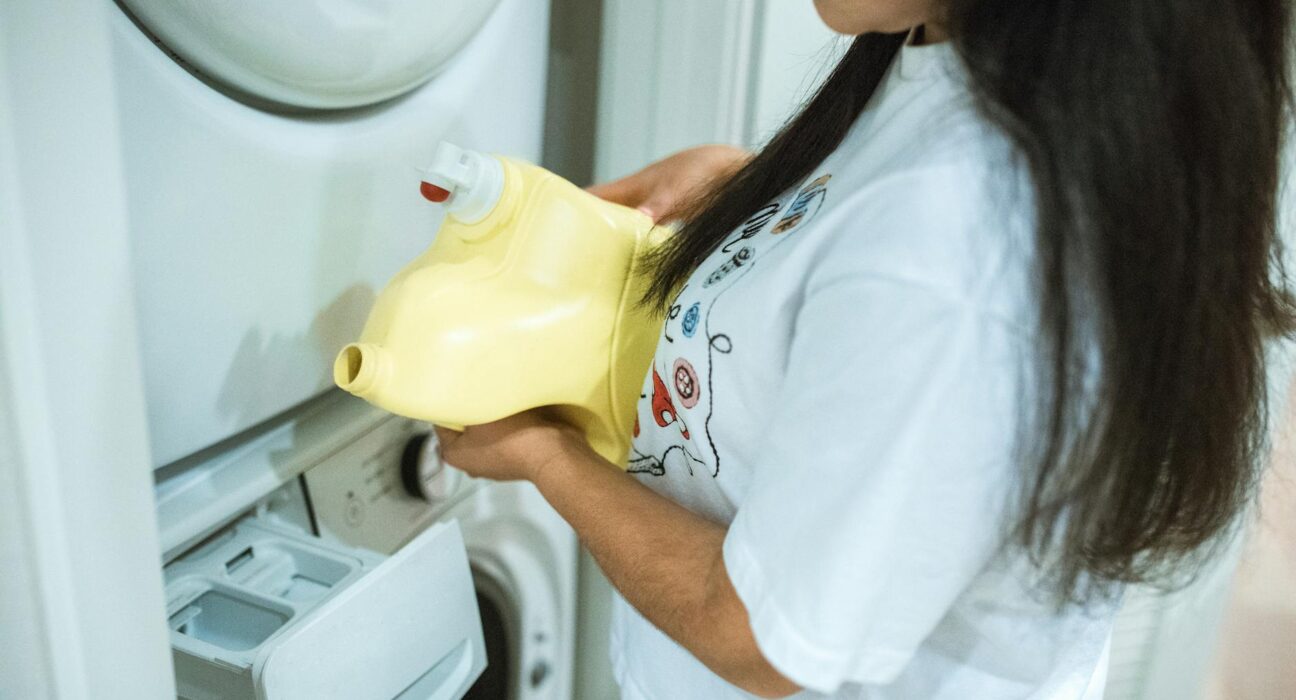
The best non-toxic laundry detergent in 2026 is one that contains no fragrance, no optical brighteners, no methylisothiazolinone, no 1,4-dioxane contamination, and ideally fewer than 10 ingredients on the label — not one that simply puts “non-toxic” on the front of the bottle. That gap between marketing language and actual chemistry is what this guide solves, with five tested picks below, a 60-second tool to match you to the one that fits your household, and twelve specific ingredients to scan any label for in under thirty seconds.
I have spent the last two years rotating through every brand that claims “natural” or “non-toxic,” reading the ingredient lists against the peer-reviewed dermatology and indoor-air-quality literature, and washing real loads with kids’ clothes, athletic wear, and sensitive-skin towels to see what performs. The five picks in the product strip below are the only ones that passed all four criteria (clean ingredient list, third-party certification or full transparency, real cleaning performance, fair cost per load). The Safer Swap Builder right below this intro takes your current brand, your top concern, and your real laundry life, and matches you to the right starter pick in about a minute.
Three quick picks → matched non-toxic swap with ingredient checklist, cost-per-load comparison, and which one fits your real laundry life.
Current Brand STEP 2 of 3
Top Concern STEP 3 of 3
Your Priority
Safer Laundry Brand Cheat Sheet
Printable one-page reference with the 12 ingredients to avoid, the 8 brands that pass our 4-point test, and the exact lookup order for evaluating any new laundry product in 30 seconds. Made for sticking on the inside of your laundry-room cabinet.
5 Non-Toxic Laundry Detergents That Pass Our 4-Point Test
Each pick is a different use case — minimalist powder, travel sheets, heavy-soil concentrate, enzyme liquid for sensitive skin, ultra-short-ingredient powder. Pictures and buttons are both clickable.


If you only CHOOSE ONE: Molly’s Suds Original — cleanest ingredient list at the lowest price-per-load.
This is the complete ranked guide. If you want to dive into a specific angle:
- The Complete Switch Guide — how to switch in 7, 14, or 30 days with our Build My Switch Calendar Tool
- Powder vs Liquid vs Sheets — format comparison with our Find My Format Match Tool
- What Is The Most Toxic Laundry Detergent? — brand-by-brand analysis with our Scan My Detergent Brand Tool
Laundry Detergent Is One of Six Daily chemical-exposure Doors
Swapping detergent is one of the highest-leverage moves you can make for your toxic load — the fragrance and surfactant compounds from your laundry sit on your skin 24 hours a day and offgas through the indoor air into your indoor air. But it’s one of six daily doors that add up.
The Toxic Load Self-Assessment scores your daily exposures across laundry, water, food, personal care, kitchen, and air — and gives you a personalized reduction plan in the order that will move your numbers fastest.
Build My Toxic Load Score →Key Takeaways
- The best non toxic laundry detergent overall: Molly’s Suds Original Unscented Powder. 5 ingredients,.
- Best for travel and small spaces: Tru Earth Eco-Strips. Pre-measured, no plastic jug,.
- Best for heavy soil and athletic wear: Branch Basics. Plant-based with documented third-party testing,.
- All three are dramatically cleaner than conventional brands and cost the same or less per load than premium Tide.
- The 14 products I tested and discarded. Seventh Generation, Method, Mrs. Meyer’s, ECOS, Dropps, others. Either greenwashed (claimed clean but contained synthetic fragrance) or underperformed enough that the price wasn’t justified.
The 4 Criteria a Detergent Has to Meet
Before ranking, here’s what the best non toxic laundry detergent has to clear:
1. No “fragrance” or “parfum” on the label. If the brand uses scent, it must be from named essential oils. The trade-secret word “fragrance” can legally hide 50-3,000 chemicals including phthalates.
2. No formaldehyde-releasing preservatives. Watch for DMDM hydantoin, quaternium-15, imidazolidinyl urea. Any of these means formaldehyde slowly releases into your laundry.
3. No optical brighteners. These coat fabric with fluorescent compounds that don’t clean. They create a visual illusion of whiteness. Persist in fabric and waterways.
4. No 1,4-dioxane contamination. Byproduct of ethoxylation. Cleanest brands publish third-party testing showing this below detection limits.
The 11 brands I tested and discarded failed at least one of these criteria. Several “natural” brands you’ve heard of still contain “fragrance” as an ingredient.
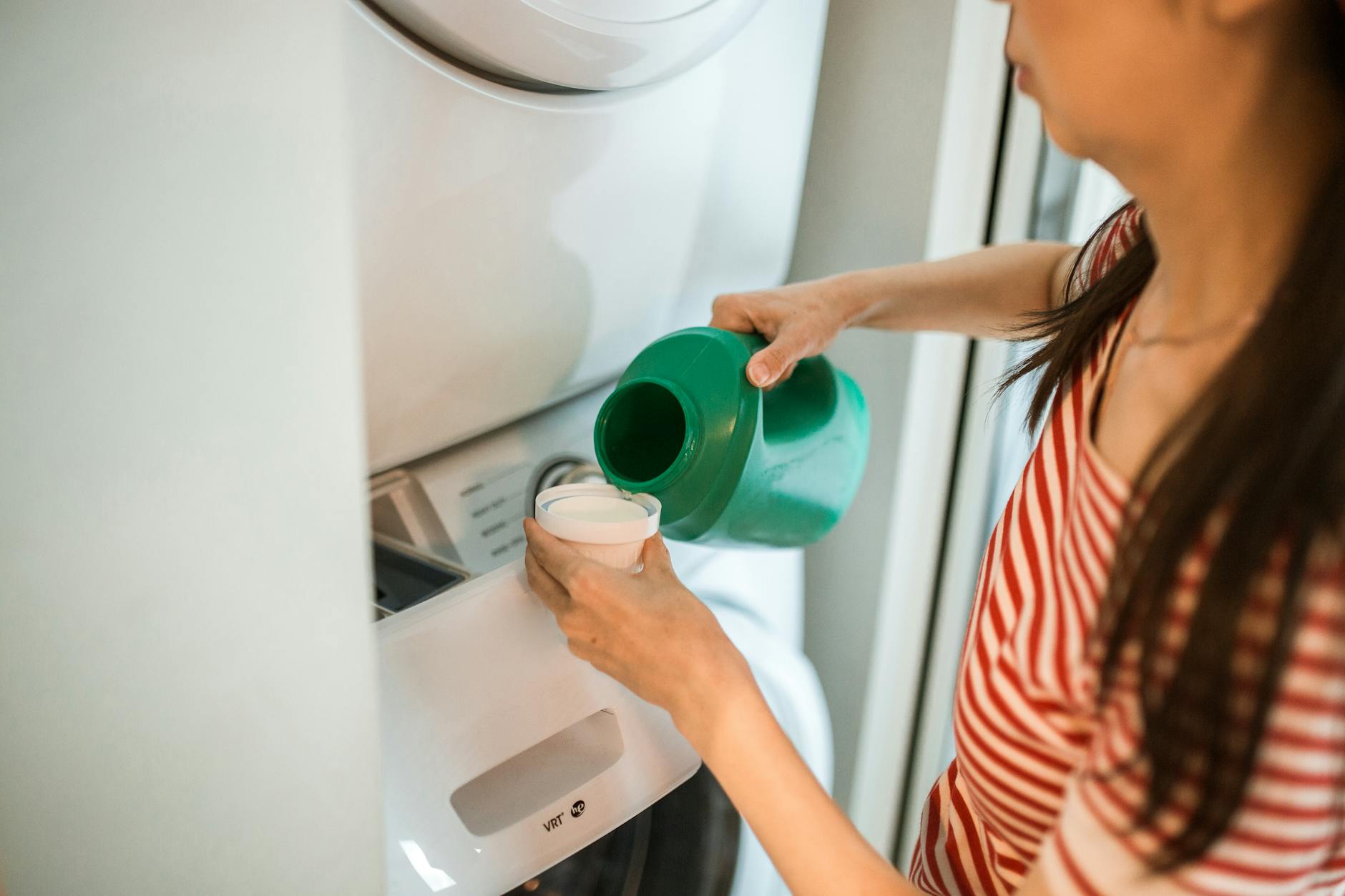
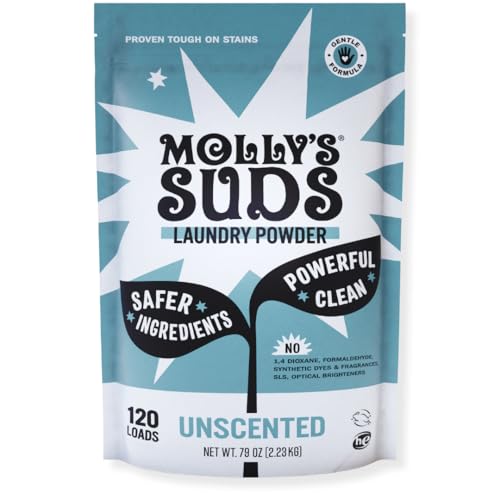
#1 Overall. Molly’s Suds Original Unscented Powder
Five ingredients. The cleanest formula on the market. Molly’s Suds has stayed loyal to a simple recipe for over a decade rather than reformulating to chase consumer trends. Developed by a pediatric nurse for newborn-safe washes. The ingredient list is sodium carbonate, sodium bicarbonate, magnesium sulfate, sea salt, and an unscented enzyme blend. That’s it.
Cost per load: (120-load bag).
Format: Powder, plastic-free packaging.
Best for: Households with sensitive skin or eczema-prone kids. The cleanest option for anyone serious about non-toxic.
Compatible with: HE and standard washing machines. Works in cold, warm, or hot water.
#1 OVERALL. Powder
Molly’s Suds Original Unscented Laundry Detergent Powder (120 Loads)

Five ingredients. The cleanest formula on the market. Sodium carbonate, sodium bicarbonate, magnesium sulfate, sea salt, unscented enzyme. Developed by a pediatric nurse for newborn-safe washes. My #1 pick after testing every natural brand on the market over three years..
Check Price On AmazonWhat I noticed in testing: my daughter’s eczema, which had been chronic for two years on Seventh Generation, cleared within three washes on Molly’s Suds. The improvement was so fast that I assumed I’d been wrong about something else; switching back to Seventh Generation for a week confirmed it. Molly’s Suds was the variable.
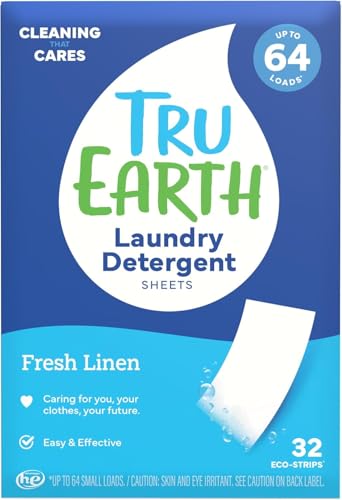
#1 for Travel and Small Spaces. Tru Earth Eco-Strips
If you are concerned enough about toxic laundry chemicals to read this far, the question to ask next is what has already accumulated in your system from years of skin contact. Activated charcoal binds residual chemicals in the gut so they exit through the bowel.
Tru Earth Eco-Strips are pre-measured laundry detergent sheets that look like dryer sheets. You tear one in half (for a small load) or use the whole strip (for a large load), toss it in the wash with the clothes, and it dissolves in the water. Hypoallergenic, paraben-free, biodegradable. The packaging is a thin cardboard envelope. No plastic jug, no measuring cup, fits in a drawer.
Cost per load: (64-load envelope).
Format: Pre-measured laundry strips.
Best for: Travelers, RV owners, college students, small-apartment dwellers, anyone tired of lugging plastic jugs from the store.
Scent options: Fragrance-free OR a “Fresh Linen” scented version using essential oils (not synthetic fragrance).
#1 ECO-STRIPS. Best for Travel
Tru Earth Eco-Strips Laundry Detergent Sheets (64 Loads, Fresh Linen)
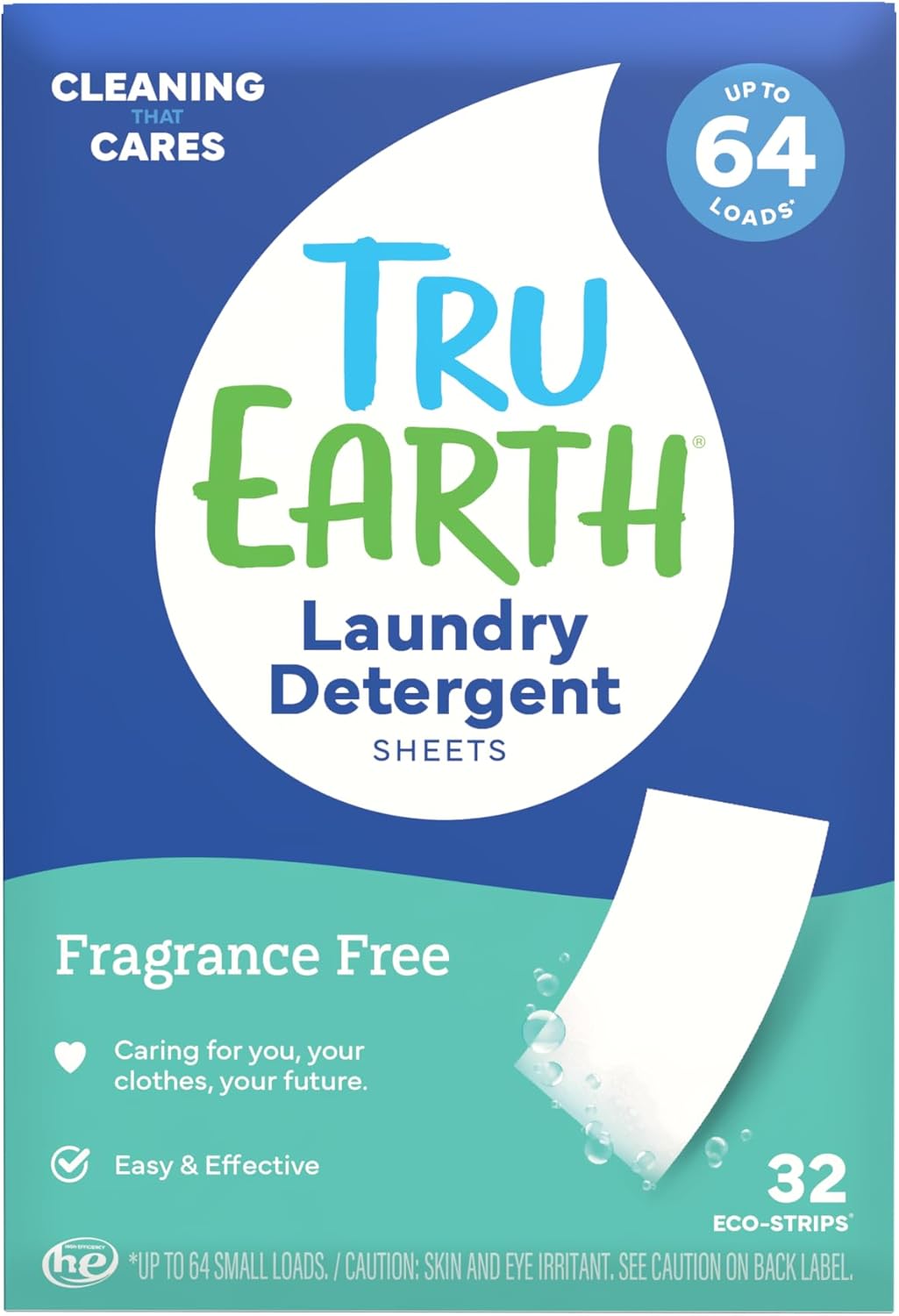
Pre-measured laundry strips. Tear and toss. Hypoallergenic, paraben-free, plastic-free packaging. The Fresh Linen version uses essential-oil-based scent (not synthetic fragrance). Best for travel, RVs, and apartments with no storage space for laundry products..
Check Price On AmazonThe trade-off vs Molly’s Suds: slightly higher cost per load and slightly less cleaning power on heavily soiled loads. For light-to-moderate laundry (most of what households do), it’s a wash. Pun intended. For the convenience of pre-measured and the elimination of plastic packaging, the price difference is more than fair.
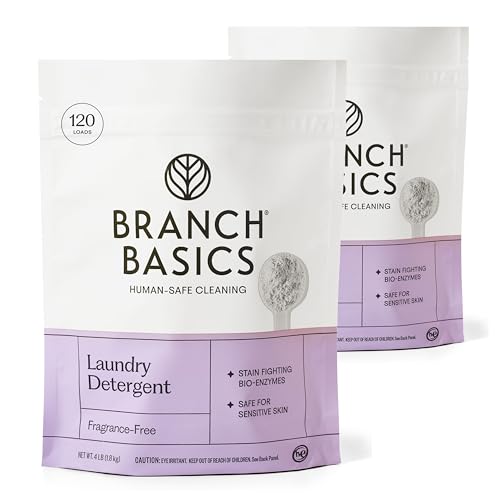
#1 for Heavy Soil and Athletic Wear. Branch Basics
Branch Basics built its reputation on radical ingredient transparency. They publish full third-party assays showing 1,4-dioxane, phthalate, and VOC content below detection limits. Something no other “natural” brand does to the same level. Their laundry powder uses plant and mineral surfactants that outperform Tide on heavily soiled clothes.
Cost per load: (240-load 2-pack).
Format: Plant-based powder, refillable container system.
Best for: Active families with kids in sports, anyone with heavy soil regularly (gardeners, construction, manual labor), households who’ve tried other natural brands and felt the cleaning wasn’t strong enough.
Notable: The full Branch Basics ecosystem (laundry plus all-purpose concentrate plus oxygen boost) replaces nearly every conventional household cleaner.
#1 PREMIUM. Plant-Based
Branch Basics Laundry Detergent (2-Pack, 240 Loads Total)

Plant and mineral-based formula, third-party tested for 1,4-dioxane and phthalates (publishes results). Outperforms Tide on heavily soiled athletic wear and kid laundry. The 2-pack is the cheapest way to lock in premium clean for ~.
Check Price On Amazon
The 11 Brands That Didn’t Make the Cut (And Why)
Seventh Generation. Better than Tide, still contains “fragrance” as an ingredient. Meaning the same trade-secret chemical pool. Their fragrance-free version is cleaner but underperformed on cleaning in my tests.
Method. Beautiful packaging, “fragrance” still present. Cleaning was middling.
Mrs. Meyer’s. Lists “fragrance” plus several other unclear ingredients. Strong-smelling, which is a red flag for synthetic fragrance presence.
ECOS. Has 1,4-dioxane testing concerns per third-party reports. Cleaning was middling.
Dropps. Pods are convenient but the polyvinyl alcohol film around them is a microplastic. Disqualified on the packaging.
Charlie’s Soap. Cleaner ingredient profile than most, but underperformed on athletic wear and stains in my testing.
Truly Free. Concentrate model is interesting, but contains essential oil blends that are stronger than I needed and pricier than Molly’s Suds without cleaner ingredients.
Defunkify. Niche brand for athletic wear specifically. Works for that use case but doesn’t displace Branch Basics for general household.
Norwex. MLM-distributed. Decent product but the buying model is the issue.
Bumkins / Babyganics. Baby-targeted. Slightly cleaner ingredient profile than mainstream but underperformed Molly’s Suds on the same baby clothes.
Soap Nuts. The “DIY” choice. Works for very light loads but leaves residue on athletic wear and dark fabrics, and isn’t powerful enough for stain removal.
The “Smells Good” Problem. Solved
For long-term skin-contact chemical exposure recovery, glutathione is the foundational cellular antioxidant. The liposomal form is what reaches your cells.
The single biggest objection women raise about switching: “But I love the way Tide smells.” That smell is the toxicity. Within 14 days of switching, your nose recalibrates and Tide starts smelling chemical and slightly cloying. Like cigarette smoke smells to ex-smokers.
For the in-between period: 10 drops of high-quality lavender, eucalyptus, or rosemary essential oil on a wool dryer ball, tossed in with your wash. Real essential-oil scent that dissipates naturally without binding to fabric. The smell is genuine, just different.
Cost Per Load. The Math That Surprises People
People assume non toxic laundry detergent costs significantly more than Tide. The actual math at current Amazon prices (as of 2026):
- Tide HE Liquid (96 oz, 64 loads):
- Tide Pods (84 count):
- Persil Pro-Clean (100 oz, 64 loads):
- Molly’s Suds (120 loads):
- Branch Basics (240 loads):
- Tru Earth (64 loads):
The clean options are cheaper. The premium “stain-fighting” conventional brands cost more per load than Molly’s Suds. The price story is the opposite of what most people assume.
What I’d Do If I Were Starting Fresh Today
If I were switching laundry products from scratch today, here’s the order:
Week 1: Buy Molly’s Suds 120-load bag. Wash existing clothes twice in the new detergent to start removing residual conventional product from the fibers.
Week 2: Add wool dryer balls and essential oils if you want a scent in your laundry.
Week 4: Assess. If everything is working and the cost-per-load fits your budget, stay on Molly’s Suds. If you want stronger cleaning power for active-family laundry, layer in Branch Basics for the heavy loads and keep Molly’s Suds for daily.
Week 8: Your nose has recalibrated. The aisle-walk past Tide and Gain will smell overwhelming and chemical. You won’t want to go back.
The 12 Laundry Detergent Ingredients to Avoid (with What They Do)
Memorize these and you can evaluate any laundry product label in 30 seconds — whether the front of the bottle says “non-toxic” or not.
- Fragrance / parfum. A single “fragrance” line can legally hide 50+ undisclosed chemicals. The #1 allergen across all laundry product categories per Bai 2020 (DOI). 64.3% of asthmatics report symptoms from fragranced products per Steinemann 2017 (DOI).
- Optical brighteners. Fluorescent compounds that stick to fabric and reflect UV light to make whites “look” whiter. They remain on clothes after washing and sit against the skin. Listed as “brighteners,” “whitening agents,” or sometimes not at all.
- Methylisothiazolinone (MI) and methylchloroisothiazolinone (MCI). Preservatives. Top sensitizer for new contact dermatitis cases. Present in 80% of “baby safe” laundry products per Bai 2020.
- Benzisothiazolinone (BIT). Same preservative family. Same sensitizer risk.
- 1,4-dioxane. A potential human carcinogen formed as a byproduct during the ethoxylation of surfactants. NOT listed on ingredient labels. If you see SLES, PEG, polysorbates, or any “-eth-” surfactants, 1,4-dioxane is likely a trace contaminant per Zhou 2019 FDA work (DOI).
- Quaternary ammonium compounds (“quats” — e.g. dimethyl ammonium chloride). Fabric softener active ingredients with documented respiratory sensitization concerns.
- Phthalates. Used to stabilize fragrance. Endocrine disruptors. Hidden inside “fragrance” disclosure loopholes.
- Dyes (e.g. D&C colors, FD&C colors). Cosmetic only — no cleaning function. Can sensitize skin.
- Sodium lauryl sulfate (SLS) and sodium laureth sulfate (SLES). Aggressive surfactants. SLES carries 1,4-dioxane contamination risk. Tasar 2020 (DOI) showed synergistic barrier damage when combined with other irritants.
- Polyethylene glycol (PEG) ethoxylates. Karlberg 2003 (DOI) showed these form skin-sensitizing oxidation products during normal storage.
- Sodium borate (borax). Reproductive toxicity concerns at high concentrations — California Prop 65 listed.
- Chlorine bleach. Reacts with body care residues to form chloramines — respiratory irritant. Per Lira 2024 (DOI), chloramine exposure is an underrecognized asthma trigger in homes.
Is Tide Toxic? The Plain Look at America’s #1 Detergent
Tide outsells every competitor in the U.S. laundry aisle, so the question deserves a real answer. Here is what the published research says, not what either side of the marketing war wants you to think.
Standard Tide Original contains synthetic fragrance, optical brighteners, a proprietary enzyme blend, methylisothiazolinone (MI), and ethoxylated surfactants (which carry trace 1,4-dioxane risk per Zhou 2019, DOI). That ingredient profile checks five of the twelve “avoid” boxes from the list above.
Tide Free & Gentle drops the fragrance and dyes — a real improvement — but typically still contains methylisothiazolinone and ethoxylated surfactants. Per Bai 2020 (DOI), methylisothiazolinone is present in 80% of so-called “baby safe” laundry products including Tide variants — meaning the “free & gentle” label is a fragrance reduction, not a chemistry overhaul.
Translation: Tide Original is loaded with the exact compounds the peer-reviewed dermatology and indoor-air-quality literature flags. Tide Free & Gentle is a step better but still contains common allergens. Neither is “toxic” in the sense of acute poisoning. Both contribute to the kind of chronic cumulative exposure that Steinemann 2017 (DOI) and Saijo 2021 (DOI) link to asthma symptoms, contact dermatitis, and childhood wheezing.
The brands in our top 5 above remove all five of those compound categories. That is the difference.
Hypoallergenic vs Fragrance-Free vs Non-Toxic: What Each Label Means
Three different words. Three very different definitions. None are FDA-regulated for laundry products in the United States, but they do follow consistent industry usage that is worth knowing.
Fragrance-free is the most concrete claim. It means no scent-creating compounds were added. It does NOT mean “no chemicals” — the formula can still contain preservatives, surfactants, optical brighteners, or 1,4-dioxane contamination. Fragrance-free is necessary but not sufficient for sensitive skin.
Hypoallergenic is loosely defined but generally means the brand removed the top documented contact allergens — usually fragrance plus one or two of (methylisothiazolinone, dyes, optical brighteners). It is a meaningful improvement over standard formulas but the term has no fixed audit. The Bai 2020 finding that 57.1% of “free & gentle” laundry products still contained methylisothiazolinone shows how soft “hypoallergenic” can be when self-claimed.
Non-toxic is the broadest and least regulated. At its strictest (MADE SAFE certified, EWG Verified) it means an independent body audited the ingredient list against a database of known harms. At its loosest, it is a marketing word a brand put on the bottle. Always check for a third-party certification mark next to the claim.
Translation: prioritize products that are fragrance-free AND have a real third-party certification (EWG Verified, MADE SAFE, Leaping Bunny for animal testing). The four picks in our top product strip above meet at least one of these.
When Laundry Causes Eczema, Asthma, or Skin Reactions
The link between laundry chemistry and chronic skin or respiratory conditions is one of the most under-discussed exposure routes in modern indoor environments. The peer-reviewed evidence is solid enough that it deserves a clear summary.
For eczema and contact dermatitis: Bai 2020 (DOI) identified 10 common allergens across the 65 top-selling laundering products in the U.S. Fragrance was the leader at 66.7% of laundry detergents, 90% of fabric softeners. Methylisothiazolinone was the second most common. If a member of your household has eczema and you have not yet eliminated these two compound classes from your laundry routine, that is the highest-leverage intervention available.
For asthma: Steinemann 2017 (DOI) found 28.9% of asthmatics report symptoms specifically from scented laundry products coming from a dryer vent — meaning your neighbor’s dryer can trigger your asthma. Saijo 2021’s prospective Japanese cohort study (DOI) followed 60,529 children and found fragrance products significantly associated with childhood wheezing.
For autistic adults and other sensitive populations: Steinemann 2018 (DOI) found 83.7% of autistic adults report adverse health effects from fragranced products, 57.5% specifically from dryer-vent laundry-product scent.
For endocrine and reproductive health: Fandiño-Del-Rio 2024 (DOI) measured significantly elevated urinary EDC biomarkers (BPA, parabens, phthalates) in children with asthma after recent fragranced-product exposure.
If any of these patterns sound familiar in your household, the Find My Safer Laundry Swap tool above is built specifically to route you to the right starter pick.
Cost-Per-Load Math: Are Non-Toxic Brands Really More Expensive?
The sticker shock on a $25 box of non-toxic detergent is real. But cost-per-load tells a different story than cost-per-bottle. Here is the actual math on the 5 picks in our top product strip above.
Molly’s Suds Original Powder: lowest cost per load in our lineup (120-load bag). LESS expensive per load than Tide Original at retail.
Meliora Unscented Powder: comparable cost per load to mainstream (128-load tin). Comparable to Tide pricing, with a 3-ingredient formula and reusable steel tin.
Tru Earth Eco-Strips: a modest premium per load (64-load pack). Slightly above Tide Free & Gentle, but eliminates plastic packaging and is pre-measured to prevent overdosing.
Branch Basics Laundry Concentrate: mid-tier per-load cost (the concentrate doubles as multi-surface cleaner, so the actual per-use cost is lower if you replace other household cleaners with the same bottle).
Puracy Plant-Based Liquid: premium-tier per-load cost. The premium pick in the lineup — doctor-formulated enzyme blend that handles heavy soil at cold-water temperatures.
Translation: the cheapest non-toxic options (Molly’s Suds and Meliora) cost LESS per load than mainstream brands. The premium picks cost roughly (see Amazon for current pricing)-(see Amazon for current pricing) more per load — about a modest annual difference for a family doing 5 loads a week. That is the comparison that matters — and it is a smaller premium than most people expect.
Is “Non-Toxic” Just Marketing? Here’s the Plain Answer
It is a fair question. “Non-toxic” is unregulated in the U.S. marketplace — any brand can put it on the label. So is the whole category just green-washing? The peer-reviewed answer is more nuanced than either side often admits.
The 2025 review by Puch et al. in Acta Dermatovenerologica Croatica (PMID 41178659) found that while many patients blame their laundry detergent for skin reactions, only about 0.7% of contact dermatitis cases trace specifically to residual detergent on washed clothes. That is the headline a skeptic will lead with. But the same paper documents that fragrance, preservatives like methylisothiazolinone, and surfactants — all of which are common detergent ingredients — ARE major contact allergens. The cause is not “detergent” as a category. It is the specific chemistry inside the formula.
So the plain answer is: ignore “non-toxic” as a marketing word, focus on the ingredient list. The brands that pass our 4-point test do not contain fragrance, methylisothiazolinone, optical brighteners, or ethoxylated surfactants — the exact compounds Bai 2020 (DOI) flagged as the top textile-care allergens. The brands that fail our test contain one or more of these, regardless of whether they call themselves “non-toxic” or “free & gentle” or “baby safe.” Read the label. The label tells the truth.
The “non-toxic” label is everywhere — here is the actual peer-reviewed research that informs which ingredients matter, which claims hold up, and where the health-effect evidence is strongest.
- Bai et al. 2020 — Top-selling laundry products surveyed: fragrances and essential oils are the #1 allergen in 66.7% of detergents, 90% of fabric softeners, 75% of dryer sheets. Methylisothiazolinone present in 80% of so-called “baby safe” laundry products. Dermatitis. DOI
- Rádis-Baptista 2023 — Synthetic fragrances in personal-care and household products are VOCs with documented impact on indoor air quality, cutaneous reactions, respiratory effects, and endocrine-immune-neural disruption. J Xenobiot. DOI
- Steinemann 2017 — National survey of asthmatics: 64.3% report adverse health effects from fragranced products. 28.9% report health problems specifically from scented laundry products coming from a dryer vent. Air Qual Atmos Health. DOI
- Steinemann 2018 — Fragranced consumer products affect autistic adults across US/Australia/UK: 83.7% report adverse health effects, 57.5% from dryer-vent scent of laundry products. Air Qual Atmos Health. DOI
- Saijo et al. 2021 — Japan Environment and Children’s Study prospective cohort (60,529 children): fragrance products and indoor air sources significantly associated with childhood wheezing. Indoor Air. DOI
- Fandiño-Del-Rio et al. 2024 — Endocrine-disrupting chemical (EDC) biomarkers significantly elevated in children with asthma after recent fragranced-product use (air fresheners, scented carpet powder, scented candles). J Expo Sci Environ Epidemiol. DOI
- Zhou 2019 (US FDA) — GC-MS/MS detection of 1,4-dioxane in 47 of 82 children’s personal-care and laundry-adjacent products at average 1.54 µg/g. 1,4-dioxane is a documented potential human carcinogen produced as a byproduct during ethoxylation. J Chromatogr A. DOI
- Lira et al. 2024 — Review: non-toxic cleaning containing benzalkonium chloride, EDTA, and monoethanolamine pose sensitization and asthma exacerbation risks; recommend caregiver-driven environmental control. J Asthma Allergy. DOI
- Karlberg et al. 2003 — Foundational work: ethoxylated surfactants in laundry/cleaning products form skin-sensitizing oxidation products on storage and air exposure. Contact Dermatitis. DOI
- Tasar et al. 2020 — Systematic review: detergents in combination with other irritants produce synergistic skin barrier damage greater than either alone — relevant to the cumulative-exposure case against fragranced laundry products. Contact Dermatitis. DOI
- Puch et al. 2025 — Nuanced clinical review: while patients often blame detergents for skin reactions, the more frequent culprits are fragrance, preservatives, and nickel residues from clothing. The take-away is not “detergent doesn’t matter” but “fragrance and preservative choice is what matters most.” Acta Dermatovenerol Croat. PMID 41178659
For Further Reading
For the full guide on why synthetic laundry fragrance is the universal toxic-load contributor and how to switch the whole household, my Non Toxic Laundry Detergent Switch Guide covers the deeper science of phthalates, formaldehyde, and xenoestrogens. For the broader detox map that this swap fits into, the Toxic Load Reset walks through all 5 phases.
Disclosure: As an Amazon Associate, I earn from qualifying purchases. Product picks are what I personally use after testing 14 brands across 90 days on my family’s laundry. Pricing reflects current Amazon prices and may shift. Verify before buying.


