

The Pomodoro Technique for ADHD adults can absolutely work, but the standard 25 minutes on, 5 minutes off rhythm rarely lands on the first try for an ADHD brain. The fix is not to throw the technique out, it is to make five small adjustments that match how an ADHD brain actually starts, sustains, and switches focus. Make those changes and the timer goes from one more failed productivity tool to the most reliable focus prop in the day.
I have written before about how body doubling supports focus and how a dopamine menu helps with task initiation. The Pomodoro Technique for ADHD adults is the third leg of that stool. The standard advice for it usually comes from neurotypical productivity blogs that treat 25 minutes like a fixed law of physics. That is the source of most of the failure.
Why the Standard Pomodoro Technique Often Fails for ADHD
The classic 25/5 cycle was developed by an Italian university student in the 1980s. It is a perfectly fine starting place, but it has three baked-in assumptions that do not hold for ADHD: that 25 minutes is the right block length, that a 5 minute break is enough recovery, and that motivation is something you bring to the timer rather than something the timer creates. Each of those assumptions can be flipped without losing the underlying value.

Key points from the video:
- The Pomodoro is a forced container, not a productivity hack. The container is what works.
- Standard 25 minute blocks often miss the ADHD sweet spot in either direction.
- Visual timers outperform phone timers because they remove the screen.
- Short breaks need to be planned, not improvised, or they swallow the day.
Adjustment 1: Pick Your Real Block Length
For some ADHD brains, 25 minutes is too long. The mind has wandered four times by the 8 minute mark and the rest of the block is performance art. For others, 25 minutes is too short. You finally hit flow at minute 22 and the timer rips you out of it. The fix is to spend one week tracking what your real attention envelope is. If you keep losing focus around minute 12, your starting block is 12 minutes. If you keep wishing for more time at minute 25, try 50.
The classic Pomodoro insists on 25. The ADHD-friendly Pomodoro insists on truth. Pick the block length that matches how your brain actually works, not the one a textbook says.
Adjustment 2: Use a Visual Timer, Not Your Phone
The single biggest leak in any focus session is the phone. Notifications are not the only problem. Even glancing at a phone to check a timer puts you one tap away from Instagram, the inbox, and the news. A physical visual timer eliminates that risk entirely. Set it, flip it, and the work is the only thing left in front of you.
Cube-style timers with preset block lengths are particularly well-suited for ADHD. You flip the cube to whichever face shows the time you want, and the timer starts. There is no menu, no app, no swipe. The reduction in friction is the entire point.
Jack Pomodoro Cube Timer

Source: amazon.com
Mute, vibration, and adjustable sound alert with 3, 5, 10, 25, 30, and 60 minute presets plus custom countdown.
The Wellthie One Review
Jack Pomodoro Cube Attributes
- Six preset block lengths: 3, 5, 10, 25, 30, and 60 minutes
- Mute mode and vibration alert for shared workspaces
- Rechargeable; sits flat on a desk and stays out of the way
- Adjustable sound from a soft chime to a loud bell
The cube is the single piece of gear I recommend most often. The mute plus vibration mode is the killer feature for libraries, cafes, or open offices. The 3 and 5 minute faces are the secret weapon for ADHD because they make starting feel almost free. You promise yourself only 3 minutes, and most days you keep working past the alarm.
Adjustment 3: Pair Every Block With a Pre-Written Next Task
Task initiation is one of the hardest parts of ADHD. The Pomodoro alone does not solve initiation, it just tries to time-box it. The way to actually win the initiation moment is to write down the next task before the previous block ends. When the timer dings, the work is already named on paper. There is no decision to make.
This pairs beautifully with the 1-3-5 rule, where you pick one big task, three medium tasks, and five small tasks for the day. Each Pomodoro picks one of those nine items off the list and gets paired with it. No staring at the list, no negotiating, just the next item.

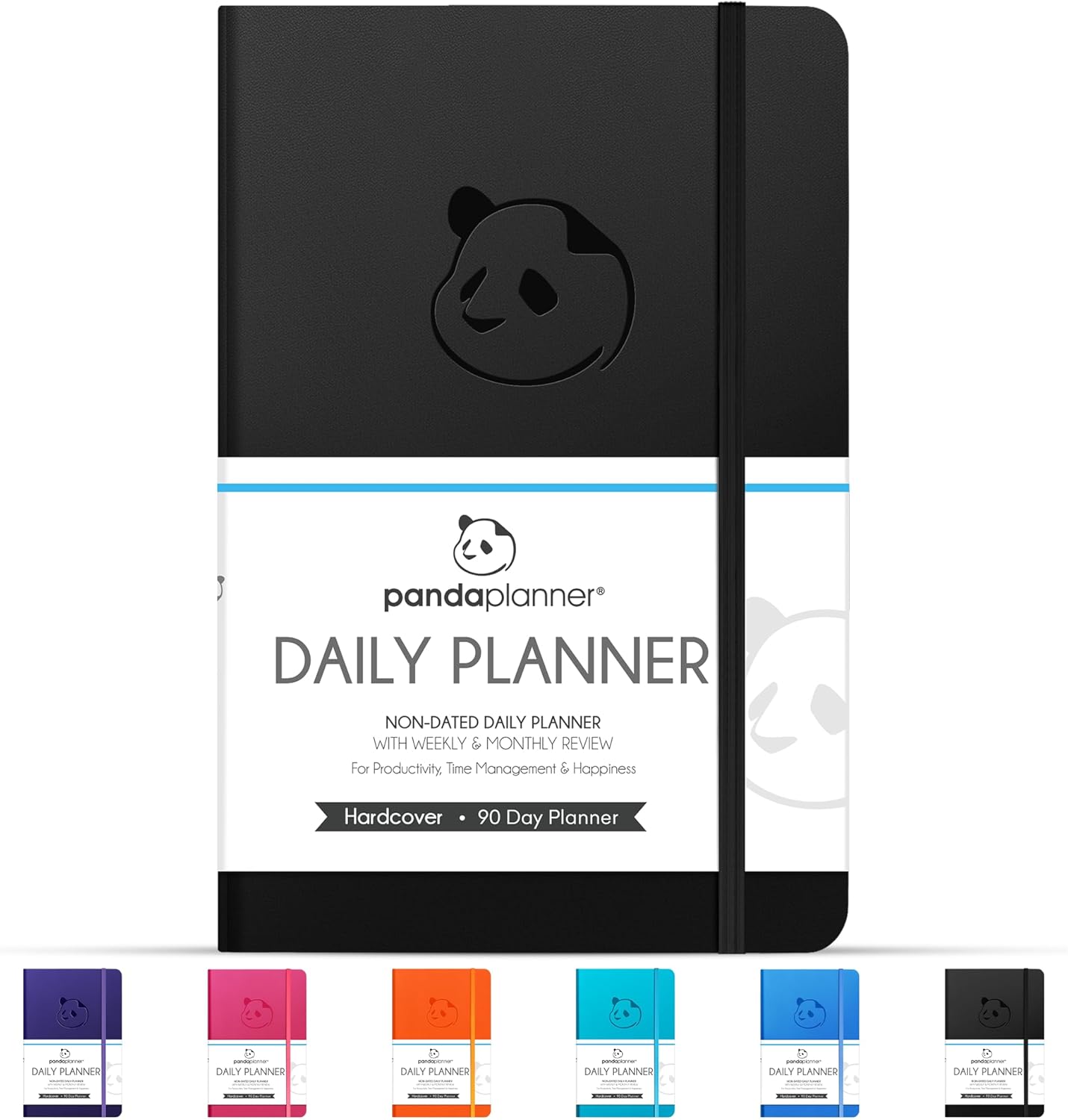
Panda Planner Classic A5 Daily Planner
Source: amazon.com
Undated daily planner with hourly schedule, to-do list, gratitude, and habit tracker.
The Wellthie One Review
Panda Planner Attributes
- Undated, so a missed week does not waste paper or guilt
- Hourly schedule lines up cleanly with Pomodoro blocks
- Daily gratitude prompt to bookend the work
- Habit tracker on the inside cover, useful for ADHD streaks
The undated format matters more than people think. ADHD brains skip days, then dread reopening the planner because the abandoned weeks are sitting there shaming them. An undated planner just picks up where you left off. The hourly schedule on each page is what makes it pomodoro-friendly. You can pencil in 25 minute blocks down the column without thinking.
Adjustment 4: Use Body Doubling Inside the Block
Body doubling means working in the presence of another person, in person or on a video call, even when you are doing different tasks. It is not new, it is just renamed. ADHD brains often borrow focus from the people around them. A Pomodoro block done with a body double tends to last twice as long without breaking.
You do not need a friend on call. Free virtual coworking rooms exist where strangers join a 50 minute block, briefly say what they are working on, then mute and work. Pomodoro plus body doubling is one of the most underrated combinations in the ADHD productivity space. Read more in our body doubling guide.
Adjustment 5: Plan the Break, Do Not Improvise It
Improvised breaks are how an ADHD afternoon disappears. The phone comes out, social media opens, then 90 minutes have evaporated. The fix is to write the break activity down at the same time as the work block. Examples that recharge instead of drain: walking around the block, refilling water, light stretching, three minutes of breathwork, hugging the dog, sitting on the porch.
This is where a dopamine menu earns its keep. Build a list of small, fast pleasures and pull from that list during 5 minute breaks. The break stops being a trap and starts being part of the system. After every fourth Pomodoro, take a longer 20 to 30 minute break to fully reset.
How to Build Your First Day
For the first week, do not aim for productivity records. Aim for finding your sweet spot. Try one day of 15/5 blocks, one day of 25/5, and one day of 50/10. Track which day felt sustainable, not which day produced the most. The point is data, not output.
From day eight onward, lock in the block length that worked best. Pair every block with a pre-written task and a pre-chosen break activity. Use a visual timer instead of your phone. Add a body double for the longest stretches. The system is now custom to your brain, not borrowed from a 1980s university student.
Common Mistakes to Avoid
The first mistake is treating the Pomodoro as a willpower test. It is not. If a block fails, the block was wrong, not you. Shorten it next time and try again. The second mistake is checking the phone during the break. The phone is the focus killer. Leave it in another room during work hours. The third mistake is skipping the long break after four blocks. The long break is what allows the next four blocks to feel possible.
The fourth mistake is doing pomodoros for tasks that should not be pomodoroed. Deep creative writing sometimes needs 90 minute uninterrupted stretches. Phone calls and meetings cannot be timed externally. The technique works best for execution work: emails, paperwork, code, drafts, design, and the kind of small daily admin that piles up because nobody wants to start.
Why This Approach Beats Standard Productivity Advice
Most productivity articles aimed at ADHD adults treat ADHD as a deficiency to compensate for. The framing here is the opposite. ADHD brains run on novelty, urgency, and external structure. The Pomodoro provides external structure. A short block creates the urgency. A pre-written task plus a body double provides novelty and accountability. When all four levers fire together, focus arrives almost as a side effect.
Used well, the Pomodoro Technique for ADHD adults is the closest thing to a focus dial I have found. It is not a personality transplant. The brain is still ADHD. But the work gets done, and the day no longer feels like it is happening to you.
Affiliate disclosure: As an Amazon Associate, The Wellthie One earns from qualifying purchases. The links above may pay a small commission if you choose to buy. Recommendations reflect what I actually use or have tested. This article is for educational purposes and is not medical advice for ADHD or any other condition. Talk to a qualified clinician for individual guidance.


