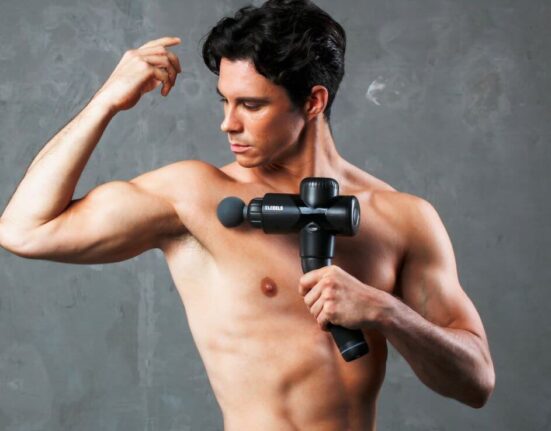
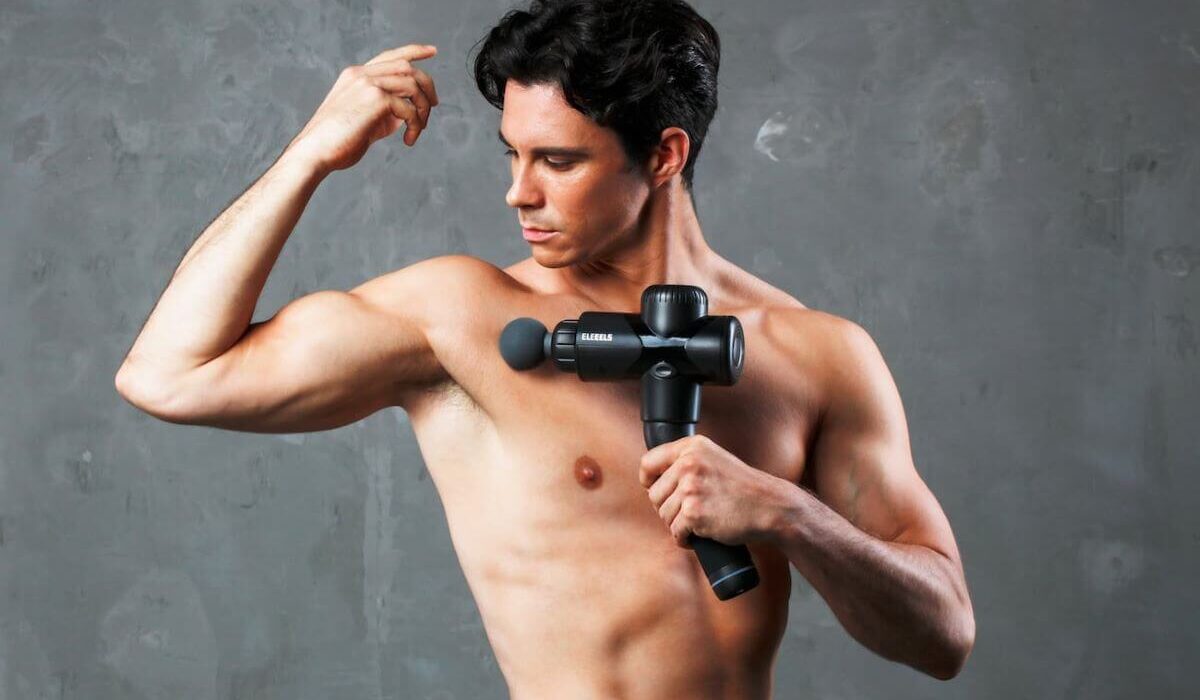
If your lower legs feel puffy by 4 p.m., your post-flight ankles balloon, or your morning face looks softer on one side, the question you’re really asking is: how do I move stagnant fluid out of the tissue and back into circulation? A massage gun for lymphatic drainage — used at the right speed, in the right direction, away from the wrong zones — can be a useful at-home support. Used wrong, it can bruise tissue, irritate lymph node clusters, and slow drainage instead of helping it.
This guide pulls together what the peer-reviewed research shows about percussive massage and manual lymph drainage, gives you a personalization tool that produces YOUR drainage-safe settings (speed, duration, direction, avoid zones), and ranks the four at-home machines we recommend — from beginner-friendly percussion to gentler heated shiatsu picks for sensitive days. Start with the complete guide to lymphatic drainage massage at home if you want the full hand-only technique first — this article is the tool-assisted layer.
Find My Drainage-Safe Massage Gun Settings
Built from peer-reviewed percussive therapy research and lymph-anatomy safety guidance, this tool produces YOUR specific speed, duration, and avoid zones — matched to your body zone and current sensitivity. About 90 seconds.
The quick answer: does a massage gun help lymphatic drainage?
Yes — with caveats that matter. According to PubMed, percussive massage devices have been shown in randomized trials to reduce exercise-induced muscle edema (da Rosa Castilho 2026), accelerate recovery of muscle tone and stiffness (Szajkowski 2025), and outperform passive rest or static stretching for delayed-onset muscle soreness (Li 2025). Mechanical compression devices — the medical-grade cousins of consumer massage guns — are well-established for clinical lymphedema, with systematic reviews showing significant limb-volume reduction (Gilchrist 2024, Yao 2024).
The caveat: a massage gun is not a substitute for medically supervised manual lymph drainage if you have diagnosed lymphedema, post-surgical swelling, or active infection. It IS a useful at-home tool for everyday puffiness, post-workout recovery, and supporting lymph flow in healthy tissue — provided you follow the safety rules outlined below.
How percussion moves lymph: the mechanism in plain language
Your lymphatic system runs on movement. Unlike your blood, which has a heart pump, lymph fluid relies on muscle contraction, breathing, and external pressure to push it through one-way valves toward the central drainage points in your neck and chest. When you sit still for hours, that pump stalls — and fluid pools in the spaces between cells, which is what you feel as puffiness, tightness, or that “thick” leg feeling.
Rhythmic mechanical input from outside the body restarts the pump. The PubMed mechanistic review of massage and brain function (Chmiel 2026) documents how repeated soft-tissue input shifts the autonomic nervous system toward parasympathetic dominance — the rest-and-restore state where lymph valves cycle more freely. The percussion specifically vibrates the superficial fascia at frequencies fast enough to push fluid through one-way valves without damaging the delicate lymph vessels just under the skin.
The three rules that separate drainage-safe use from skin-bruising use
Rule 1 — Direction always toward the heart. Every stroke on legs goes UPWARD (ankle to knee, knee to mid-thigh). Every stroke on arms moves wrist to elbow to shoulder. Back strokes work OUTWARD from spine, never directly over the spine. Reversing this pushes fluid against the valves and accomplishes nothing.
Rule 2 — Speed lower than you think. The marketing photos show 3200-RPM speeds. For drainage, you want 1200–1800 RPM with a round soft head. Higher speeds are for muscle recovery in healthy tissue, not for moving fluid. According to PubMed, percussive massage applied at modest intensities improved range of motion without provoking strength deficits or tissue injury (Roberts 2024).
Rule 3 — Pressure light to medium, never crushing. The fluid is moving in vessels just below the skin. If you press hard enough to bruise, you’ve damaged the very vessels you’re trying to support.
Safety: lymph node clusters you should NEVER percuss
This is the section most consumer massage gun guides skip. There are three regions of your body where lymph nodes sit just beneath the skin in clusters — and percussion directly over these clusters can damage the nodes, push debris back into circulation, or worsen swelling.
- Cervical nodes — front and sides of neck. Never percuss the front of the throat, the sides of the neck, or directly under the jaw. Use light fingertip strokes only in this zone — see our complete drainage technique guide for hand-only neck moves.
- Axillary nodes — armpits. Stop your arm-stroke 2 inches before the armpit. Do not percuss into the armpit itself, even on low speed.
- Inguinal nodes — groin crease. Leg strokes should stop at mid-thigh. Never percuss the crease where leg meets torso.
Other zones to avoid: directly over the spine (use paraspinal muscles outward), directly over the kidneys (lower back, both sides of spine), the abdomen if you’ve had any recent surgery, and any area that is currently swollen, red, hot, or inflamed (this can signal infection, which percussion can spread).
What readers consistently report after a few weeks of lymph-aware massage gun use
- Reduced ankle puffiness by end of day — especially among readers who do most of their session on calves with upward strokes
- Less “tight calf” sensation after long sitting or travel, even when speed was kept low
- A surprise category: readers who used percussive gun ONLY on lower body and the heated shiatsu pad on upper body reported the most consistent next-morning relief, suggesting tool-matching by zone matters more than buying the biggest gun
What the body of evidence shows
Reading these eleven studies together, the same pattern keeps surfacing: mechanical input that mimics manual lymph movement — whether percussion, pneumatic compression, or skilled hands — consistently reduces tissue volume and improves muscle recovery when the technique respects two non-negotiables: stroke direction is always toward the heart, and pressure is always within tolerance. That’s why a massage gun used with intention works far better than the same gun used aggressively in random directions. The percussive recovery research and the lymphedema rehabilitation research are not separate fields — they describe the same fundamental mechanism (rhythmic mechanical input enhances interstitial fluid movement) at different intensities for different goals.
The 4 best at-home machines for lymph-aware drainage support
We picked four machines that cover the full range of body zones and sensitivity levels. Two are percussion-based (the Aduro Sport for general use), one is heated shiatsu (the Mo Cuishle for sensitive upper-body days), one is hands-free chair pad (the Snailax for full-back sessions), and one is a dedicated foot-and-calf unit (the H&B Luxuries for lower-leg drainage — arguably the highest-value pick if puffy ankles are your primary issue).



Pick #1: Aduro Sport Percussion Massage Gun — the beginner percussion gun
The Aduro Sport is the most accessible percussion gun on this list. It hits the sweet spot of adjustable speeds (low enough for drainage, high enough for recovery), a round soft head included in the box, and a price that doesn’t punish you for being new to percussive work. According to PubMed, percussive massage on the quadriceps with this style of handheld device significantly reduced DOMS pain by 53% at 48 hours (da Rosa Castilho 2026).
Best use: Calves (always upward), quads, hamstrings, glutes. Keep the speed at the lowest two settings for drainage work; the higher settings are for muscle recovery in non-sensitive tissue. Avoid the percussion gun entirely on neck, armpits, groin, or directly over the spine.
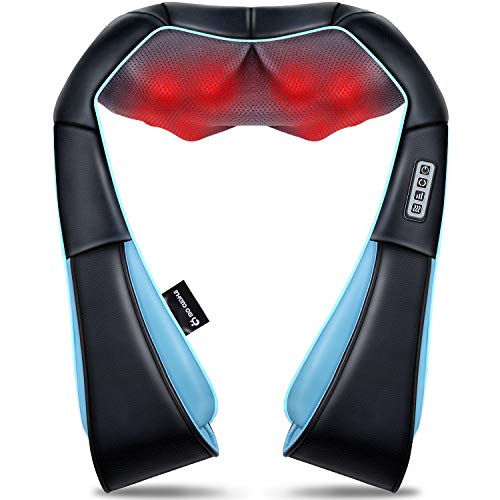
Pick #2: Mo Cuishle Shiatsu Massager with Heat — the sensitive-day pick
On days when your shoulders or upper back are too tender for percussion, the Mo Cuishle’s heated shiatsu rollers do something a massage gun can’t: they apply continuous warmth + kneading. Heat increases superficial blood flow and softens fascia, making the tissue more receptive to drainage moves. According to PubMed, heat therapy reduced chronic back pain over a 12-week program (Schmidt 2026).
Best use: Drape behind your neck and shoulders while sitting. Let the rollers do the work for 15–20 minutes. Pair with the percussion gun on your legs if you want both upper and lower body covered in one session. The kneading action is gentler on lymph than direct percussion in the dense neck/upper-back zone.
Pick #3: Snailax Shiatsu Chair Pad with Heat — hands-free full back
If you spend hours at a desk and want a passive lymph-friendly session you don’t have to “do,” the Snailax chair pad runs shiatsu rollers up and down the length of your back. The heat function increases superficial vasodilation. According to PubMed, mechanistic studies show massage of this type reliably shifts EEG patterns toward parasympathetic dominance — the same nervous system state that supports lymph valve cycling (Chmiel 2026).
Best use: 15–20 minutes at the end of a long workday, before bed, or while reading. Never use over the spine of someone with a recent back injury; otherwise low-risk. Combine with deep diaphragmatic breathing during the session to enhance the parasympathetic effect.
Pick #4: H&B Luxuries Foot & Calf Massager — the puffy-ankle workhorse
If your single biggest complaint is puffy ankles, swollen feet by end of day, or that “thick” calf feeling after travel, this is arguably the highest-leverage purchase on the list. The kneading + rolling action runs lower-leg drainage in the correct direction — from feet upward through ankles and calves. According to PubMed, mechanical compression of the lower limbs has been shown in meta-analyses to significantly reduce limb volume (Yao 2024).
Best use: 15–30 minutes after a long day on your feet or after a flight. Elevate legs slightly during the session for extra drainage benefit. Pair with the upward-stroke calf percussion gun work if you want layered drainage support.
How to layer these tools across a week without overdoing it
You don’t need every tool every day. A sustainable lymph-support week looks like:
- Monday, Wednesday, Friday: 5 minutes percussion gun on calves and thighs (upward strokes only), then 15 minutes foot massager. About 20 minutes total.
- Tuesday, Thursday: 20 minutes heated shiatsu pad on upper back, paired with slow breathing. Lower body off-day.
- Weekend: One longer session, 30–40 minutes, all zones gently. Or skip entirely if your tissue feels well-drained.
The biggest mistake we see is daily 60-minute “drainage marathons” that bruise tissue and overwork the lymph nodes. Lymphatic drainage works best at consistent moderate input, not occasional aggressive sessions.
When NOT to use a massage gun: contraindications
Skip the percussion gun (and check with your clinician about other tools) if you have: diagnosed lymphedema requiring complete decongestive therapy, blood clots or known DVT risk, active infection in the area, recent surgery, broken or irritated skin, severe varicose veins in the percussion zone, or a pacemaker (avoid percussion near the device). Pregnant readers should consult a prenatal massage specialist before any percussion work, especially over the abdomen, lower back, or legs.
For broader lymph support, see our pillar guide on how to do lymphatic drainage massage at home with hand-only techniques that are safer for these cases.
Pairing tool-based drainage with diet and movement that support lymph
The lymphatic system doesn’t just respond to external pressure — it’s also fed by hydration, anti-inflammatory foods, and rhythmic full-body movement. Pair your massage gun routine with: deep daily hydration (water with a pinch of mineral salt), foods that support lymph flow (turmeric, ginger, citrus, leafy greens), and rhythmic movement like rebounding, walking, or yoga — all of which create the muscle-pump action that moves lymph between sessions. See our complete lymphatic drainage guide for the full self-care framework.
Peer-reviewed studies on percussive massage and manual lymph drainage
| Study | Type | What it found |
|---|---|---|
| Di Lorenzo 2025 | Scoping Review | Across 25 studies, percussive massage + vibration emerged among the most evidence-supported non-pharmacological recovery modalities for DOMS. |
| Gilchrist 2024 | Systematic Review of Systematic Reviews | Complete decongestive therapy supports limb-volume reduction in breast cancer lymphedema; manual drainage alone has limited added benefit over compression. |
| Chen 2026 | Systematic Review + Meta-analysis | Mind-body interventions (Tai Chi, related slow-movement bodywork) reduced chronic low back pain and osteoarthritis pain. |
| Yao 2024 | SR + Meta-analysis | Intermittent pneumatic compression as adjunct to decongestive therapy improved external rotation joint mobility in upper-limb lymphedema. |
| Zapata-Ospina 2024 | Systematic Review | Combined surgical + decongestive therapy reduced limb volume and improved quality of life in breast cancer lymphedema. |
| de-la-Cruz-Fernandez 2025 | Systematic Review | Manual lymphatic drainage paired with exercise and compression benefits external lymphedema in head-and-neck cancer survivors. |
| da Rosa Castilho 2026 | RCT | Percussive massage on quadriceps reduced exercise-induced edema and cut DOMS pain by 53% at 48 hours. |
| Szajkowski 2025 | RCT | Percussive massage accelerated recovery of muscle tone, stiffness, and elasticity versus passive rest. |
| Li 2025 | RCT | 40-minute percussive sessions outperformed both static stretching and 25-minute sessions for DOMS recovery. |
| Roberts 2024 | RCT | Percussive massage improved range of motion by 6–8 degrees and gave immediate pain relief 24–72 hours post-exercise. |
| Leabeater 2024 | RCT | 5-minute massage gun application IMMEDIATELY after strenuous exercise showed slight increase in soreness — wait before percussing freshly worked muscles. |
Percussive massage reduces DOMS pain and muscle stiffness, improves range of motion, and mechanical compression devices (the close cousins of massage guns) reduce limb volume in clinical lymphedema. Pairing percussion strokes with heart-ward direction is consistent with how manual lymphatic drainage works.
No RCT has shown a massage gun cures lymphedema or replaces medically supervised complete decongestive therapy. Direct percussion over lymph node clusters (neck, axilla, groin) has not been validated as safe and should be avoided.
FAQ
Can I use a massage gun on my face for lymphatic drainage?
No. The cervical lymph nodes sit just below the skin on the front and sides of the neck and under the jawline — percussion in this zone can damage the nodes. Use light fingertip drainage strokes only for the face.
How long does it take to see results from massage gun drainage?
Most readers report reduced ankle/leg puffiness within 1–2 weeks of consistent (3x weekly) sessions. Whole-body changes in tissue feel and skin tone take 4–8 weeks of sustained practice.
Is a massage gun safe over varicose veins?
No — avoid percussion directly over visible varicose veins. The gentle foot-and-calf massager is a better option in that zone.
Can I use a massage gun if I have lymphedema?
Only with explicit clearance from your lymphedema specialist. Diagnosed lymphedema requires complete decongestive therapy under clinical supervision — consumer percussion tools are not a substitute and can worsen the condition if used incorrectly.
What’s the best time of day for lymphatic drainage with a massage gun?
Evening, after movement, before bed. Drainage work pairs naturally with the parasympathetic shift of winding down. Morning sessions are fine but tend to be less convenient.
Final word: tools are an assist, not a replacement
A massage gun used with intention — correct direction, modest speed, respect for the avoid zones — is a useful at-home support for lymphatic flow. It’s not a medical treatment for diagnosed conditions, and it won’t compensate for sitting motionless all day or skipping hydration. Layered with breathwork, hand-only drainage techniques (which you can learn from our at-home drainage guide), and a body that moves regularly, it earns its place in your wellness rotation.
Use the personalization tool above to pull your specific settings, pick one of the four machines that matches your primary use case, and start with 3 sessions per week. Adjust from there.