
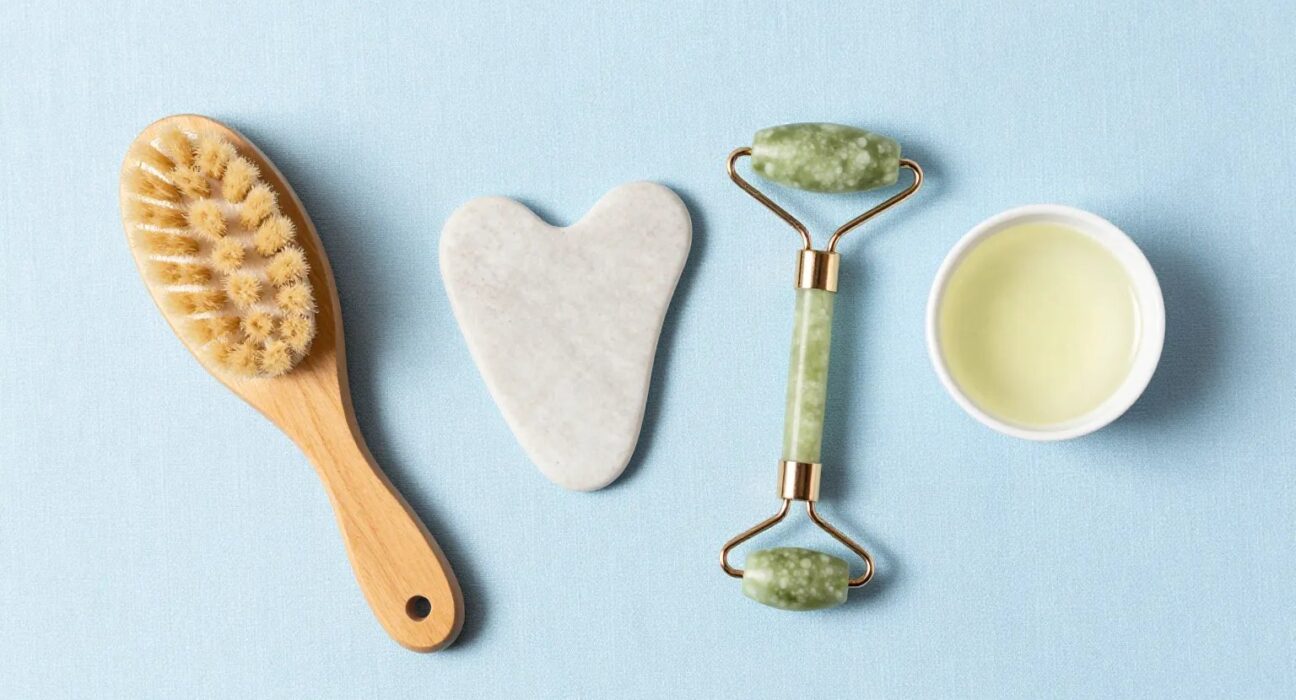
The right lymphatic drainage tool depends on three things: which body area you most want to work on, your experience level, and whether you want one device that does it all or two tools that do specific jobs better. The Find My Lymphatic Tool Match tool right below this intro routes you to the matched pick in two clicks. The five categories that have real evidence are dry brushing (surface lymph), gua sha and jade rollers (face and neck, with strong RCT support per Ahn 2025), wood therapy and body rollers (cellulite and deep tissue), vibration plates (whole-body fluid mobilization), and rebounders (covered in our dedicated rebounding article).
Per Ahn et al. 2025 (DOI), an 8-week randomized trial directly compared facial roller and gua sha. Both significantly improved facial contour, but they worked through DIFFERENT mechanisms: gua sha reduced muscle tone and dynamic stiffness, while jade roller improved skin elasticity. Translation: they are not redundant tools — pick based on what you want to change.
For the complete at-home lymphatic drainage protocol with 5 body-area diagrams and 45 cited studies: How to Do Lymphatic Drainage Massage at Home →
Sister read: Find your matched lymphatic drainage supplement (puffiness / chronic / immune) →
Two picks → matched tool for your body area + experience level, with technique and stack-with notes.
Body Area STEP 2
Experience
Drainage Pathway Activation Checklist
Printable one-pager: the exact daily order to wake up your 5 drainage pathways (bowels, kidneys, skin, lungs, lymph) so supplements and tools work.
5 Tested Lymphatic Drainage Tools (Each for a Different Body Area)
Each pick is a different use case. Pictures and buttons both clickable.
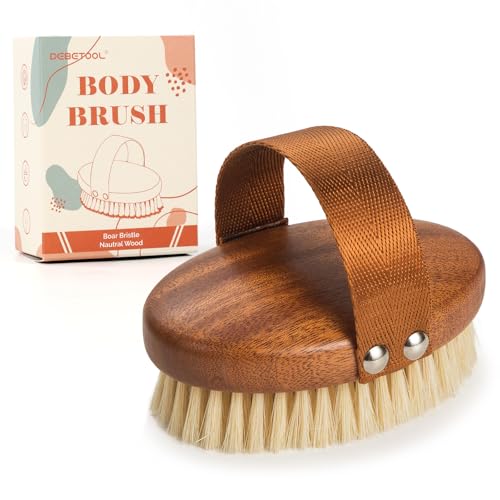


If you only CHOOSE ONE: DEBETOOL Dry Brush — the affordable foundation tool everyone should start with.
Why Your Lymph Slows Down in the First Place
Supplements and tools support drainage. But if your daily toxic load is high — fragranced laundry, chlorinated water, processed food, plastic exposure, mold — lymph keeps refilling no matter what you take or use. The Toxic Load Self-Assessment scores your daily exposures across 6 categories and gives you a personalized reduction plan in the order that matters most.
Build My Toxic Load Score →The tools worth owning
Most people only need one or two. A gua sha stone rules the face; a natural-bristle dry brush rules the body; a jade roller is a gentle daily option; and a wooden roller adds deeper sweeping for legs and arms. Gadgets and electric devices are optional — the simple tools, used consistently, do the work.
Here’s the bigger picture most articles skip: these methods move fluid and ease puffiness, but if your body keeps holding water and feeling sluggish, something upstream is driving it. For a lot of people that’s an everyday toxic load — the steady pull of processed food, plastics, and low movement on the lymphatic system.
What’s keeping your lymph backed up?
How to use each one
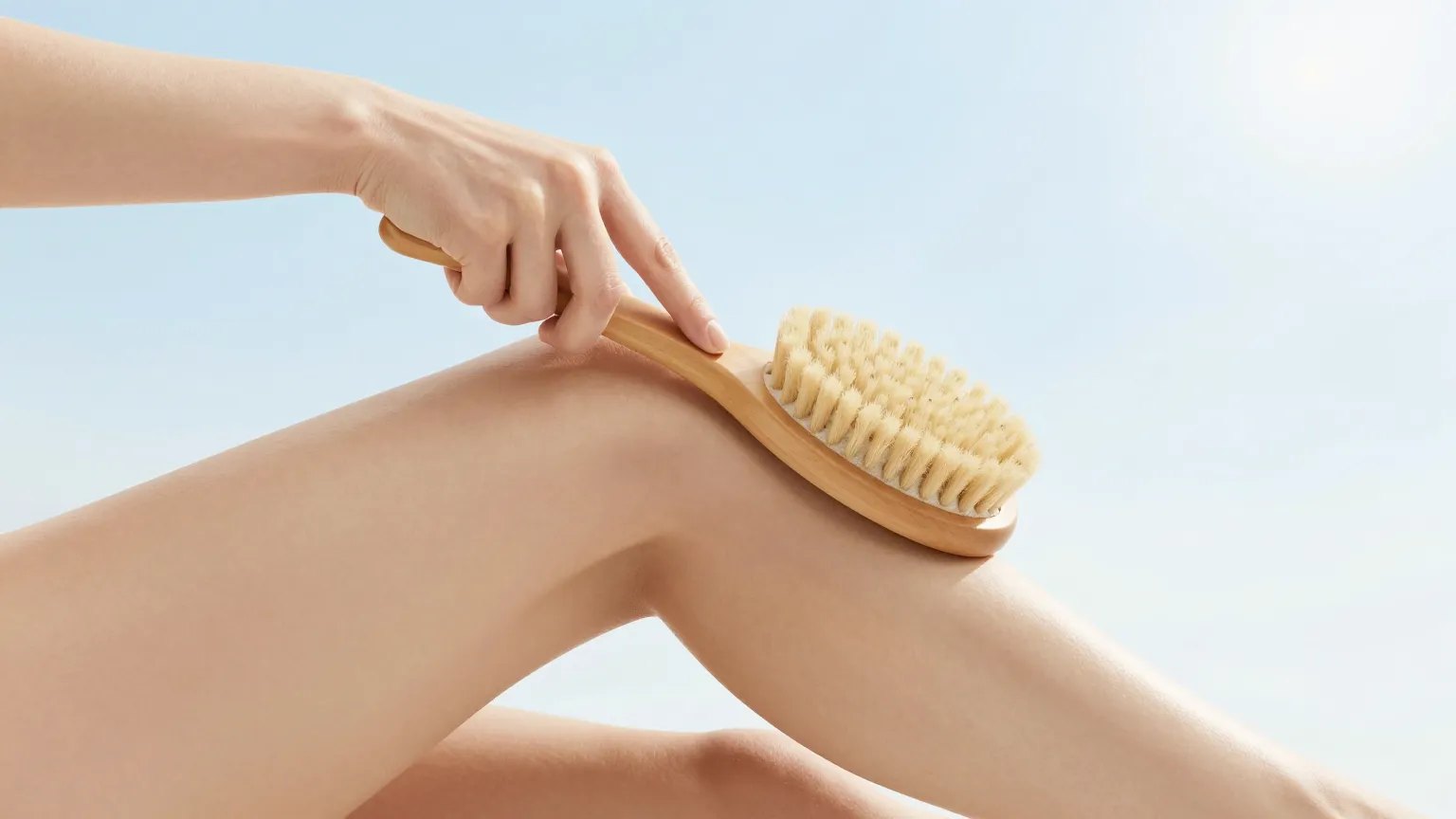
The golden rules apply to every tool: feather-light pressure (lymph sits just under the skin), always move toward the nearest lymph nodes, and open the neck and collarbone first. For the face, glide with oil; for the body, dry brush upward before a shower. Five consistent minutes beats an occasional heavy session.
What the research says
Based on articles retrieved from PubMed, here is what supports using these tools:
Gua sha measurably boosts circulation
A study using laser Doppler imaging found gua sha produced a fourfold rise in local microcirculation that stayed elevated for the full 25-minute window — why skin looks flushed and refreshed after (Nielsen et al., Explore 2007; DOI: 10.1016/j.explore.2007.06.001).
The drainage principle is real
The fluid-moving these tools assist is the same mechanism shown to reduce swelling in clinical manual lymphatic drainage (Guney-Deniz et al., Physiotherapy Theory and Practice 2022; DOI: 10.1080/09593985.2022.2044422). Tools simply make the strokes easier to do well.
Frequently asked questions
What is the best lymphatic drainage tool?
For the face, a gua sha stone; for the body, a natural-bristle dry brush. Most people only need one or two tools used consistently.
Do lymphatic drainage tools work?
They help when used correctly — light pressure, toward the lymph nodes. Gua sha is even measured to boost local circulation. They assist technique; they don’t replace it.
Gua sha vs. jade roller — which is better?
Gua sha gives more sculpting and drainage; a jade roller is gentler for daily, sensitive-skin use. Many people own both.
How often should I use them?
Daily is fine if you’re gentle. Dry brush before showers; gua sha in the morning. Consistency matters more than intensity.
This article is for general education and isn’t medical advice. See a clinician for persistent, painful, or one-sided swelling, which can signal lymphedema, infection, a clot, or a heart/kidney issue.
The 5 Lymphatic Tool Categories That Have Evidence
1. Dry Brushing (The Foundation Tool)
Boar-bristle dry brush, used on dry skin before showering, with strokes always toward the heart. Affordable, no batteries, no technique to master beyond direction. Wakes up surface lymph and exfoliates dead skin so subsequent body care absorbs better. Daily use, 3-5 minutes total. The compounding effect over weeks is what people notice — less puffiness on awakening, smoother skin texture, the ankles feel less heavy by mid-afternoon.
2. Gua Sha and Jade Rollers (Face and Neck)
Ahn et al. 2025 (DOI) ran an 8-week RCT comparing the two: gua sha significantly reduced facial muscle tone (-2.02 Hz oscillation frequency, p<0.001), while jade roller significantly improved skin elasticity (R2: +8.6%, R7: +7.5%, p<0.001). Both improved measurable facial contour. Translation: if your goal is jawline release and reducing tension lines, gua sha. If your goal is skin glow and elasticity, jade roller. If you want both, the BAIMEI combo set covers both at one price.
Technique: never use either on dry skin. Apply a facial oil first. Always stroke UPWARD and OUTWARD: chin to ear along jawline, brow to hairline, nose to temple. 5-8 minutes per session, 3-4 sessions per week minimum.
3. Wood Therapy and Body Rollers (Cellulite + Deep Tissue)
Brazilian-style wood therapy (madeotherapia) uses contoured wooden tools to manually break up adipose fibrosis and stimulate deeper lymphatic drainage than a brush can reach. Used in Brazilian massage studios for decades. The cup-shaped roller addresses cellulite directly; the long roller drives upward lymphatic flow along legs and arms. Use with body oil for glide. 10-15 min per session, 3-4x weekly. Best paired with vibration plate as a warmup.
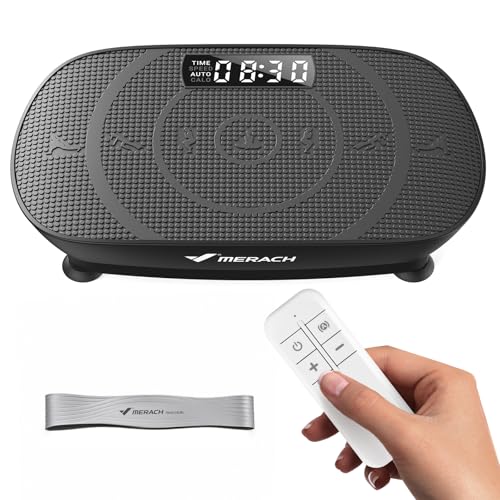
4. Vibration Plates (Whole-Body Fluid Mobilization)
Whole-body vibration (WBV) at 20-30 Hz stimulates muscle contraction at frequencies you cannot replicate voluntarily. Per Mahbub 2020 (DOI), even 1-minute exposures at 20 Hz significantly improved dorsal foot skin blood flow in older adults. The vibration drives the calf-muscle pump (the secondary lymph engine per Frankel & McLeod 2005). 5-10 minutes daily covers most users. Skip if pregnant, severe osteoporosis, or recent abdominal surgery.
5. Rebounders (Vertical Bouncing)
Mini-trampolines are a category unto themselves — we cover them fully in our rebounding for lymphatic drainage at home article including the Build My Rebounding Routine tool. Short version: vertical acceleration and deceleration creates a gravity-shift effect that opens and closes one-way lymphatic valves throughout the body. 5-10 minutes daily delivers measurable results within 2-3 weeks.
What the Top-Ranking “Best Lymphatic Tools” Articles Skip
Most ranking articles read like a product roundup. Here is what they miss:
- Direction of strokes ALWAYS matters more than the tool itself. Toward the heart, away from the body’s midline, never against the natural drainage current. A perfect tool used wrong does nothing.
- The “do I really need this” question deserves an answer. Reddit’s r/beauty thread on whether lymphatic tools are even necessary ranks in the top 10 because nobody else is willing to address it. Plain position: no, you do not NEED a tool — manual hand strokes work. But tools provide consistency, depth, and a tactile cue that builds the daily habit.
- Tool + supplement + movement stack outperforms any single intervention. The pillar guide covers the integrated daily protocol — this article covers the tool layer specifically.
- Tools without contraindication lists are dangerous. Acute lymphedema, recent surgery, active eczema, pregnancy, severe osteoporosis — each has its own no-go list. Section above covers them.
Tool Care: Make Them Last 5+ Years
Dry brushes: never wet them. Tap bristles after each use to dislodge skin flakes. Wash with mild soap once monthly, air-dry bristles-down. Replace every 12-18 months when bristles soften.
Gua sha stones and jade rollers: rinse with water and mild soap after each use, dry with a soft cloth. Store in the original silk pouch or a clean drawer. Genuine stones last forever; resin “jade” rollers wear within 12-18 months.
Wood therapy tools: wipe with damp cloth, air-dry completely (mold loves wet wood), oil the wood every 2-3 months with food-grade mineral oil to prevent cracking.
Vibration plates: keep on a stable, level floor (not carpet directly — use a yoga mat underneath if needed for stability). Wipe down motor housing weekly. Check the motor warranty — the cheap plates burn out at 12-18 months.
- Ahn et al. 2025 — RCT (n=34, 8 weeks): gua sha significantly reduced facial muscle tone and dynamic stiffness; jade facial roller significantly improved skin elasticity. J Cosmet Dermatol. DOI
- Mahbub et al. 2020 — Whole-body vibration at 20 Hz significantly increased dorsal foot skin blood flow in older adults — mechanism backing vibration-plate tools. Int J Environ Res Public Health. DOI
- Picelli et al. 2026 — Manual lymphatic drainage + adjunct modalities reduced upper-limb circumference at 7 of 9 anatomical sites in chronic post-mastectomy lymphedema. Minerva Med. DOI
- Donahue et al. 2023 — Lymphedema management review: confirms manual stimulation as core of standard care; supports the role of at-home tools as maintenance after professional MLD. Breast Cancer Res Treat. DOI
- Ezzo et al. 2015 (Cochrane) — Manual lymphatic drainage is safe and adds 7.11% volume reduction beyond compression bandaging in BCRL. Cochrane Database Syst Rev. DOI
- De Vrieze et al. 2017 — Fluoroscopy-guided MLD documents lymphatic transport responding to manual stimulation — the mechanism your tools mimic. Eur J Obstet Gynecol Reprod Biol. DOI
- Frankel & McLeod 2005 — Calf-muscle pump stimulation enhances skeletal muscle pump activity in the lower limbs, improving lymphatic flow — mechanism backing vibration-plate use. Surg Technol Int. PMID 16525986
- Yin et al. 2025 — Home exercise + tool-based movement program cut BCRL incidence from 34.62% to 7.69% in 104 post-surgical breast cancer patients. Front Oncol. DOI


