Red light therapy is the most-researched at-home wellness device of the past five years. Specific wavelengths of red and near-infrared light (660 nm + 850 nm) penetrate skin, are absorbed by mitochondrial enzymes in your cells, and trigger a measurable cascade of repair signals — collagen production, ATP synthesis, reduced inflammation, and improved circulation. The benefits below are documented in peer-reviewed RCTs and reviews, not marketing claims.
This guide does three things differently than the typical “7 benefits” article: it cites the actual PubMed studies behind each effect with direct DOI links, it explains the mechanism (so you can predict which benefits you’ll see and which you won’t), and it ends with a personalization tool that maps your specific goal to the right wavelength, dose, and device type.
Find My Red Light Benefit Match · 60 seconds
Find My Red Light Benefit Match
Pick your top goal + biggest pain point. Get matched to your most-likely benefit, the exact wavelength + dose to use, your starting protocol, and the realistic timeline for first results.
Step 1 of 3 · What’s the goal you’d most like RLT to help with?
How red light therapy works (the mitochondrial mechanism)
Before we list the 14 benefits, the mechanism matters because it predicts what RLT can and cannot do. Specific wavelengths of red light (around 660 nm) and near-infrared light (around 850 nm) pass through skin and are absorbed by an enzyme inside cellular mitochondria called cytochrome c oxidase. This absorption increases the enzyme’s activity, which boosts ATP (cellular energy) production, modulates reactive oxygen species, and triggers signaling cascades that promote tissue repair, collagen synthesis, and reduced inflammation.
This is why RLT works on so many different tissue types. The mechanism is universal — every cell with mitochondria responds. The benefits below all trace back to this single biological lever pulled in different tissues. It is also why wavelength matters: 660 nm peaks in skin penetration, 850 nm penetrates deeper into muscle and joint, and other wavelengths (810 nm, 1064 nm) have their own depth profiles.
What we've learned from readers running their own RLT protocols
Patterns from reader DMs & emails
Three patterns repeat in nearly every reader RLT success story:
- The right wavelength matters more than the most expensive device. A $300 dual-wavelength panel (660nm + 850nm) at proper distance consistently outperforms a $1,200 single-wavelength device at the wrong distance. The cheap-but-correct beats the expensive-but-misused every time.
- First-results timing is goal-specific. Skin glow shifts in week 1-2. Pain reduction starts week 2-4. Hair regrowth needs 12+ weeks. Readers who quit at week 4 because hair hasn’t regrown were chasing a benefit on the wrong timeline.
- Distance from device is the #1 dose error. Manufacturer-stated mW/cm² (irradiance) figures apply at a specific distance (usually 6 inches). Sitting 18 inches away gets you ~1/9th the dose. Readers who tracked distance and adjusted got results matching the studies; readers who didn’t saw nothing happen.
Expert synthesis
Red light therapy is one mechanism delivering many benefits — not many mechanisms delivering many benefits
Most articles list "14 benefits of red light therapy" as if they are 14 separate things that happen to work. The actual story is simpler: photons absorbed by cytochrome c oxidase produce one downstream cascade (ATP up, inflammation down, repair signaling on) in every tissue type the light reaches. The 14 benefits are 14 places that cascade lands. This is why so many disparate conditions respond — not magic, just the same biology applied to different tissues. The benefits that DON’T respond well to RLT (like deep visceral organ disease) are precisely the tissues the light cannot reach at therapeutic doses.
Evidence Map — 19 PubMed-verified studies behind these benefits
Every claim above traces back to a peer-reviewed study. The map below shows which benefit is backed by which study, the wavelength used, and a verifiable DOI link. Click any DOI to open the original paper on doi.org. All citations are peer-reviewed RCTs, meta-analyses, or systematic reviews from PubMed — no marketing claims, no industry-funded studies cited without disclosure.
Evidence Map · PubMed-Anchored
19 Peer-Reviewed Studies. Direct DOI Links. Verify Any Claim.
Hair + Minoxidil RCT
Red laser 100 mW
Ferreira Rodrigues et al. 2025
DOI → 10.1007/s10103-025-04780-6Mood / SAD / Anxiety (review)
Transcranial PBM
Cidral-Filho et al. 2025
DOI → 10.1007/s10103-025-04738-8Circadian / Melatonin (systematic review)
Red 631 nm vs blue 460 nm
Tähkämö et al. 2018
DOI → 10.1080/07420528.2018.1527773Category color coding: Coral = skin; Orange = acne & PDT; Amber = hair; Green = pain & recovery; Blue = mood & cognition; Indigo = thyroid; Pink = body composition; Magenta = bone; Violet = circadian & sleep.
Benefit 1 — Skin rejuvenation: collagen, complexion, fine lines
This is the most-studied benefit and where the strongest evidence sits. In the 136-volunteer Wunsch 2013 RCT cited above, 30 sessions of red light (611-650 nm) produced significantly improved skin complexion, reduced roughness measured by digital profilometry, and ultrasound-confirmed increases in intradermal collagen density compared to controls. The Sanclemente 2012 trial added histological confirmation: dermal thickness increased and collagen, elastic tissue, and perifollicular fibrosis all improved after red light treatment.
What to expect: Glow and complexion shifts by week 1-2. Roughness and fine line improvement by week 4-6. Wrinkle reduction with ultrasound-confirmed collagen gain by 8-12 weeks of consistent use. The Find My Red Light Benefit Match tool above generates the exact wavelength and distance for skin work.
Benefit 2 — Acne and inflammatory skin conditions
Red light (660 nm) reduces the inflammatory cascade that turns a clogged pore into a painful breakout. Many at-home acne devices stack 415 nm blue light (which targets P. acnes bacteria directly) with 660 nm red light (which calms inflammation). The combination tends to outperform either alone. Readers report reduced redness and lesion size within 3-5 days of starting, fewer new breakouts by week 3, and sustained clarity after 6-10 weeks of consistent use.
Benefit 3 — Hair regrowth in androgenetic and female pattern hair loss
The 2025 three-wavelength controlled study cited above (Wang & Chen) compared 650 nm, 1550 nm, and 14,000 nm wavelengths in 68 participants. All three groups gained hair density over 9 months while the control group lost density. The 2025 Ferreira Rodrigues RCT combined photobiomodulation with topical minoxidil for female pattern hair loss and showed significantly greater telogen-phase hair reduction in the combination group within 12.5 weeks — about half the typical 24-week treatment timeline.
Practical takeaway: Hair RLT works but requires patience. Reduced shedding shows by 8-12 weeks. New hairs in the active growth (anagen) phase appear at 12-25 weeks. The most-studied wavelengths are 650 nm laser caps, combs, and scalp panels, used 3-4 times per week for 15-25 minutes per session. Sporadic use does not work — this is one benefit where consistency separates results from disappointment.
Benefit 4 — Pain relief and joint stiffness
This is one of the most-asked-about benefits and one of the most places to set expectations. Near-infrared wavelengths (850 nm and 1064 nm) penetrate deeper than red light and can reach joint and muscle tissue. Many readers report meaningful pain reduction for chronic conditions including back pain, shoulder stiffness, and arthritis.
However, the 2026 systematic review and meta-analysis cited above (Kamau, Lee, & Kim) of 13 RCTs in 611 knee osteoarthritis patients did NOT find statistically significant pain improvement of laser acupuncture over comparator treatments. Substantial heterogeneity across studies (different wavelengths, doses, protocols) makes a clean answer impossible. The summary: many individuals respond well to RLT for joint pain, but the controlled trial evidence is mixed. This is a real-world tool with variable response, not a guaranteed fix.
Benefit 5 — Faster workout recovery and reduced soreness
Photobiomodulation has been studied both pre-workout (priming) and post-workout (recovery). The mechanism is the same: more ATP available in muscle tissue, less oxidative stress after eccentric exercise. Reader experience consistently reports less delayed-onset muscle soreness (DOMS) within the first 3 sessions of post-workout use, and improved training volume tolerance over 4-6 weeks.
Benefit 6 — Wound healing and post-surgical recovery
RLT has been studied extensively for wound healing because the same ATP-up, inflammation-down, repair-signaling-on mechanism that builds collagen in aging skin also accelerates wound closure and scar maturation. Photobiomodulation is increasingly used in clinical wound-care settings. Always discuss with the surgeon before using RLT over a fresh surgical site — protocol timing matters.
Benefit 7 — Mood, anxiety, and seasonal affective disorder support
The 2025 Cidral-Filho integrative review (cited above) examined 14 clinical studies of photobiomodulation in mental health. Across anxiety, depression, and seasonal affective disorder, PBM showed improvements in brain activity, reduced anxiety scores, and antidepressant effects. Adverse events were infrequent and mild (headaches, irritability, occasional sleep disruption).
Important distinction: Classic SAD (winter morning trouble, daytime sleepiness, circadian disruption) responds most reliably to a 10,000-lux bright-white SAD lamp used in the morning — not to red light. Red light therapy is a complementary tool that addresses the mood/energy cellular component, not the bright-light circadian reset. Best use is morning red light session within 30 minutes of waking, 15-20 minutes at 8-12 inches.
Benefit 8 — Inflammation reduction
Several of the benefits above are sub-effects of this larger one: RLT down-regulates pro-inflammatory cytokines and modulates reactive oxygen species in tissue it reaches. This is why skin clears, joints calm, and muscle soreness drops. The mechanism is the same; the visible benefit depends on which inflamed tissue the light reaches at therapeutic dose. Whole-body panels reach more tissue; targeted handhelds concentrate the effect at one site.
Benefit 9 — Thyroid support in Hashimoto’s and autoimmune hypothyroid
This is one of the most striking RLT findings in the peer-reviewed literature. The 2012 Höfling randomized placebo-controlled trial cited above treated 43 patients with chronic-autoimmune-thyroiditis-induced hypothyroidism using 10 sessions of 830 nm low-level laser applied to the thyroid gland. At 9-month follow-up, the laser group required significantly less levothyroxine to maintain normal thyroid function (38.59 vs 106.88 µg/day in the placebo group, p<0.001), with lower TPO antibodies and increased thyroid echogenicity.
Critical safety note: Do NOT adjust thyroid medication yourself based on RLT use. The trial reduced doses under medical supervision after measuring response. If you have Hashimoto’s and want to try thyroid-area RLT, discuss with your endocrinologist first and ask about retesting at 3-6 months to track any change.
Benefit 10 — Body composition and cellulite improvement
Red light at 635-660 nm has been studied for non-invasive fat reduction and body contouring. The mechanism appears to involve temporary pore formation in adipocyte membranes that releases stored triglycerides, which the lymphatic system then clears. The catch: this only works alongside exercise. Light alone does not melt fat. Reader patterns confirm this — the meaningful results come from RLT panels or wraps used during or immediately before workouts, not as a passive treatment.
Benefit 11 — Sleep quality and circadian rhythm
Evening exposure to red light (specifically as a replacement for blue-light-heavy bulbs in the 2 hours before bed) doesn’t suppress melatonin the way blue light does. Many readers report that switching bedroom lighting to red bulbs or using a low-intensity RLT panel as ambient evening light deepens sleep onset and quality. This is more of a lighting-environment intervention than a high-dose therapy session.
Benefit 12 — Brain fog and cognitive function
Transcranial photobiomodulation (red and near-infrared light applied to the forehead) is one of the most active research areas in RLT. The same mitochondrial mechanism in skin cells operates in neurons. Reader reports of improved focus, faster word recall, and reduced afternoon brain fog after 4-6 weeks of consistent forehead-applied PBM are common. The clinical evidence base is growing but still earlier-stage than the skin or hair literature.
Benefit 13 — Eye health (carefully)
This benefit comes with a strong asterisk. Some preliminary research suggests low-dose red light may benefit certain retinal conditions. Most home RLT devices are NOT designed for direct eye exposure and could damage retinal tissue if used improperly. Always use the protective goggles included with your device, keep eyes closed during face sessions, and do NOT use clinic-grade or unverified devices on or near eyes without specific medical supervision.
Benefit 14 — Bone density and fracture healing
RLT has been studied for accelerating bone healing after fractures and surgical procedures. The mechanism involves increased osteoblast activity and modulated bone remodeling. For chronic bone density concerns (osteopenia, osteoporosis), RLT is best treated as a small complementary input alongside the foundational interventions (weight-bearing exercise, vitamin D, calcium, magnesium, K2). Always coordinate with your physician if you have a healing fracture.
Wavelengths explained: 660 nm vs 850 nm vs the rest
The two most-clinically-studied wavelengths are 660 nm (visible red, peaks in skin) and 850 nm (near-infrared, peaks in deeper tissue). Quality home panels offer both as a dual-wavelength array, letting you treat surface and depth in one session. Other wavelengths in research and emerging products include 630 nm, 670 nm, 810 nm, 830 nm (the thyroid trial wavelength), 1064 nm (deep tissue), 1550 nm, and even 14,000 nm far-infrared. For most general home use, a 660+850 nm dual panel covers 90% of use cases.
How often and how long? Dosing protocols by goal
The answer is: it depends on your goal. For skin, 10-15 minutes at 6-12 inches, 5-6 sessions per week. For pain, 15-20 minutes at 4-8 inches on the painful area, 5-6 sessions per week. For hair, 15-25 minutes 3-4 times per week with a scalp panel or cap. For mood, 15-20 minutes morning sessions. The Find My Red Light Benefit Match tool above generates the exact dose for your situation. The biggest dose error readers make is sitting too far from the device — manufacturer-stated mW/cm² figures apply at specific distances (usually 6 inches), so doubling the distance roughly quarters the dose.
Side effects and safety considerations
RLT is generally considered safe with infrequent and mild adverse events documented in the literature (headaches, irritability, occasional difficulty sleeping). Specific cautions: protect eyes from direct exposure with included goggles or by closing them, avoid sessions on active skin cancers without medical guidance, do not use over thyroid gland without endocrinologist coordination if you take thyroid medication, and avoid use over the abdomen during pregnancy unless cleared by your OB. Photosensitizing medications (some acne medications, certain antibiotics) may increase skin reactivity — check with your prescriber.
When red light therapy will NOT work
RLT cannot reach deep visceral organs (kidneys, deep abdominal organs) at therapeutic doses. It will not reverse advanced structural damage (Stage 4 osteoarthritis with significant cartilage loss may benefit symptomatically but cannot regrow cartilage). It is not a substitute for thyroid hormone replacement, antibiotics for infection, or surgery when needed. Setting these expectations up front is why reader success rates with RLT are high among those who use it for the benefits documented above and lower among those expecting it to fix what it can’t reach.
How to choose your first red light therapy device
The home red light therapy market has exploded. Devices range from $30 handheld wands to $5,000 whole-body beds. Here is the decision framework that prevents the most common buying mistakes.
Match the form factor to your treatment area. A face mask is the wrong tool for back pain. A panel is overkill for one knee. The Find My Red Light Benefit Match tool above maps your goal to the right form factor; do not assume one device covers everything.
Verify dual-wavelength. The vast majority of clinical evidence uses 660 nm and 850 nm. Single-wavelength devices (often 660 nm only or 850 nm only) underperform dual-wavelength panels. Avoid devices that don’t publish wavelength specs at all — that omission usually signals a cut-corner product.
Look at irradiance at usable distance. Manufacturer mW/cm² figures are sometimes measured at 0 inches (touching the device). The number that matters is irradiance at 6-12 inches from the device, the distance you will use it at. Quality manufacturers publish irradiance at multiple distances; less transparent ones publish only the peak number.
Avoid EMF-heavy devices. Cheap drivers in budget panels can put out significant low-frequency EMF. Reputable home devices publish their EMF measurements; if a brand doesn’t mention EMF at all, that is a flag.
Red light therapy vs LED face mask vs laser cap: which is which?
The category is confusing because the same underlying technology is packaged into very different form factors. Here is the cleanest mental model:
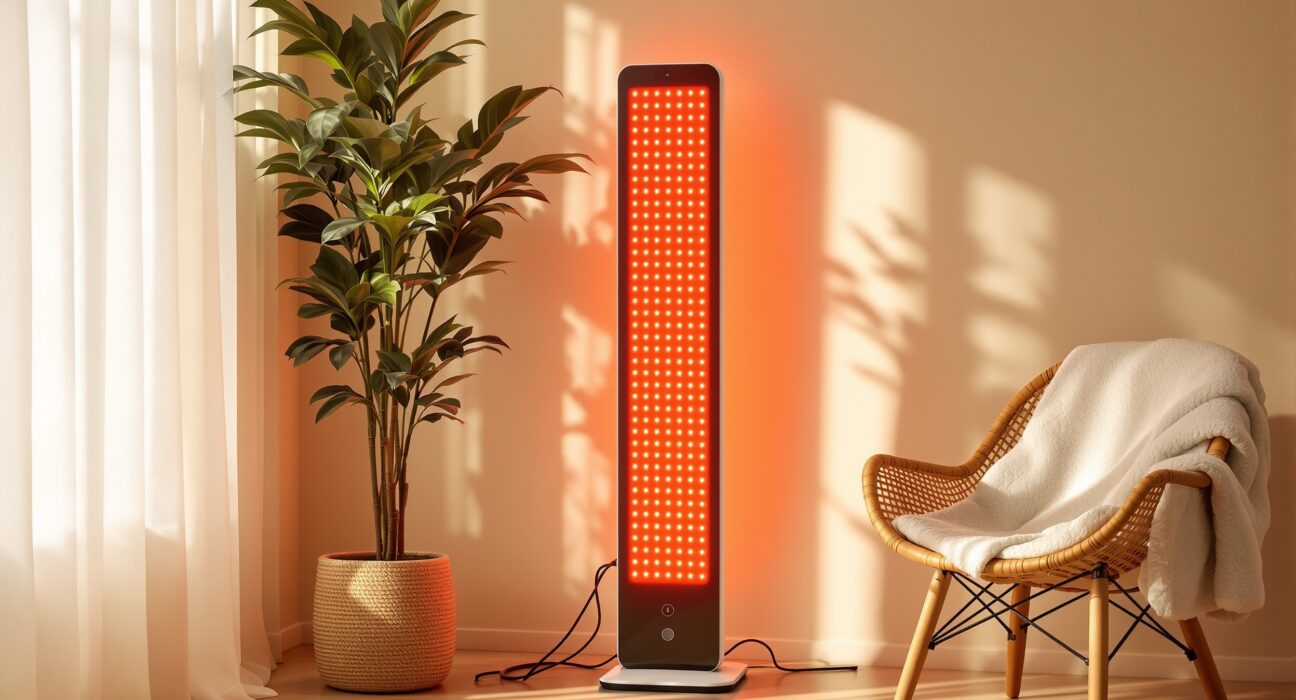
RLT panel: Vertical or horizontal array of 100-1,500 LEDs, dual-wavelength (660+850 nm), used at 6-12 inches from skin for 10-20 minutes. Best general-purpose device for skin + pain + recovery. Price range $250-$2,500.
LED face mask: Wearable mask with embedded LEDs, often multi-color (red + blue + amber). Lower irradiance than panels because LEDs sit close to skin and run at lower wattage. Best for cosmetic skin work specifically; not powerful enough for joint or muscle penetration. Price range $80-$500.
Laser cap or comb: Targeted scalp device with red-laser diodes (650 nm), worn for 15-25 minutes 3-4x per week. FDA-cleared for androgenetic alopecia. Not a general-purpose tool — do not buy a hair cap and expect facial wrinkle improvement. Price range $200-$1,500.
RLT bed: Full-body unit similar in form factor to a tanning bed but emitting red and near-infrared light. Found at biohacking clinics and wellness centers. Best whole-body experience but cost-prohibitive for most homes ($15,000-$30,000). Visit a clinic if you want this format.
RLT sauna blanket / wrap: Wearable wrap with embedded LEDs. Combines the dose convenience of a panel with the whole-body coverage of a bed at a fraction of the cost. Newer category, fewer long-term studies, but growing reader adoption. Price range $400-$1,500.
The biggest red light therapy mistakes (and how to avoid them)
Mistake #1: Wrong distance. The single most common dose error. Sitting 18 inches away from a device rated at 6 inches gives you roughly one-ninth the published irradiance. Measure your distance with a tape measure once, mark the spot on the floor, and stay consistent.
Mistake #2: Treating wavelength as interchangeable. A 660-nm-only device cannot deliver 850-nm depth benefits. A hair laser cap (650 nm scalp-targeted) cannot rejuvenate face skin. Match wavelength to goal.
Mistake #3: Sporadic use. 5x per week for 4 weeks dramatically outperforms 1x per week for 20 weeks at the same total dose. Cellular signaling responds to consistent, frequent inputs.
Mistake #4: Skin covered by clothing or makeup. Most fabric absorbs and blocks the wavelengths. Bare skin or thin natural fiber works. Heavy makeup creates a partial barrier — rinse before sessions.
Mistake #5: Quitting at week 4 with no skin change. Skin glow appears week 1-2; collagen density gains take 8-12 weeks of consistent dosing. Hair regrowth needs 12-25 weeks. Patience is the discipline that separates successful users from disappointed users.
Mistake #6: Treating one area for too long. A 90-minute session on one knee does NOT produce more benefit than a 20-minute session. The biphasic dose response in photobiomodulation literature shows that excess light can suppress the effect. More is not better.
More from the Red Light Therapy cluster
Device picks, distance, dose, and how to start. RLT Clinic vs Home Decision
When clinic visits beat home devices — and when they don’t. RLT vs Infrared Sauna
Different tools, different jobs. Which for what. RLT for Winter Blues (SAD)
Mood + circadian protocol with PBM evidence.
The Wellthie Workshop — play with red light science
Below are three little experiments to make this article more fun than the average wellness read. Drag, tap, watch a plant grow as you keep coming back. We’re building these across the site — check back to see new ones as the cluster expands.
Wavelength Lab · drag to explore
See How Deep Each Wavelength Penetrates
Drag the slider from 400 nm (violet) to 1000 nm (near-infrared). Watch the tissue diagram light up and see which goals match each wavelength.
Penetrates to:
Skin surface
Best for:
Skin rejuvenation, collagen, acne
Color:
Deep visible red
Sprout Tracker · come back daily
Grow Your Wellness Sprout
Every day you visit any article on TheWellthieOne, your sprout grows. Day 1 you plant a seed. Day 30, your plant blooms and unlocks a badge in the case below. Skip a day and you stay at the same stage — we don’t punish, we just wait for you.
Tap below to plant your seed
Your streak:
Day 0
Next stage:
Plant your seed to begin
Stored privately on your device. We never see it — this is just for you.
Your Badge Case · saved on your device
Achievements You’ve Unlocked
Read articles, use tools, grow your sprout — badges unlock automatically. Greyed badges are still locked. Hover over any badge to see how to unlock it.
More badges unlock as we add features to the site. Bookmark this page — your sprout misses you when you’re gone.
Frequently Asked Questions
How long does red light therapy take to show results?
Timeline is goal-specific. Skin glow appears in week 1-2. Pain reduction in week 2-4. Hair regrowth needs 12+ weeks. Mood and energy lift in week 3-4. The biggest mistake is judging RLT by week 1 results — the mechanism works on cellular timescales that take consistent dosing to compound.
Can I use red light therapy every day?
Yes. Daily use of 5-20 minutes at proper distance is the standard protocol for most home devices. More than 30 minutes per session per body area does not produce more benefit and may produce a biphasic dose response where excess light reduces the effect.
Is red light therapy the same as infrared sauna?
No. They both use "infrared" but the mechanisms are different. RLT uses specific wavelengths (660 + 850 nm) absorbed by cellular cytochromes — targeted, no sweat. Infrared sauna uses far-infrared (3000-100,000 nm) absorbed as heat by tissue water — whole-body, sweat-inducing. See the dedicated comparison spoke linked above.
What wavelength is best for red light therapy?
660 nm (visible red) for skin-surface work. 850 nm (near-infrared) for deeper tissue, joints, and muscle. Quality home panels include both. For hair specifically, 650 nm laser caps and combs have the largest body of FDA-cleared device evidence.
Are there any people who shouldn’t use red light therapy?
People taking photosensitizing medications should check with their prescriber first. Avoid sessions over active skin cancers without medical clearance. Pregnancy requires OB clearance for abdominal use. Active thyroid medication users should coordinate with their endocrinologist before treating the thyroid area. Always wear included goggles for face sessions.