
Lymphatic drainage supplements work when they target a specific job and run on a short, intentional cycle — not as a daily “lymph tonic” you take forever. The four categories that have evidence behind them are proteolytic enzymes (serrapeptase, nattokinase) for swelling and stagnation, traditional lymph herbs (cleavers, red root, calendula) for everyday puffiness, immune-support botanicals (echinacea, elderberry, dandelion) for cold-season use, and nothing else. The Find My Lymphatic Supplement Match tool right below this intro asks two questions and routes you to the right pick with dose, duration, and stack-with notes.
Per the Tamimi 2021 RCT in BMC Oral Health (DOI), serrapeptase significantly reduced trismus and swelling vs placebo over 5 post-surgical days — the strongest single-supplement evidence we have for any lymph-adjacent product. For day-to-day puffiness, herbal blends like cleavers and red root remain the traditional pick because they are gentle, taste of nothing notable, and produce mild diuretic effects without the harsh edge of pharmaceutical diuretics.
For the complete at-home lymphatic drainage protocol with 5 body-area diagrams and 45 cited studies: How to Do Lymphatic Drainage Massage at Home →
Sister read: Find your matched lymphatic drainage tool (face / body / legs) →
Two picks → matched herb or enzyme for your specific drainage goal, with duration and stack-with notes.
Goal STEP 2
Use Style
Drainage Pathway Activation Checklist
Printable one-pager: the exact daily order to wake up your 5 drainage pathways (bowels, kidneys, skin, lungs, lymph) so supplements and tools work.
5 Tested Lymphatic Drainage Supplements (Each for a Different Job)
Each pick is a different use case. Pictures and buttons both clickable.


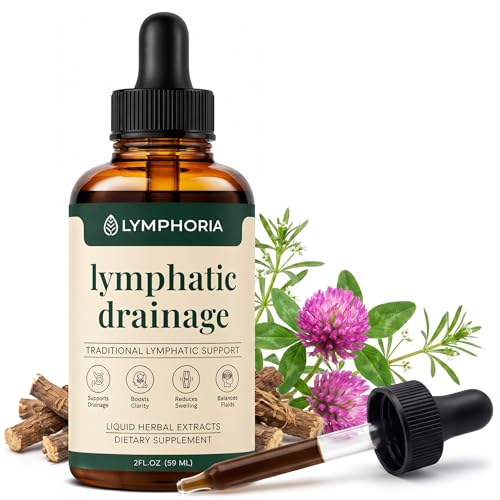


If you only CHOOSE ONE: LYMPHORIA Drops — the most versatile multi-herb blend for everyday puffiness.
Why Your Lymph Slows Down in the First Place
Supplements and tools support drainage. But if your daily toxic load is high — fragranced laundry, chlorinated water, processed food, plastic exposure, mold — lymph keeps refilling no matter what you take or use. The Toxic Load Self-Assessment scores your daily exposures across 6 categories and gives you a personalized reduction plan in the order that matters most.
Build My Toxic Load Score →What moves your lymph
Your lymphatic system has no pump — it relies on muscle movement, deep breathing, hydration, and manual techniques like massage and dry brushing. That’s why walking, rebounding, drinking water, and lymphatic massage do far more than any capsule. No supplement replaces those.
Here’s the bigger picture most articles skip: these methods move fluid and ease puffiness, but if your body keeps holding water and feeling sluggish, something upstream is driving it. For a lot of people that’s an everyday toxic load — the steady pull of processed food, plastics, and low movement on the lymphatic system.
What’s keeping your lymph backed up?

So do the supplements do anything?
A few have a plausible, gentle role: mild herbal diuretics (like dandelion) may slightly reduce water retention, and traditional ‘lymph’ herbs like cleavers are long-used though under-studied. Treat them as small, optional support — not a fix — and be skeptical of dramatic ‘detox’ claims.
What the research says
Based on articles retrieved from PubMed, here’s the clear-eyed evidence picture:
The proven therapies aren’t pills
What clinical medicine uses for lymphatic and fluid disorders is manual lymphatic drainage, compression, exercise and skin care — not supplements (Reich-Schupke et al., JDDG 2017; DOI: 10.1111/ddg.13036). And hands-on drainage is measured to reduce swelling (Guney-Deniz et al., Physiotherapy Theory and Practice 2022; DOI: 10.1080/09593985.2022.2044422).
Where supplements stand
There are few rigorous human trials on ‘lymphatic’ supplements specifically. That doesn’t mean they’re useless — just that the evidence is thin, and they should sit behind hydration, movement, and massage, not in front of them.
Frequently asked questions
Do lymphatic drainage supplements work?
There’s little direct evidence. Some act as mild diuretics or traditional ‘lymph movers,’ but hydration, movement, and massage do far more. Treat supplements as a minor, optional extra.
What is the best thing for sluggish lymph?
Movement (walking, rebounding), deep breathing, hydration, and lymphatic massage or dry brushing. These are free or cheap and far more effective than pills.
Are lymphatic drops safe?
Most gentle herbal blends are well tolerated, but quality varies and they can interact with medications. Check with your provider, especially if you take diuretics or BP meds.
Can a supplement ‘detox’ my lymph?
No — your body does that itself when hydrated, moving, and not overloaded. Be wary of dramatic detox claims.
This article is for general education and isn’t medical advice. See a clinician for persistent, painful, or one-sided swelling, which can signal lymphedema, infection, a clot, or a heart/kidney issue.
What Lymphatic Drainage Supplements Do (And What They Don’t)
Supplements support drainage. They do not replace it. Your lymphatic system has no pump of its own — it relies on muscle contraction, breathing, and manual stimulation to move fluid. A pill cannot replicate any of that. What a well-chosen supplement CAN do:
- Reduce fibrin buildup (serrapeptase, nattokinase) so lymph can flow through tissues where it has been stagnant per Chandanwale 2016 (DOI)
- Provide mild diuretic effect (cleavers, dandelion) to help kidneys process the fluid your lymph offloads to the bloodstream
- Support immune-tissue function (echinacea, elderberry, calendula) since lymph nodes are immune organs — useful in 7-14 day cold-flu windows
- Reduce post-surgical or post-injury edema when started within 24-48 hours of the inflammatory trigger
What supplements WILL NOT do: replace manual lymphatic drainage massage (per Picelli 2026 DOI and Donahue 2023 review at DOI, hands-on MLD remains standard of care for chronic lymphedema), replace movement (rebounding and walking are doing the actual pumping), or fix a high toxic load that is filling lymph back up faster than anything can clear it.
The 4 Lymphatic Supplement Categories That Have Evidence
1. Proteolytic and Fibrinolytic Enzymes
Serrapeptase (240,000 SPU is the standard high-potency dose) and nattokinase (4,000 FU servings) both break down fibrin — the protein scaffold that builds up in stagnant tissues and slows lymphatic transport. Tamimi 2021 (DOI) showed serrapeptase significantly reduced edema and trismus vs placebo over 5 post-surgical days. Take on an empty stomach (30 min before food or 2 hr after) so the enzymes are not used digesting your meal. Cycle: 30-60 days on, 14 days off.
2. Traditional Lymph-Moving Herbs (Cleavers, Red Root, Calendula)
Cleavers (Galium aparine) is the herbalist’s signature lymph mover — gentle, mild diuretic, traditional use spans centuries across European and Eastern systems. Red root (Ceanothus americanus) is the deeper-tissue partner often blended with cleavers for chronic lymphatic congestion. Calendula adds skin-and-lymph-node tissue support. Liquid tincture format absorbs faster than capsules and lets you adjust dose precisely. Typical course: 14 days on, 7 days off, repeat as needed.
3. Immune-Support Botanicals (Echinacea, Elderberry, Dandelion)
Lymph nodes are immune organs. During cold and flu seasons, supporting them with proven immune botanicals (echinacea for innate immunity, elderberry for antiviral support, dandelion for liver-and-kidney drainage that downstream supports lymph) makes biological sense. Use for 7-14 days at first sign of symptoms or known exposure, not as a daily lifelong tonic.
4. Movement-Adjacent Pairings (Magnesium, Vitamin C, Bromelain)
These are NOT lymph supplements per se but they support the systems lymph depends on. Magnesium glycinate at night helps muscle recovery so your calf-pump (the secondary lymph engine per Frankel & McLeod 2005) works tomorrow. Vitamin C supports collagen in lymphatic vessel walls. Bromelain is a pineapple-derived enzyme that pairs well with serrapeptase for layered anti-inflammatory effect.
Safety, Cycles, and What to Avoid
Stop and check with a clinician if: you take blood thinners (especially relevant for serrapeptase and nattokinase — they have mild antiplatelet effects), are pregnant or nursing, have a known bleeding disorder, or are scheduled for surgery within 14 days. Stop enzymes at least 14 days before any planned surgery.
Avoid the “lymph cleanse for 90 days straight” trap. No evidence supports that pattern. Short, targeted cycles (5-14 days for acute issues, 30-60 days for chronic stagnation) match how the body uses these compounds and avoid building tolerance or stressing detox pathways.
Avoid combining 4+ herbal supplements at once. Herbalists call this “kitchen sinking” — you cannot tell which one is working or which one is causing a reaction. Pick one or two from the widget result and run them for one cycle. Then assess.
- Tamimi et al. 2021 — Serrapeptase RCT (n=133): significantly reduced trismus and swelling vs placebo after impacted third-molar surgery over 5 days. BMC Oral Health. DOI
- Chandanwale et al. 2016 — Comparative RCT of proteolytic enzymes (serrapeptase, trypsin:chymotrypsin, bromelain): all significantly reduced post-orthopedic-surgery edema, with TC group showing best results. Advances in Therapy. DOI
- Picelli et al. 2026 — Manual lymphatic drainage + adjunct therapy reduced limb circumference at 7 of 9 anatomical sites in breast-cancer-related chronic lymphedema. Minerva Med. DOI
- Donahue et al. 2023 — Comprehensive lymphedema review: confirms complete decongestive therapy (including MLD) as standard of care; no pharmacological approaches yet proven for primary lymphedema. Breast Cancer Res Treat. DOI
- Yin et al. 2025 — Home exercise program (including lymphatic movement) reduced breast-cancer-related lymphedema incidence from 34.62% to 7.69% — relevant for “supplement plus movement” combination. Front Oncol. DOI
- Mahbub et al. 2020 — Whole-body vibration significantly improved dorsal foot skin blood flow in older adults — pair with vibration-plate tools (see Tools sister article). Int J Environ Res Public Health. DOI
- Ezzo et al. 2015 (Cochrane) — Manual lymphatic drainage is safe and adds 7.11% volume reduction on top of compression bandaging for breast-cancer lymphedema. Cochrane Database Syst Rev. DOI
- De Vrieze et al. 2017 — Fluoroscopy-guided MLD protocol: confirms lymphatic transport responds to manual stimulation guided by imaging — supports the case for hands-on tools alongside supplements. Eur J Obstet Gynecol Reprod Biol. DOI


