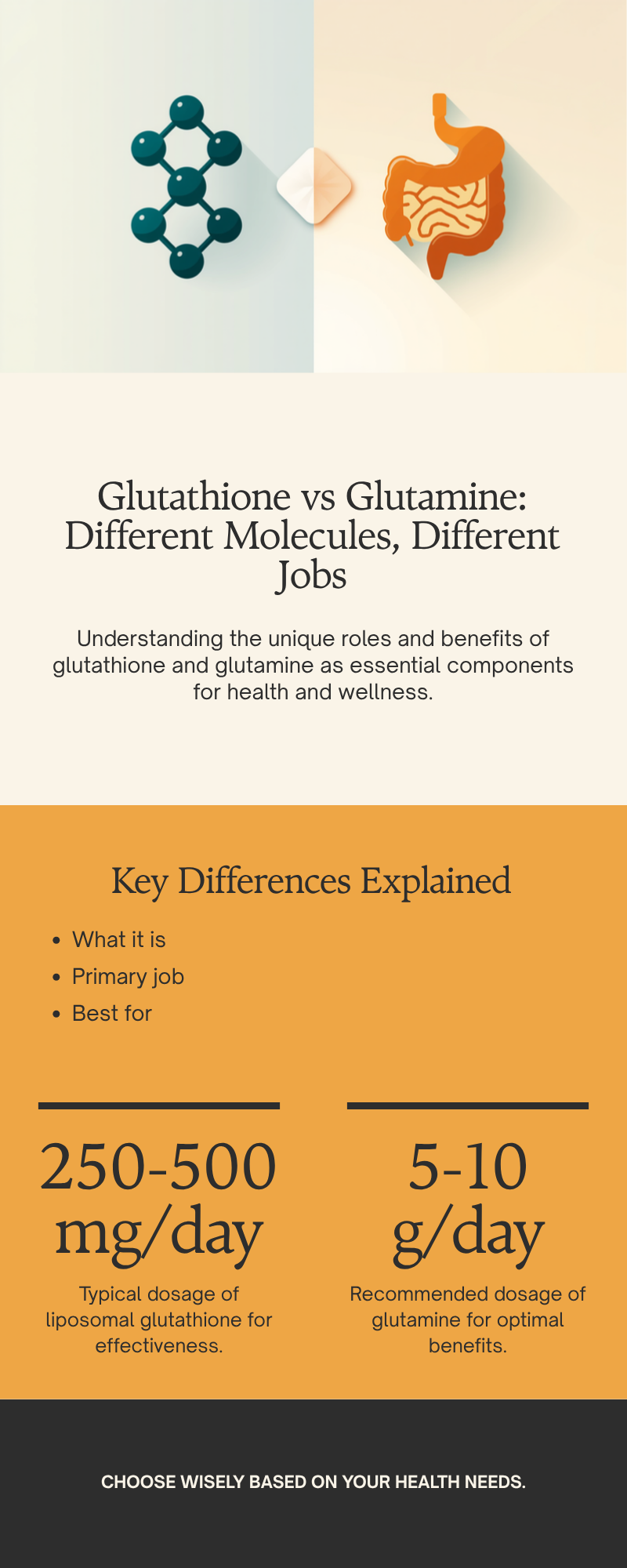
Glutathione vs glutamine. Both are amino-acid-based supplements with names so similar people regularly buy the wrong one. They’re completely different molecules that do completely different things in the body. Glutathione is a tripeptide and the body’s master antioxidant + detoxifier. Glutamine is a single amino acid and the body’s primary fuel for the gut lining + immune cells. Mixing them up means missing the result you came for.
Before stocking either supplement, the free 90-second Toxic Load Type Tool identifies whether your symptoms point toward toxic load (glutathione territory) or gut inflammation / overtraining (glutamine territory). Different protocols.
Glutathione Dose Calculator
Personalized mg/day + best form (IV vs liposomal vs oral vs patch vs injection).


The deeper pattern
Low glutathione almost always signals an upstream toxic-load problem.
Glutathione is the body’s master detoxifier — every Phase 2 liver pathway pulls from the same pool. When the burden is heavy (mold, heavy metals, plastics, chronic stress), the pool depletes faster than diet alone can rebuild. Supplementing glutathione directly without addressing what is draining it is like topping up a leaky tank.
The 90-second Toxic Load Tool maps which exposure is the biggest drain on your glutathione reserves right now.
The research on each molecule
- Glutathione for oxidative stress: Liposomal glutathione increases stores in healthy adults across multiple controlled studies (Sinha et al., 2018).
- NAC as glutathione precursor: N-acetylcysteine reliably raises intracellular glutathione (Mokhtari et al., 2017 review).
- Glutamine for gut barrier: L-glutamine reduces intestinal permeability in clinical populations (Wang et al., 2015).
- Glutamine for athletic recovery: Reduces muscle soreness and supports immune function post-exercise (Cruzat et al., 2018 review).
These are two different molecules with two different jobs — see comparison above.
Free: Heavy Metal Detox Grocery List
A printable grocery list organized by which metal each food moves (mercury, aluminum, lead, cadmium) plus liver Phase 1 and 2 support foods, plus 7 ready-to-make meals using only foods on the list.
Delivered instantly. Premium content — your information stays with us. PDF arrives instantly.
Low Glutathione And Burned Out Glutamine Have An Upstream Cause
Most people running through glutathione faster than they can make it are doing so because something is consuming it. Heavy metals, mold biotoxins, parasites, and chronic adrenal depletion all drain the glutathione supply faster than supplementation can refill. Same story for glutamine if your gut is leaking it as fast as you take it in. The 90 second Toxic Load Tool finds which one is driving yours.
Use The Toxic Load ToolThe Core Difference In One Sentence
Glutathione is the body’s master antioxidant. It neutralizes free radicals, binds toxins for elimination, recycles vitamins C and E, and supports immune function. Glutamine is the body’s most abundant amino acid. It fuels the gut lining (enterocytes), feeds rapidly-dividing cells like immune cells and fibroblasts, and supports muscle recovery after intense exercise.
Side-By-Side Comparison
| Factor | Glutathione | Glutamine |
|---|---|---|
| Molecular structure | Tripeptide (3 amino acids: cysteine + glutamic acid + glycine) | Single amino acid |
| Primary role | Master antioxidant + detoxifier | Gut + immune cell fuel |
| Best for | Heavy metal detox, skin brightening, immune support, anti-aging | Leaky gut, IBS, muscle recovery, post-surgery healing |
| Typical dose | 300-1,500 mg/day | 5-15 grams/day |
| Form availability | IV, liposomal, injection, patch, capsule | Powder (most common), capsules |
| Bioavailability concern | Standard capsules destroyed by stomach acid; need liposomal or Setria | Excellent. Absorbed readily as L-glutamine |
| Cost (monthly) | $40-$80 (liposomal), $300-$1,200 (IV protocol) | $15-$30 (powder) |
| Timeline to results | 60-90 days for full effect | 2-4 weeks for gut healing |
GLUTATHIONE. DETOX & SKIN
Rho Nutrition Liposomal Glutathione
Source: amazon.com
Best for detox + skin + immune support goals. Liposomal delivery matches IV bioavailability at 12 weeks.
Check Price On AmazonWhen Glutathione Is The Right Choice
The first foundational support for any detox or cellular-repair protocol is glutathione. Most adults run depleted, especially during active detox when the body burns through it faster than it can produce. The liposomal form below absorbs through the gut where capsules largely do not.
Rho Nutrition Liposomal Glutathione
The form Andrea uses in her own protocol. Liposomal absorption through stomach acid intact. Use morning, away from food, away from dairy.
Check Price on AmazonPick glutathione if your primary need is:
- Heavy metal detox. Mercury, lead, aluminum, cadmium. Glutathione binds metals so they can be excreted. Glutamine doesn’t.
- Skin brightening / hyperpigmentation. Glutathione inhibits tyrosinase (melanin production). Glutamine has no skin-tone effect.
- Anti-aging. Glutathione protects collagen + elastin from oxidative damage. Different mechanism than glutamine.
- Liver support. Glutathione is THE liver’s detoxification molecule. Fatty liver, alcohol recovery, medication burden all benefit.
- Immune support during chronic illness. Glutathione maintains T-cell function.
- Mitochondrial energy. Glutathione protects mitochondrial membranes from oxidative damage.
- Mold mycotoxin recovery. Glutathione conjugates mycotoxins for excretion.
When Glutamine Is The Right Choice
Pick glutamine if your primary need is:
- Leaky gut / intestinal permeability. Glutamine is the preferred fuel for enterocytes (gut lining cells). Without it, the gut lining can’t repair effectively.
- IBS, ulcerative colitis, Crohn’s flares. Supports gut lining integrity, reduces inflammation.
- Post-surgery healing. Accelerates tissue repair, especially after GI surgery.
- Muscle recovery after intense training. Replaces glutamine burned through during exercise.
- Reducing sugar / alcohol cravings. Glutamine stabilizes blood sugar between meals (5g sublingually kills a sugar craving in minutes).
- Post-antibiotic gut repair. Rebuilds the gut lining after antibiotic damage.
- Catabolic / wasting conditions. Preserves muscle tissue during chronic illness.
GLUTAMINE. GUT & RECOVERY
Pure Encapsulations L-Glutamine Powder

Source: amazon.com
Best for gut healing + muscle recovery. 5-10g twice daily, empty stomach. Tastes like nothing. Mix in water.
Check Price On AmazonCan You Take Both Together?
Yes. They work synergistically for many people. The classic stack for chronic illness recovery is:
- 5-10 g L-glutamine powder in water, twice daily on empty stomach (for gut healing)
- 500-750 mg liposomal glutathione, once daily on empty stomach (for detox + immune)
- NAC 600 mg + alpha-lipoic acid 300 mg + selenium 200 mcg (precursor support for glutathione)
- Vitamin C 1 g (cofactor for both)
This stack addresses gut + detox + antioxidant systems simultaneously. Many functional medicine practitioners run this protocol for 12 weeks with leaky gut + mold patients.
Common Confusions
The second foundational support is activated charcoal as a binder. Glutathione mobilizes toxins out of cells faster than your drainage pathways can clear them. Without a binder in the gut, mobilized toxins recirculate. Take charcoal 2 hours away from food, supplements, and meds.

Pure Original Ingredients Activated Charcoal
Coconut shell sourced, fine mesh. The binder Andrea recommends. Take on empty stomach, two hours from food.
Check Price on Amazon“Don’t they sound the same?” Yes. Both start with “glut-” and both contain glutamic acid in some form. But glutamine is one amino acid, while glutathione is three amino acids bonded together. Different molecules, different functions.
“Won’t taking glutamine boost my glutathione?” A little. Glutamic acid (which the body makes from glutamine) is one of the three building blocks of glutathione. But the rate-limiting precursor is cysteine, not glutamic acid. Taking N-acetylcysteine (NAC) does FAR more for glutathione production than glutamine does.
“My gym buddy takes glutamine for muscle recovery. Should I switch to glutathione for better skin?” Different goals, different choice. If muscle recovery is your goal, stay on glutamine. If skin is your goal, add glutathione SEPARATELY. Don’t substitute.
“Why does glutathione cost 5x more than glutamine?” Three reasons: (1) it’s a tripeptide that’s harder to manufacture stable, (2) standard reduced glutathione is destroyed by stomach acid so you need expensive delivery methods (liposomal, IV, injection), (3) glutamine is one of the most common amino acids and is mass-produced for athletic supplements.
Side Effects + Cautions
Glutathione: Generally well tolerated. Possible: headache during first week (Herxheimer from increased detox), loose stools at high doses, rare sulfite sensitivity reactions, asthma flare in small subset.
Glutamine: Generally well tolerated. Possible: mild bloating at high doses, not recommended for severe liver or kidney disease (the body converts excess glutamine to ammonia which the liver normally clears), avoid if Reye’s syndrome history.
People with active cancer should not supplement glutamine without oncologist guidance. Some tumor cell types use glutamine as fuel. Glutathione is more complex during chemotherapy. Work with practitioner.
NAC. GLUTATHIONE COFACTOR
Pure Encapsulations NAC 600mg (Glutathione Precursor)
Source: amazon.com
NAC is the rate-limiting precursor for glutathione production. Take alongside glutathione (or alone if budget) for sustained intracellular glutathione levels.
Check Price On AmazonThe Verdict
Glutathione vs glutamine is not really a “vs”. They’re complementary tools for different jobs. If you’re trying to clear toxic load, support skin, or reduce oxidative stress: glutathione. If you’re trying to heal a leaky gut, recover from training, or rebuild post-surgery: glutamine. If you have BOTH a toxic load problem AND a gut problem (which is very common): both, together, for 12 weeks.
For glutathione dosing, use the Glutathione Dose Calculator above. For deeper detox protocol context, the cellular detox framework.com/heavy-metal-detox-phase-tracker/”>Heavy Metal Detox Phase Tracker shows where glutathione fits in the 5-phase Klinghardt sequence.
The full integration of glutathione + glutamine + the broader protocol stack is in the Toxic Load Reset PDF.
Disclosure: As an Amazon Associate, I earn from qualifying purchases. Educational content only. Work with a practitioner if you have chronic illness, are on medications, or are pregnant/nursing.