
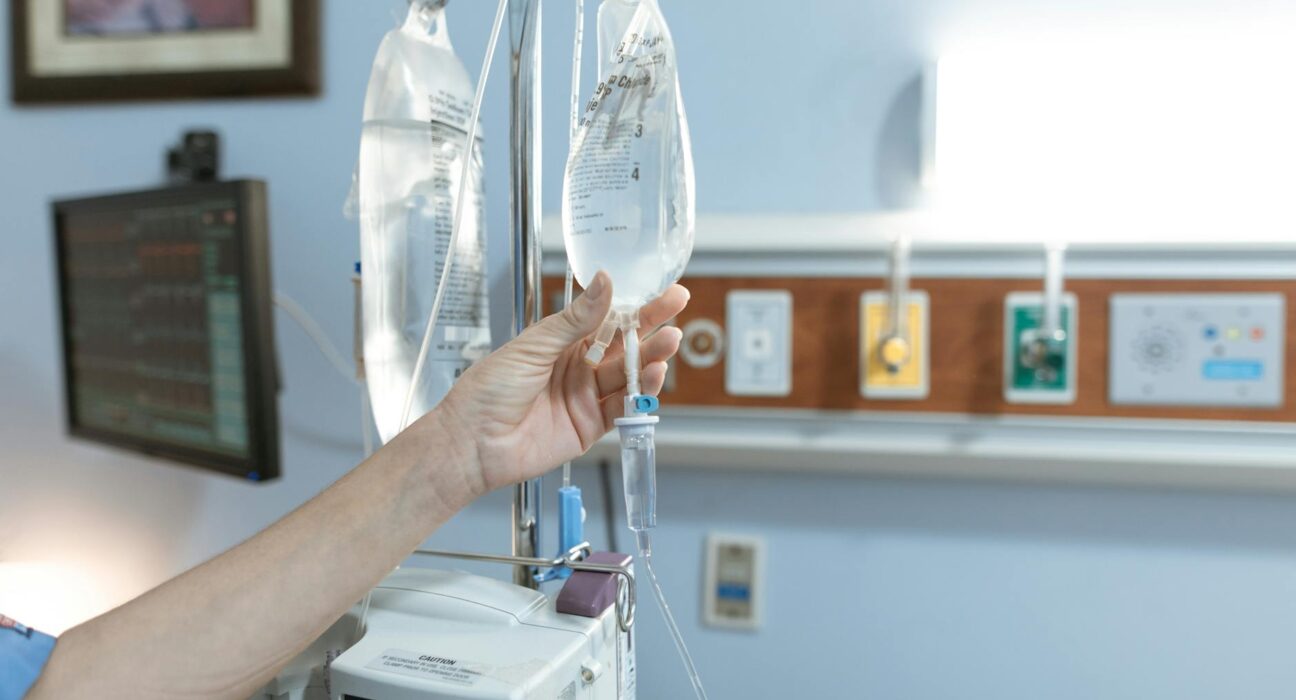
Free water deficit calculator. The clinical tool for determining how much free water a hypernatremic patient needs, calculated from body weight, total body water (TBW), current serum sodium, and target sodium. The formula matters because the correction speed matters even more: dropping sodium too fast in chronic hypernatremia triggers cerebral edema, seizures, and death. Use the calculator below to get the deficit in liters, the maximum safe drop rate, and the recommended IV solution.
This is a clinical reference tool for healthcare professionals and informed patients understanding inpatient protocols. Always work with a physician on actual treatment.
Free Water Deficit Calculator
Hypernatremia correction. Deficit in liters, max safe drop rate, recommended IV solution.
The Free Water Deficit Formula
The standard clinical free water deficit formula:
Free Water Deficit (L) = Total Body Water × ((Current Na⁺ / Target Na⁺) − 1)
Most people in detox or chronic-symptom work eventually hit the same problem: the same symptoms — fatigue, brain fog, gut issues, poor sleep — can come from completely different root causes, and the wrong protocol can run for months before that becomes obvious. The 2-minute What's Draining Your Brain Tool sorts you into one of four toxic load types so the next thing you try has a real chance of actually working.
Where Total Body Water (TBW) is calculated from body weight × body water fraction:
- Adult male: 0.6 × weight in kg
- Adult female: 0.5 × weight in kg
- Elderly male (65+): 0.5 × weight in kg
- Elderly female (65+): 0.45 × weight in kg
- Child (1-12 yr): 0.6 × weight in kg
These fractions reflect the proportion of body weight that is water, which differs by sex (more lean muscle mass = higher water content) and age (older adults have less lean mass + more fat).
How To Calculate Free Water Deficit. Worked Example
Take an 80 kg adult male with serum sodium of 160 mEq/L (severe hypernatremia), target 140:
- TBW = 80 × 0.6 = 48 L
- FWD = 48 × ((160 / 140) − 1) = 48 × 0.143 = 6.86 L deficit
- Total drop needed: 160 − 140 = 20 mEq/L
- Max chronic drop rate: 0.5 mEq/L/hr → minimum 40 hours of correction
- Practical infusion: 6.86 L over 48 hr = roughly 143 mL/hr of free water (D5W or PO if able)
The calculator above does all of this in 5 seconds.
What Each Input Affects
Body weight: The largest single driver of TBW. Doubling the patient’s weight doubles the deficit estimate.
Sex + age: Determines the body water fraction. Failing to adjust for an elderly female overestimates deficit by ~25%. Overcorrection risk.
Current sodium: The hypernatremia severity. Higher current Na⁺ produces larger deficit AND requires slower correction.
Target sodium: Default 140 mEq/L (mid-normal range). Some institutions target 145 in elderly patients to avoid over-correction.
Symptom onset (chronic vs acute): Critical safety distinction. Chronic hypernatremia (>48 hours or unknown duration) requires very slow correction (max 0.5 mEq/L/hr, total ≤12 mEq/L/24hr). Acute hypernatremia (<48 hours) can be corrected faster (up to 1 mEq/L/hr) because the brain hasn't had time to accumulate idiogenic osmoles.
Why The Correction Rate Matters
Chronic hypernatremia is the more dangerous scenario, not because the high sodium itself is more dangerous (though it is), but because too-rapid correction kills patients.
When sodium is chronically elevated, neurons accumulate “idiogenic osmoles”. Intracellular osmotically active solutes. To prevent the cells from shrinking. When you drop the sodium too fast, water rushes back into neurons faster than the cells can dispose of those osmoles. The result is cerebral edema, seizures, herniation, and death.
The safe maximum: 0.5 mEq/L/hour or 12 mEq/L per 24 hours in chronic cases. Acute hypernatremia (developed within 48 hours) can tolerate faster correction because brain adaptation hasn’t occurred yet.
Recommended IV Solutions
Free water replacement options, ranked by clinical preference:
- Oral water. Preferred if patient is alert and can drink safely. Spread intake over 24-48 hours.
- D5W (5% dextrose in water). Pure free water IV. Standard for moderate-severe cases. Watch for hyperglycemia.
- 0.45% NaCl (half-normal saline). Slower correction, contains some sodium. Useful when initial Na⁺ correction needs to be very gradual.
- 0.225% NaCl (quarter-normal saline). Rarely used in adults; common in pediatrics.
- Lactated Ringer’s. NOT typically used for free water replacement (contains 130 mEq/L Na⁺).
Monitoring During Correction
Repeat serum sodium every 4-6 hours during active correction. Calculate the rate of change:
- If dropping faster than maximum safe rate: reduce infusion rate immediately
- If dropping slower than 0.3 mEq/L/hr in symptomatic patient: increase infusion rate
- If patient develops headache, vomiting, altered mental status, or seizure: STOP correction immediately. This is cerebral edema until proven otherwise. Hold fluids, consider hypertonic saline rescue, get neurology + ICU involved
Common Hypernatremia Causes
Understanding the cause helps with disposition + ongoing fluid management:
- Hypovolemic hypernatremia: GI losses (vomiting, diarrhea), burns, fever, inadequate oral intake (elderly, dementia, restrained patients). Most common.
- Euvolemic hypernatremia: Diabetes insipidus (central or nephrogenic). Often after pituitary surgery, lithium use, or hereditary.
- Hypervolemic hypernatremia: Sodium overload. Iatrogenic (hypertonic saline, sodium bicarb), salt poisoning, mineralocorticoid excess.
Treatment differs by category: hypovolemic patients need volume + free water; euvolemic patients with DI need DDAVP plus free water; hypervolemic patients may need loop diuretics + free water replacement.
Who This Calculator Is For
- Hospitalist physicians managing inpatient hypernatremia
- ICU nurses verifying physician orders
- Nephrology consults
- Pharmacy reviewing fluid orders
- Medical students and residents learning the formula
- Informed patients understanding their hospital course
Who This Calculator Is NOT For
- Self-treatment of dehydration (drink water, see a physician)
- Hyponatremia correction (different formula + different risks)
- Pediatric ICU-level cases (consult pediatric nephrology for precise calculations)
- Patients with concurrent hyperglycemia (correct glucose first, then recalculate)
What NOT To Do
- Don’t correct chronic hypernatremia at acute rates. The #1 cause of correction-related death is using acute-rate correction on chronic hypernatremia.
- Don’t rely on the deficit calculation alone. Add ongoing free water losses (insensible + urinary) to the deficit.
- Don’t skip the 4-6 hour Na⁺ recheck. Real-world correction rates vary from predicted rates because of ongoing losses, fluid distribution shifts, and individual variation.
- Don’t use this formula alone for hyperglycemia-induced hypernatremia. Correct glucose, recheck Na⁺, then calculate.
- Don’t use lactated Ringer’s as free water replacement. It contains 130 mEq/L Na⁺ and won’t correct hypernatremia.
Quick Reference Card
| Na⁺ Range | Severity | Setting |
|---|---|---|
| 145-149 | Mild | Often outpatient if alert |
| 150-159 | Moderate | Hospitalization typical |
| ≥160 | Severe | ICU-level care; high mortality |
References
Adrogué HJ, Madias NE. Hypernatremia. N Engl J Med. 2000;342:1493-1499. (The foundational paper for these formulas.)
UpToDate: Treatment of hypernatremia in adults. Updated regularly.
Sterns RH. Disorders of plasma sodium. N Engl J Med. 2015;372:55-65.
This is a clinical reference tool. Not medical advice. Hypernatremia treatment requires physician supervision. The formulas presented are widely accepted but individual cases may require adjustment based on comorbidities and clinical context.


