

You sit down to write a report. You give yourself the whole afternoon to finish it. Somehow, the report stretches across the entire afternoon, and you barely finish before dinner. Now imagine you had only 90 minutes. You would likely still finish the report, just faster and tighter. That is Parkinson’s Law in action.
Parkinson’s Law states that work expands to fill the time available for its completion. Cyril Northcote Parkinson coined the phrase in a 1955 essay in The Economist. He was writing about the British civil service, but the idea applies to almost any task. The more time you give yourself, the longer you take. The less time, the more focused you become.
This guide breaks down how to use Parkinson’s Law for productivity. You will learn why it works, the simple techniques that turn it into a daily habit, and a few tools that make the system stick. We will keep things practical and grounded.
Key Takeaways
- Parkinson’s Law says work expands to fill the time available, so shorter deadlines force sharper focus.
- Apply Parkinson’s Law for productivity by setting tight time blocks for every task on your list.
- Visual timers and structured planners make artificial deadlines easier to honor.
- Pair Parkinson’s Law with realistic energy planning to avoid burnout.
- Most people can cut task time by 30 to 50 percent without losing quality.
What you will learn in this video:
- The origin story of Parkinson’s Law and why it still applies today
- A simple mental shift that gets you to finish tasks faster without burnout
- How to set artificial deadlines that your brain actually respects
- Real-world examples of Parkinson’s Law in everyday work and life

Where Parkinson’s Law Comes From
Cyril Northcote Parkinson was a British naval historian. In 1955 he wrote a satirical essay for The Economist about how bureaucracies grow. He noticed that the British Colonial Office kept hiring new staff even as the British Empire shrank. There was less actual work to do, yet more people were doing it.
His core observation was simple. When a task has a long deadline, it fills that time. When the same task has a short deadline, it shrinks to fit. The work itself does not change much. What changes is how much effort you put into delay, distraction, and over-polishing.
The law became one of the most cited ideas in time management. Authors like Tim Ferriss, James Clear, and Cal Newport all reference it. Once you start watching for it, you see Parkinson’s Law everywhere in your own day.
Why Parkinson’s Law for Productivity Actually Works
Three forces make this principle so powerful when you apply it on purpose.
Constraints Force Decisions
When you have all day, you can chase every detail. When you have an hour, you must pick the few things that matter most. Constraints turn off the perfectionist voice. They force you to ship a draft instead of polishing endlessly.
Urgency Sharpens Focus
A short deadline triggers a small stress response. This focuses your attention. Background thoughts quiet down. Distractions feel less appealing. You enter a state closer to flow because your brain knows the clock is ticking.
Done Beats Perfect
Parkinson’s Law helps you finish things. Finished work has value. Half-polished work that drags on for weeks has none until it ships. Tight deadlines train you to send the email, file the report, or post the project before your inner critic talks you out of it.
How to Apply Parkinson’s Law for Productivity in Daily Life
Knowing the law is one thing. Putting it to work is another. Here are five practical techniques that turn the principle into a daily habit.
1. Set Half the Time You Think You Need
Estimate how long a task will take. Then cut that estimate in half. If you think a report takes two hours, give yourself one. The first few times this feels uncomfortable. Soon you will notice you finish on time more often than you expected.
This works because most time estimates already include hidden buffer. We pad our predictions to avoid feeling rushed. Parkinson’s Law removes the buffer and shows you what is really required.
2. Use Visual Countdown Timers
A timer turns abstract time into something you can see. A 25 minute timer on your desk makes minutes feel real. You stop drifting because the clock is right there. Visual timers help even more than digital ones because the shrinking color block is hard to ignore.
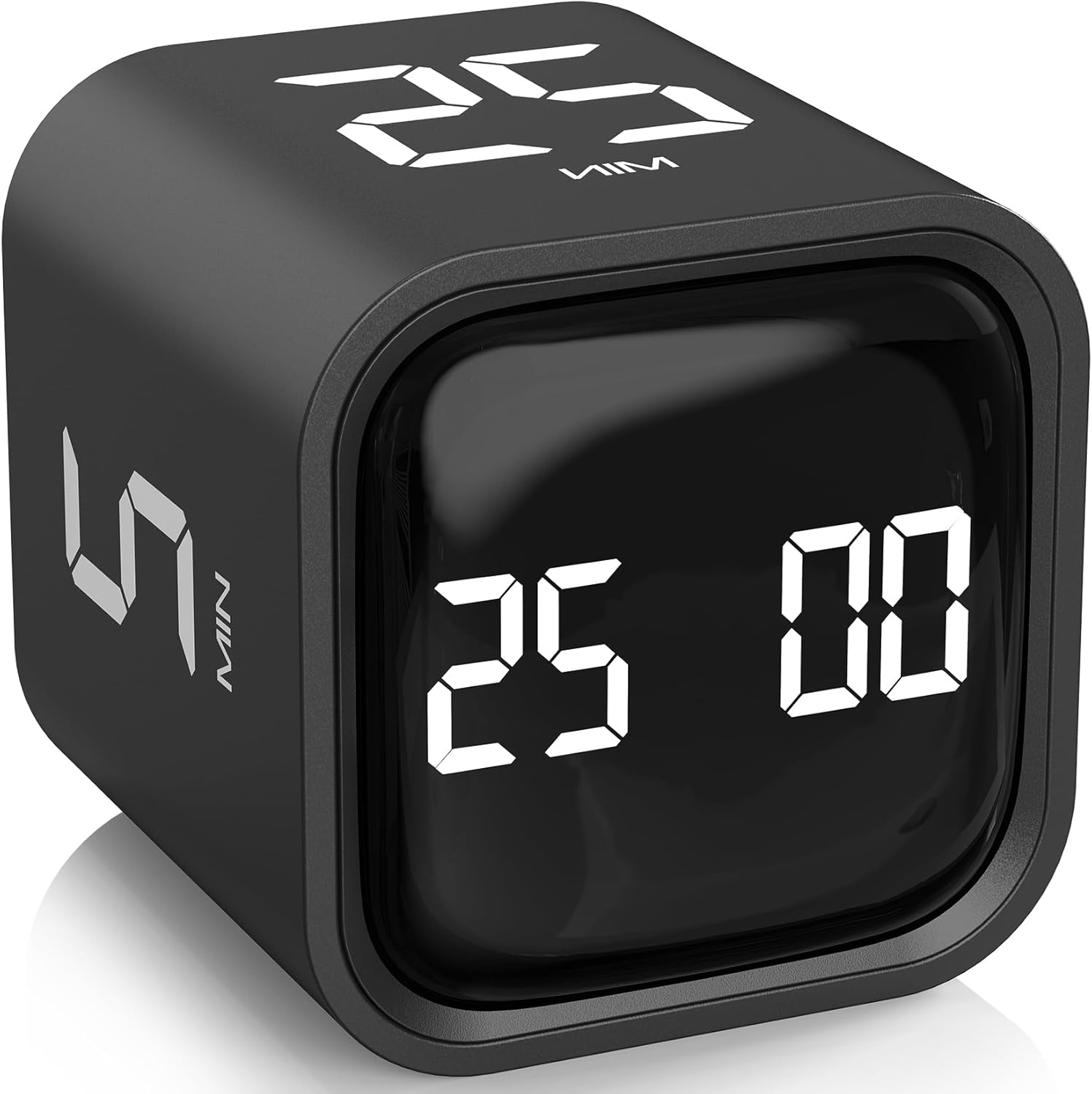
Rotating Pomodoro Timer Cube
Source: amazon.com
5, 25, 10, 50 Minute Preset Flip Timer With Vibration and Volume Modes
The Wellthie One Review
This flip cube timer is one of the simplest tools you can put on your desk. Turn the cube to the side you want and the timer starts automatically. The four preset modes cover the most common time blocks, including a long 50 minute deep work session. Vibration mode is helpful in a quiet office or shared space. We like that there is no app, no setup, and no friction. You see it and you start.
Rotating Pomodoro Timer Attributes
- Four preset times: 5, 25, 10, and 50 minutes
- Custom mode for setting your own intervals
- Vibration alert option for quiet spaces
- High and low volume modes for different environments
- USB rechargeable, no batteries needed

3. Block Your Calendar Aggressively
Open work hours feel like open ocean. You drift. A blocked calendar gives every hour a destination. Assign a specific task to each block, even small ones. Email gets 20 minutes. The slide deck gets 45 minutes. Lunch gets 30 minutes.
Time blocking works even better when paired with the Eisenhower Matrix for daily decisions. Use the matrix to pick your tasks, then use Parkinson’s Law to set the deadlines.
4. Announce a Deadline Out Loud
Self-imposed deadlines are easy to break. Public deadlines are not. Tell a coworker you will send the draft by 3 p.m. Tell your spouse you will be done at 5. Even a casual mention adds a layer of accountability. Your brain takes the deadline more seriously when someone else is watching.
5. Build in Real Breaks
Parkinson’s Law works because focus is finite. Trying to sprint for eight hours straight kills the magic. Pair short, focused work blocks with real breaks. Stand up. Walk away from the screen. The break is what makes the next sprint possible.
Examples of Parkinson’s Law in Action
Real life is full of moments when this law shapes the outcome. Here are a few that may sound familiar.
Packing for a Trip
If you start packing the night before a trip, you pack in a few hours. If you start a week early, packing somehow becomes a week-long project. The clothes are the same. The suitcase is the same. The time available shapes the experience.
Writing an Email
A simple email can take five minutes or fifty. Without a constraint, you draft, rewrite, and overthink. Set a five minute timer and the email gets sent. Most messages do not need polishing. They just need to leave your outbox.
Cleaning the House
Tell yourself you will clean today, and the day slips by. Tell yourself you have one hour before guests arrive, and the whole place sparkles. The work itself was always the same. Only the deadline changed.
ZICOTO Daily Planner With Hourly Schedule

Source: amazon.com
Aesthetic Spiral Daily Planner With Hourly Schedule and To-Do List
The Wellthie One Review
This planner is built for time blocking, which is the perfect partner for Parkinson’s Law. Each daily page has an hour by hour schedule on one side and a to-do list on the other. You can assign tight deadlines to each task and watch yourself honor them. The aesthetic design makes it pleasant to open every morning. We like that it is undated, so you can start any day without wasting pages.
ZICOTO Daily Planner Attributes
- Spiral hardcover with thick paper for a smooth writing experience
- Hourly schedule layout for daily time blocking
- To-do list and notes section on each page
- Undated, so you can start any day
- Compact size that fits in most bags

When Parkinson’s Law Does Not Apply
This principle is powerful, but it is not magic. A few situations call for a softer approach.
Creative Work That Needs Incubation
Some ideas need time to form. A poem, a strategy, a new product concept. Forcing artificial deadlines on the early phases can produce shallow work. Use Parkinson’s Law for execution, not always for ideation. Give yourself looser blocks for thinking and tighter blocks for doing.
Tasks With External Dependencies
If your work waits on someone else, your deadline is only as fast as the slowest link. Setting tight deadlines for yourself while waiting on a vendor or a teammate just adds stress. Map the dependencies first, then apply Parkinson’s Law to the parts you actually control.
When Your Energy Is Low
Tight deadlines work best when you have the cognitive fuel to honor them. If you are exhausted or sick, pushing harder backfires. Rest first. The Parkinson’s Law approach pairs well with the Ivy Lee Method for daily productivity for matching tasks to your energy levels.
Combining Parkinson’s Law With Other Productivity Systems
Parkinson’s Law shines as a layer on top of other methods. It is not a full system on its own. Here are a few combinations that work well together.
Parkinson’s Law and the Pomodoro Technique
The Pomodoro Technique uses 25 minute work blocks with short breaks. Layer Parkinson’s Law on top by committing to finish a specific task before the timer ends. Now the Pomodoro is not just about working, it is about shipping something inside that window.
Parkinson’s Law and the 1-3-5 Rule
The 1-3-5 Rule means tackling one big task, three medium tasks, and five small tasks per day. Add Parkinson’s Law by assigning a tight time block to each. The system becomes a self-paced sprint instead of a vague list.
Parkinson’s Law and Time Boxing
Time boxing means setting a fixed amount of time for a task and stopping when the time is up. This is Parkinson’s Law made concrete. Many high performers use 90 minute time boxes for deep work and 30 minute boxes for shallow tasks.
Full Focus Planner by Michael Hyatt

Source: amazon.com
Quarterly Daily Planner Designed to Eliminate Overwhelm and Build Focus
The Wellthie One Review
The Full Focus Planner is a structured tool for people who want to apply Parkinson’s Law to bigger goals. The system uses 90-day quarters, weekly previews, and a daily Big 3 task structure. Each day asks you to set time blocks for your top three tasks. This makes it harder to drift and easier to honor the deadlines you set. The hardcover feels durable. The pages are thick enough for fountain pens. This is for people serious about a long-term focus practice.
Full Focus Planner Attributes
- 90 day planning system covers one quarter
- Daily Big 3 framework for top priorities
- Weekly preview and weekly review pages
- Hardcover with thick, fountain pen friendly paper
- Built-in goal review and reflection prompts

Common Questions About Parkinson’s Law
Is Parkinson’s Law scientifically proven?
The original observation was anecdotal. Since then, productivity research and behavioral economics studies have repeatedly confirmed that people work to fill the time given. The classic study by Roy Baumeister on ego depletion supports the idea. Time constraints help maintain decision quality.
Does Parkinson’s Law work for creative tasks?
Yes, with some flexibility. Use loose blocks for brainstorming and tight blocks for execution. Many writers use timed sprints once they have an outline. The deadline pushes them past the perfectionist phase and into a finished draft.
Can Parkinson’s Law cause burnout?
Only if you ignore breaks. The principle works because focus is finite. Pair tight work blocks with real rest. A 90 minute sprint followed by a 20 minute break beats three sloppy hours every time.
How tight should the deadlines be?
Start by cutting your normal estimate by 30 percent. After a few weeks, try 50 percent. The goal is to find the edge where you stay focused without dropping quality. Everyone’s edge is different.
Final Thoughts on Using Parkinson’s Law for Productivity
Parkinson’s Law is one of the simplest ideas in time management. The work expands or contracts based on the time you give it. By setting tighter deadlines on purpose, you train yourself to focus, to ship, and to protect your energy for what matters.
Start small. Pick one task tomorrow and give it half the time you would normally allow. Use a visual timer. Notice what changes. After a week, you will see how much extra time you have been quietly losing. That found time is yours to spend on rest, family, hobbies, or the next thing that matters.
This post may contain affiliate links, which means we may receive a small commission, at no cost to you, if you make a purchase through a link.


