
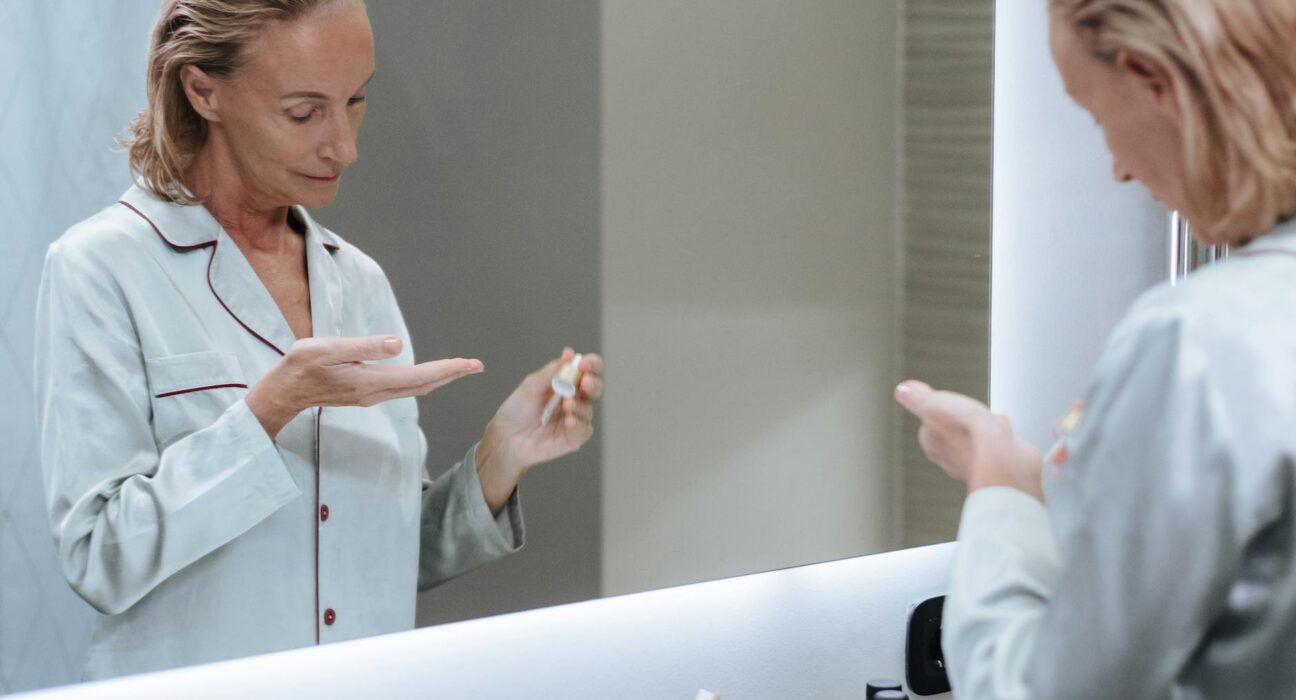
The retinol you swore by for twenty years stopped doing what it used to. The serum that gave you a glow in your forties just sits on the surface now. You added a peptide cream, a vitamin C, a barrier repair. You are spending more than you used to spend, and you are paying for it with skin that looks less rested, less plump, less you. Skincare stops working after fifty for a reason almost nobody is willing to say out loud: nothing you put on the surface can rebuild what has dropped beneath the surface.
After menopause the rate of skin collagen production falls by roughly thirty percent in the first five post-menopausal years. The decline keeps going at one to two percent per year after that. No cream, no serum, no laser, no ten-step Korean routine penetrates deep enough into the dermis to replace what is missing. Your skin needs the building blocks from the inside, in the same way it has always needed them, and after fifty you are no longer making enough of them on your own. This is the collagen-from-within reset.
Key Takeaways
- After menopause, skincare stops working because the collagen layer beneath your skin is depleted, not because your products are wrong.
- Three inputs rebuild collagen visibly within 12 weeks: hydrolyzed collagen peptides daily, vitamin C as the cofactor that crosslinks them, and bone broth for the glycine and proline that bind everything together.
- You do not need to abandon your topical routine. You need to feed the layer your topicals can never reach.
- Expect the change to show up around week eight, not week two. Anyone selling you “results in 14 days” is selling water retention, not skin remodeling.

Why Topical Skincare Stops Working In Your 50s
Your skin is built in three layers. The epidermis (the outermost, the part everyone obsesses over) is mostly waterproof keratin. The dermis (the middle, where the magic actually lives) is mostly collagen, elastin, and hyaluronic acid. The subcutis (the deepest) is fat and connective tissue. Every cream, every serum, every laser, every treatment you have ever paid for works on the epidermis or upper dermis only. The deeper layers are too far down for topical molecules to reach in any meaningful concentration.
Until you were about forty-five, this did not matter. Your dermis was making plenty of its own collagen and elastin, and your topicals were polishing the surface of an already-supple foundation. After menopause, the foundation thins. The same polish on a thinner foundation looks like… exactly what your mirror is showing you. There is no topical version of the missing dermis. There is no surface application that can rebuild collagen in the middle layer. The work has to happen from the bloodstream.
Inside-Out Collagen
Garden of Life Grass-Fed Hydrolyzed Collagen Peptides (Unflavored)

Source: amazon.com
Unflavored hydrolyzed bovine collagen that mixes into hot or cold liquid without clumping. After 50, your skin’s daily collagen synthesis drops more than your skin cream can ever compensate for. One scoop daily into morning coffee or smoothie for the full 12-week visible-change window.

Input One: Hydrolyzed Collagen Peptides Daily
Hydrolyzed collagen peptides are bovine (or marine) collagen that has been enzymatically broken into di-peptides and tri-peptides — small enough to absorb intact through the gut wall and reach the bloodstream. From there, your fibroblasts (the cells in the dermis that build collagen) pull the peptides up and stitch them into new collagen fibers exactly where you need them.
The dosing that has the most clinical research behind it: ten to fifteen grams daily, every day, for a minimum of eight weeks before you judge results. This is one full scoop of a standard unflavored hydrolyzed collagen powder. I stir it into my morning coffee and the only thing it changes is the cup gets opaque for thirty seconds. No clumps, no taste, no aftertaste.
Unflavored, grass-fed bovine is the workhorse formula. Marine collagen is fine but expensive and not meaningfully better unless you cannot tolerate beef. Skip the gummies — the peptide dose is one-fifth what the powder delivers, the sugar load is high, and the cost per gram of collagen is four to six times higher.

Input Two: Vitamin C — The Cofactor Nobody Mentions
Collagen cannot be built without vitamin C. Specifically, the enzyme that hydroxylates the proline and lysine residues in the collagen triple helix (prolyl hydroxylase) is vitamin-C-dependent. No vitamin C, no crosslinking, no functional collagen. This is biochemistry, not opinion. Without enough vitamin C in your bloodstream at the moment fibroblasts are trying to assemble peptides, you build collagen that falls apart faster than your body breaks it down.
Collagen Cofactor
Food to Live Organic Freeze-Dried Acerola Cherry Powder

Source: amazon.com
Whole-food vitamin C from acerola is the cofactor collagen needs in order to crosslink properly inside the skin matrix. Half a teaspoon into the same morning collagen drink delivers 700 mg of bioavailable vitamin C; far gentler on the gut than ascorbic acid capsules.
Whole-food vitamin C from acerola cherry is far gentler than ascorbic acid capsules, and the bioflavonoid co-factors that come with the whole fruit dramatically improve absorption and prolong the half-life in your bloodstream. Half a teaspoon of organic freeze-dried acerola powder mixed into the same morning collagen drink delivers about 700 mg of bioavailable vitamin C. That is more than enough to saturate the collagen synthesis pathway for the day.
Ascorbic acid capsules are not wrong; they are just harder on the gut and the body excretes more of them in urine. If you tolerate ascorbic acid and you prefer the convenience of a capsule, 500 to 1000 mg twice daily with food works. Liposomal vitamin C is the gold standard for absorption but it is expensive — buy it if you have actively photodamaged skin you are trying to repair, not if you are doing maintenance.
Input Three: Bone Broth For Glycine And Proline
Hydrolyzed peptides give you peptides. Vitamin C gives you the cofactor. The third piece is the raw amino acids — glycine and proline — that the fibroblast actually needs in bulk to assemble new collagen fibers. Modern Western diets are remarkably low in both. Glycine comes mostly from skin, bone, connective tissue, and cartilage — the parts of the animal almost nobody eats anymore. Proline comes from the same sources plus aged cheese, but again — not in the quantities the dermis needs after fifty.
The simplest fix is one mug of organic chicken bone broth daily as an afternoon snack. Real bone broth simmered for 18 to 24 hours pulls glycine, proline, and structural minerals into a form the body recognizes immediately. If you have the time and a slow cooker, simmer your own from pasture-raised chicken backs and feet — the cost is almost nothing and the result is closer to what your great-grandmother gave her family every week. If you do not have the time, a ready-made organic bone broth in a carton, warmed up, takes ninety seconds.
Whole-Food Collagen
Kettle & Fire Organic Chicken Bone Broth (6-Pack)

Source: amazon.com
For weeks when you cannot simmer your own bones for 24 hours. Slow-simmered free-range chicken bones with organic vegetables, 10 g of protein and glycine plus proline per serving. One mug daily as an afternoon collagen snack for the women who do not like the taste of powder.
What To Keep In Your Topical Routine
The inside-out protocol does not mean abandoning your topicals. It means understanding what they can and cannot do. Topicals are great for: the moisture barrier (a good ceramide cream), surface texture (gentle exfoliation, retinol if your skin tolerates it), sun damage prevention (mineral SPF every morning), and surface hydration (hyaluronic acid serum on damp skin).
Topicals cannot rebuild dermis. They were never going to. The reason the routine stops “working” at fifty is not that the topicals got worse. It is that the foundation they were polishing is no longer plump enough for the polish to register. Feed the foundation, keep the polish — that is the actual fifty-and-after skincare equation.
Why Pearl Powder Earned A Permanent Spot In My Cabinet
I added one more piece to my own protocol that did not make this article’s main three: pearl powder, a quarter teaspoon stirred into my evening collagen, three nights a week. The amino acid profile (high in proline, glycine, and a unique conchiolin peptide) plus the mineral content (calcium, magnesium, zinc, copper — all collagen-relevant) makes it a quiet workhorse. My full breakdown including the DIY toothpowder recipe and the specific brand I use lives in my pearl powder series. Add it after you have done eight weeks of the main protocol and want to layer on the next tier.
What The Internal Protocol Will Not Fix
Be realistic. The collagen-from-within reset rebuilds skin density, plumpness, and resilience. It softens fine lines. It improves the dewy quality that you used to take for granted. It does not erase deep-set wrinkles that have been carved for thirty years, it does not lift jowls, and it does not undo cumulative sun damage. For those you have other options (laser, microneedling, surgical), and those options will work much better on a foundation that has been fed for three months than on one that has not. Inside-out work is the precondition for any external work doing what it is supposed to do.
Eight-Week Timeline: What You Will Notice And When
Week one to two: easier digestion, often better sleep (the glycine in bone broth and collagen acts as a mild calmative), no visible skin change yet.
Week three to four: nails grow noticeably faster and stronger. Hair shedding decreases. This is your body’s signal that the protein and cofactors have reached the periphery — skin is next.
Week five to six: skin texture in the cheeks softens. Less papery, more pliable. You will notice it when applying moisturizer.
Week seven to eight: the first visible plumping in the under-eye area and the smile lines. This is when partners and friends start asking what you changed.
Week twelve: the new baseline. Most women say this is the point where they realized the old skincare routine never actually lost effectiveness — the canvas just changed underneath it, and now the canvas is back.
The Klinghardt-Pompa Frame Behind This Protocol
This piece sits at step five (integrate) in the broader Klinghardt and Pompa detox sequence. You cannot rebuild collagen on top of a body that is still heavily toxic, inflamed, or mineral-deficient — the fibroblasts simply do not have the bandwidth. If you have not done a foundational detox pass yet, the Toxic Load Reset covers the first four steps in depth. The collagen reset above is the integration phase that comes after the body is no longer fighting on multiple fronts.
My Own Three-Month Result
I started this protocol at fifty-three after watching my own foundation thin enough that no amount of hyaluronic acid serum could hide it in evening lighting. Twelve weeks in: my smile lines softened, my cheek volume came back enough that my reading glasses started sliding down my nose instead of resting on my cheekbones, and I dropped two products from my evening routine because they had become unnecessary. The protocol cost less than a third of what I had been spending on serums.
Disclosure: As an Amazon Associate, I earn from qualifying purchases. Product picks are what I personally use. Dosing is education, not prescription — weigh both sides, listen to your body, and if you have a history of kidney issues or are on protein restriction, check with your nephrologist before starting daily collagen at 15 g per day.


