
Goat milk for dogs has gone from niche raw-feeder ingredient to mainstream food topper in just a few years, and most of the hype centers on three claims: easier digestion than cow’s milk, natural prebiotics and enzymes for the gut, and added moisture for picky drinkers. Some of those claims hold up better than others. Goat milk is genuinely lower in lactose and easier on most dog stomachs than cow’s milk, and small amounts (a tablespoon or two for medium dogs) are usually well tolerated.
That said, goat milk is not a miracle cure. There is no peer-reviewed canine research that confirms it heals allergies, fixes itchy skin, or rebuilds a damaged microbiome. What it can do is add hydration, gentle calories, and a small dose of natural probiotics for dogs who like the taste. If you have been wondering whether to add it to your dog’s bowl, here is the honest, useful version.

What is in goat milk that dogs do well with
Goat milk’s nutritional profile is what makes it interesting as a topper. It is roughly 87 percent water, naturally lower in lactose than cow’s milk, and contains smaller fat globules that most dogs digest more easily. It also has a different protein structure (more A2 casein, less A1) that some dogs tolerate better even when they react to cow’s milk.
The extras worth mentioning:
- Natural enzymes (lipase, lactase, and others) that survive raw or gently fermented forms
- Calcium, magnesium, phosphorus, and trace minerals for hydration support
- Vitamin A and B-complex vitamins, which are usually adequate in commercial dog food too
- Medium-chain triglycerides (MCTs), which are easy energy for active dogs
- Live cultures in raw or fermented (kefir-style) versions, which act as a small probiotic dose
For most dogs, the practical value is that goat milk is mostly water and tasty. Dogs that ignore their water bowl will often lap it up over kibble. That hydration alone can be the biggest real-world benefit, especially in summer or after exercise.
The main goat milk for dogs benefits worth knowing
Some claims about goat milk have decent reasoning behind them. Others are marketing. Let’s separate them.
Better hydration for dogs that ignore water
This is the most reliable benefit. A drizzle of goat milk over kibble adds moisture without adding much calorie load. For older dogs, dogs on dry food, or dogs that just are not big drinkers, this is a low-effort way to support hydration.
Easier digestion than cow’s milk
Goat milk is naturally lower in lactose (about 4.1 percent vs. 4.7 percent in cow’s milk) and has smaller fat globules. Many dogs that loose-stool with cow’s milk handle small amounts of goat milk fine. This is a real, measurable difference, not just marketing.
A small probiotic dose (raw or fermented forms)
Raw goat milk and fermented goat milk kefir contain live cultures that may support gut health. The dose is small compared to a dedicated probiotic supplement, but it adds variety to the gut microbiome. The pasteurized powder versions lose most of these live cultures during processing.
Extra calories for picky eaters or underweight dogs
Goat milk is calorically denser than water but lighter than oils or fatty toppers. For a senior dog losing interest in food, a tablespoon over kibble can make a meal more appealing without overloading the stomach.
What you will learn in this video:
- The seven most-cited reasons raw feeders give goat milk
- How goat milk’s lower lactose level compares to cow’s milk
- Why small fat globules digest more easily for sensitive dogs
- Practical serving notes by dog size
Where the claims get oversold
A few claims show up everywhere online and do not have much science behind them yet:
- “Cures allergies” – dogs allergic to cow milk protein are often allergic to goat milk protein too
- “Heals leaky gut” – no canine studies support this claim, and the term itself is debated
- “Replaces a balanced probiotic” – the live culture content is small and inconsistent
- “Stops itching and skin issues” – skin reactions in dogs have many causes; goat milk alone rarely fixes them
None of this means goat milk is bad. It just means the realistic upside is hydration, digestibility, and palatability. Anything beyond that is a bonus.
How much goat milk to give a dog
Start small and watch the stool for 24 hours. Most dogs do well at the following daily amounts as a topper:
- Small dogs (under 20 lb): 1 tablespoon
- Medium dogs (20 to 50 lb): 2 tablespoons
- Large dogs (50 to 90 lb): 1/4 cup
- Giant breeds (over 90 lb): up to 1/3 cup
That is a maintenance amount. For sensitive stomachs or first introductions, halve those numbers and work up over a week. If you are using a powdered version, follow the label scoop size, which is calibrated to give roughly the same hydration when reconstituted.
Goat milk should be a topper, not a meal. It is not nutritionally complete for dogs and should not replace a balanced diet. It also adds calories, so on weight-management diets, factor it into the daily total.
The Honest Kitchen Instant Goat’s Milk with Probiotics

Source: amazon.com
A shelf-stable instant goat milk with added probiotics, made with human-grade ingredients. Mix with warm water and serve as a topper or stand-alone treat.
The Wellthie One Review
The Honest Kitchen Goat’s Milk Attributes
- Human-grade ingredients, made in a USA-based facility
- Added probiotics for gut support
- Shelf stable until reconstituted, no need to manage a frozen supply
- Works for both dogs and cats
This is the easiest entry point for most owners. There is no defrosting and no cold chain to manage. You scoop, stir with warm water, and pour. The added probiotic content is a small bonus for digestion-sensitive dogs. The trade-off is that pasteurized powder loses some natural enzymes, so it is more about palatability and convenience than raw nutrition. For everyday use, that is the right trade-off.
Who should not get goat milk
Goat milk is generally well tolerated, but some dogs should skip it.
- Dogs with a confirmed dairy allergy (test by giving a small amount and watching for itching, ear inflammation, or GI upset within 24 hours)
- Dogs with pancreatitis or a history of fat-sensitive flareups (goat milk has fat content)
- Puppies under 8 weeks (use a vet-formulated milk replacer, not adult goat milk)
- Dogs on weight-loss plans (factor calories in or skip)
- Dogs in the middle of an elimination diet for food sensitivities
If your dog is already on a careful gut protocol, talk with your vet before adding goat milk. For dogs already doing well on a basic gut topper like our reader-favorite colostrum for dogs, goat milk can layer in without issue. For dogs already drinking bone broth as a topper, you can rotate the two so the bowl stays interesting.
Raw vs. pasteurized vs. powdered goat milk
There are three main forms on the market, and each has its place.
Raw goat milk
Frozen, sold by raw feeders and specialty pet shops. The most enzymes and live cultures, but requires freezer space and a cold chain. The CDC notes that unpasteurized milk carries a higher risk of pathogens, so source carefully and use within 3 days of thawing.
Pasteurized goat milk (liquid)
Less common in the pet space but available. Loses some enzyme activity but is shelf-stable longer and lower risk than raw. A reasonable middle ground.
Powdered goat milk
Most convenient. Mix with warm water as needed. Loses most live cultures unless probiotics are added back in (which most reputable brands do). Best for travel, picky eaters, and owners who want a “set and forget” pantry option.
For most owners, powdered with added probiotics is the realistic everyday choice. Raw is for committed raw feeders. Liquid pasteurized is harder to find but a fine option if it works for your routine.
Native Pet Goat Milk Powder Topper

Source: amazon.com
A whole goat milk powder topper with MCTs and essential minerals, marketed for active dogs and post-activity recovery, hydration, and bone health.
The Wellthie One Review
Native Pet Goat Milk Powder Attributes
- Whole goat milk with naturally occurring MCTs
- 60 scoops per bag, scoop included
- Calcium, magnesium, and trace minerals already in the milk itself
- Marketed for active or working dogs, but fine for any healthy dog
This is a useful pick if you have an active or athletic dog who could use a little extra hydration after long walks, training sessions, or hikes. The MCT content is naturally part of goat milk, not a marketing add-on. The scoop sizing is convenient, and the bag stays fresh longer than a half-used carton would. For dogs that just need a hydration bump rather than added probiotics, this is a clean choice.
How to introduce goat milk to a sensitive dog
Most dogs handle goat milk fine on first introduction, but a small percentage have soft stools the first day. The simplest gentle introduction:
- Day 1 to 2: Give half the maintenance dose, served once a day with a meal.
- Day 3 to 4: If stool is normal, increase to 75 percent of the maintenance dose.
- Day 5 onward: Move to the full maintenance dose, served once or twice a day.
Watch for soft stools, gas, or scratching during the introduction window. Any of those means the dose is too much or your dog is one of the small percentage that does not tolerate goat dairy. In that case, stop and try a different topper.
Goat milk and immune support
Some goat milk products add ingredients aimed at immune support, like colostrum, mushrooms, or extra probiotics. The ingredients themselves have varying levels of research behind them, and a small daily scoop is unlikely to produce a dramatic change. They can be a reasonable convenience for owners who already wanted to give those ingredients separately.
If you want a clear single-ingredient picture, plain goat milk powder is the simpler choice. If you would have given colostrum or turkey tail anyway, an “immune blend” version is fine. Neither is a substitute for actual veterinary care if your dog has a real immune issue.
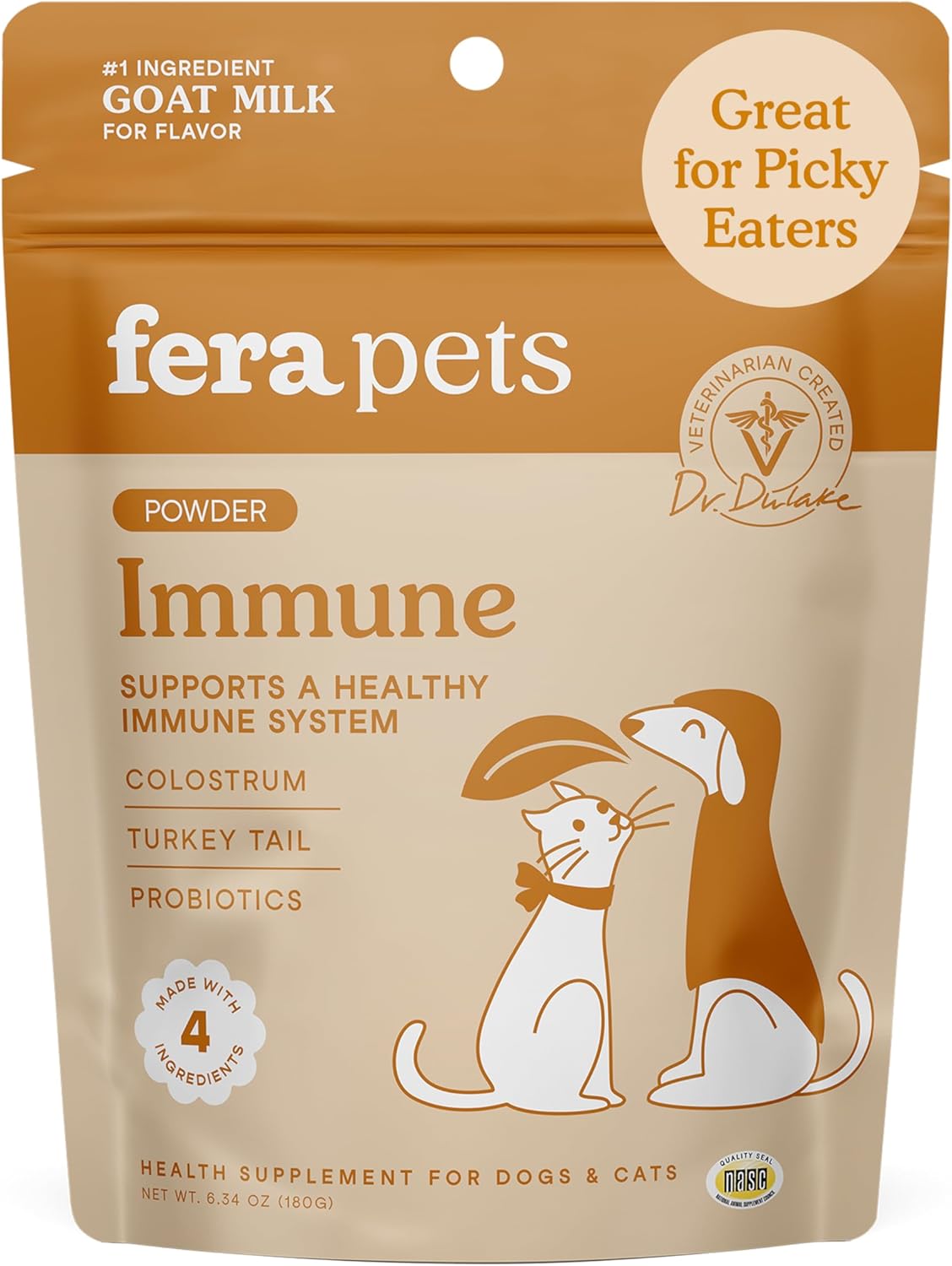
Fera Pets Immune Goat Milk with Colostrum and Turkey Tail
Source: amazon.com
A goat milk powder blend with added colostrum, organic turkey tail mushroom, and probiotics. Marketed for immune support and finicky eaters.
The Wellthie One Review
Fera Pets Immune Goat Milk Attributes
- Combines goat milk with bovine colostrum and organic turkey tail mushroom
- Added probiotics for gut and immune support
- 60 teaspoons per bag, easy to scale by dog size
- Strong appeal for picky eaters because of the dairy base
This one earns its keep if you were already considering adding colostrum and turkey tail separately. Bundling them into one scoop reduces friction. The probiotic count is modest, so if your dog has a more serious gut issue, layer this with a dedicated probiotic. For routine support, the all-in-one approach is convenient. The taste is mild enough that finicky dogs usually accept it on the first try.

What to expect after a few weeks
Most dogs that tolerate goat milk show one or two small changes within two weeks: better appetite at meals, slightly firmer stools (or unchanged stools, never worse), and in some cases a noticeably softer coat. A few dogs drink more water overall, since the goat milk seems to “open the door” to hydration generally.
If you do not see anything good after three weeks, goat milk is probably not adding much for your dog. There is no harm in stopping. Pet wellness toppers are personal, and the right one for your dog might be a different supplement entirely.
Quick FAQ on goat milk for dogs
Can puppies have goat milk?
Puppies over 8 weeks can have small amounts as a topper. Younger puppies need a vet-formulated milk replacer instead, since goat milk is not nutritionally balanced for early growth.
How long does goat milk last after mixing?
Powdered milk reconstituted with water should be refrigerated and used within 24 to 48 hours. Raw frozen goat milk should be used within 3 days of thawing.
Is goat milk safe for dogs with pancreatitis?
Talk to your vet first. Goat milk does contain fat, and any fat addition can be a trigger for pancreatitis-prone dogs. A low-fat alternative is usually the safer call.
How is goat milk different from kefir?
Kefir is fermented goat (or cow) milk with much higher live culture counts. If your goal is probiotic content, kefir delivers more. If your goal is hydration and palatability, plain goat milk is simpler.
This post may contain affiliate links, which means we may receive a small commission, at no cost to you, if you make a purchase through a link.


