

For years, my morning routine included parking my reading glasses on top of my head. Every single morning. I needed them within reach all day, in case anything required actual reading. Ingredient labels in the kitchen. The fine print on a vitamin bottle. A receipt. A text on my own phone if my contacts were giving me trouble that day. I am 51. I had been wearing contacts since my twenties. My most recent prescription was minus 3.75 in my right eye and minus 3.5 in my left. The contacts let me see well at distance. They did not let me read close up. I was caught in the in-between zone where the optometrist had been gently flagging that I might need bifocals soon, and I felt like I was way too young for that to be the answer.
Tired eyes are often a mineral and drainage story.
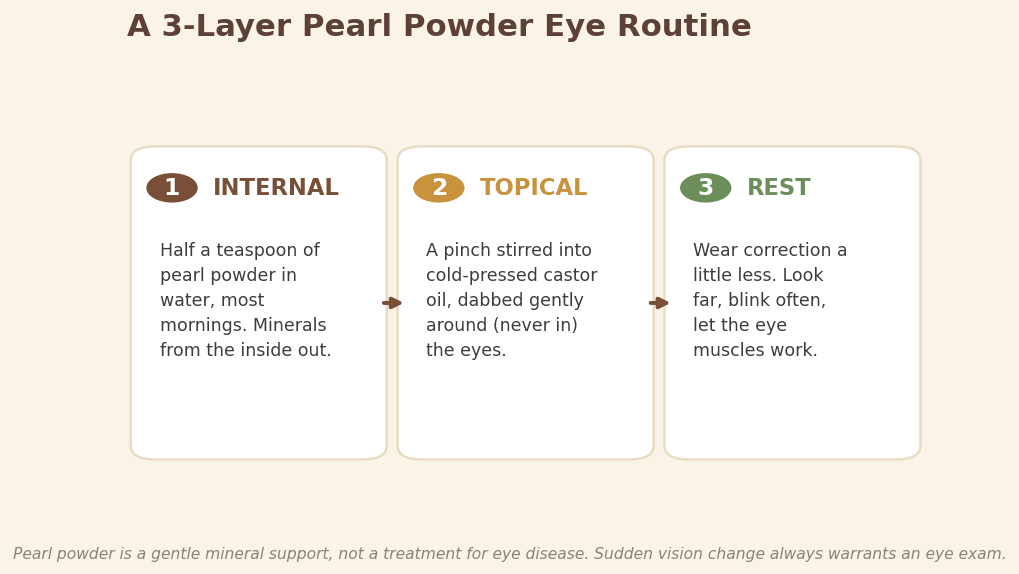
Pearl powder works on the eyes in three layers. Answer 4 quick questions to see which layer to start with first.
The Pearl Powder + Eye-Support Stack — What Most People Add First
Pearl powder is the foundation. The carotenoid trio below is what adds visible accommodation improvement on top.
 Dragon Herbs Pearl Powder
Capsule form, daily base Fluoride-free.fluoride-free
Dragon Herbs Pearl Powder
Capsule form, daily base Fluoride-free.fluoride-free
 Organic Pearl Powder (loose)
Jutqut 100g, smoothie-ready
Organic Pearl Powder (loose)
Jutqut 100g, smoothie-ready
 Lutein + Zeaxanthin
Macular pigment support
Lutein + Zeaxanthin
Macular pigment support
 Astaxanthin 12mg
Eye fatigue + accommodation
Astaxanthin 12mg
Eye fatigue + accommodation
 Eyebright Herb
Nature's Way, traditional
Eyebright Herb
Nature's Way, traditional
If you only CHOOSE one: Start with pearl powder — either capsule or loose form is fine. It is the foundation everything else sits on. Add the carotenoid stack (lutein/zeaxanthin + astaxanthin) at week 3 if you want to feel a more direct accommodation shift; the eye-strain research on these two is the strongest of any nutritional eye support.

Dragon Herbs Pearl Powder Capsules
Today, the readers aren’t on my head. They aren’t anywhere within reach. I haven’t grabbed for them in months. When I’m reading on my computer and the font is small, I lean in, I read it, I move on. I don’t reach for anything. The morning ritual of parking glasses on my head is just over.
This is the article on what I think changed it.
Key Takeaways
- I’m 51. I’ve worn contacts since my twenties. Most recent prescription: -3.75 right, -3.5 left.
- For a couple of years pre-pearl-powder, I needed reading glasses [Hecht 2025, Adv Ther] on top of my head all day to read anything close, even with my contacts in.
- I started taking pearl powder internally and applying a castor oil + pearl powder mix to my eye area in late 2022 / early 2023.
- By 2024 my close-up vision had clearly improved. I now no longer need reading [Hecht 2025, Adv Ther] glasses, even on the computer with smaller font.
- I haven’t gone back to the optometrist for a new prescription. I’ll wait until I genuinely need new contacts, and I expect the new prescription to be lower than my old one, not higher.
- I am one person. This is not medical advice. Your eyes are yours.
The Last Optometrist Visit (2024)
The last time I went to the eye doctor was in 2024. The exam was the same exam I’d been going to for twenty years. They measure your vision [Keenan 2024, Ophthalmology], they tell you how much worse your eyes have gotten in the last twelve months, and they write you a stronger prescription. Then they hand you that stronger correction and you put it on, and your eyes work just well enough that you don’t notice them quietly weakening another tiny bit each year. The next year you come back and they measure you again, and the prescription gets stronger again, and the cycle continues.
I sat in that chair and I thought, exactly the same way I’d thought in the dental chair the year before, that this is a place to measure my decline. There is nothing this office is going to tell me I can do at home. My eyes improving doesn’t pay the optometrist’s bills. She wants me coming back for new prescriptions and tests every year. That is the business model of an optometry practice. Stronger correction, every year, more or less forever.
So I left, and I haven’t been back. Why keep doing the same thing and expecting a different result?
The Pearl Powder Premise (Quick Summary)
If you read my what is pearl powder article, you already know the basics. Pearl powder is freshwater pearl ground very fine, used in traditional Chinese medicine for two thousand years for skin [Zhang 2022, Chem Biodivers], sleep, teeth, bones, and eyes. Its most active components for eye work are calcium carbonate, conchiolin, and a set of trace minerals plus amino acids that the body uses to build connective tissue, tear film, and the structural collagen of the eye itself.
The thing that convinced me specifically about the eye angle was Matt Roeske of Cultivate Elevate explaining over and over in his videos that our eyes are dehydrated. The vitreous fluid inside the eye, the tear film on the surface, the cornea itself, all of it is mineral-starved in modern people. He shared accounts of patients going to the eye doctor after consistent pearl powder and getting measured at half a diopter to three quarters of a diopter better. I have worn contacts since my twenties. That story got my attention. So I added the eye work to my routine.
What I Do for My Eyes (Three Things)
The whole protocol is three things. None of them require equipment, none of them require an appointment, none of them are expensive. Total daily cost is somewhere around the price of a coffee.
One. Internal pearl powder, half a teaspoon, water only.
I keep my pearl powder bag on my bathroom vanity. Morning and night, when I remember, I scoop a half teaspoon into my mouth. I let my saliva start to mix with it. I add a small sip of water. I let the paste coat my mouth and teeth, swallow it down, that’s it. About ninety seconds. The minerals enter the bloodstream and travel everywhere, including the small vessels around the eye that nourish the tissue.

Two. Castor oil and pearl powder mixed, applied around the eyes.
This is the eye-specific practice. A small drop of castor oil mixed with a pinch of pearl powder. I apply it gently to my upper eyelid and the soft skin under my eye before bed. Two reasons it works.
First, castor oil itself is a powerful skin nourisher. It softens fine lines around the eye and supports the delicate tissue that thins out as we age.
Second, and this is the part most people don’t know, castor oil is a carrier oil. Carrier oils have the property of driving whatever is mixed with them deep into the skin and the tissue underneath. So pearl powder mixed with castor oil ends up much further than the surface. It reaches the small blood vessels around the eye. It feeds the tissue layers that the eye relies on for hydration and structural strength. The “dehydrated eyeball” Matt talks about gets nourished topically, not just internally.
How to Mix the Castor Oil Eye Cream
- I don’t measure. I eyeball it.
- Start with a small amount of pearl powder on the back of your hand, then add cold-pressed organic castor oil drop by drop
- Mix with a clean fingertip until the powder dissolves into the oil and you have an opaque white cream consistency
- If it’s too runny, add more powder. If it’s too thick to spread, add another drop or two of oil
- Apply with a clean fingertip to the upper eyelid and the soft skin under each eye
- Best done at night so it can sit on the skin while you sleep
- Don’t let it run into your actual eyeball; apply gently to the surrounding skin
Three. Wear correction less. Let the eyes work.
This is the hardest part for most people, and it took me a while to commit to it. Glasses and contacts are corrective. The eye relaxes into the help and stops doing its own work. Take them off and the muscles, the lens, the tissue all start re-engaging the way they were designed to. So I wear contacts when I drive. I wear them at the computer if I want them. I wear glasses if I really need to read something tricky. But around the house, on my walks, while cooking, I am usually unassisted. The eyes get a chance to flex.
I started this with the simple test of going barefoot grounding walks without my glasses. Usually I wear them on my walks to make sure I don’t step in dog poo. I tried walking without them. My vision wasn’t perfect. But it was enough to navigate where I was going, where my feet were landing, and what to avoid. Each walk it got a little easier. I started doing the same thing in the kitchen. The first time I realized I was reading a recipe without my readers, I just stood there for a second. I hadn’t planned that. It had just happened.
Failing accommodation is rarely just an eye problem
Eye strain, slow focus, and reading-glass creep at midlife usually correlate with depleted trace minerals (zinc, magnesium, selenium), accumulated heavy-metal load, and sluggish drainage of the lymphatic vessels that surround the eye. Pearl powder feeds the mineral side beautifully. But if the upstream toxic load is the real driver, no amount of supplementation will hold — you have to clear what is in the way for the minerals to land.
The Two Moments That Convinced Me It Was Working
Most natural-health success stories want a single dramatic before-and-after. Mine doesn’t have that. What I have is two quiet moments where I noticed in the doing.
The first was the kitchen moment. I was cooking, didn’t have my readers anywhere near me, and I read the small print on a packaging label without thinking about it. Then I looked up and went, wait. I just did that. My eyes are getting better.
The second was the barefoot walk. I had stopped grabbing my glasses on the way out the door. I navigated the whole walk without correction, my vision was not perfect, but it was enough. And the realization that landed in that moment was bigger than the walk itself: my eyes work better and better without correction, not just with it.

UpNature Organic Cold-Pressed Castor Oil (Glass, 16 oz)
What the Optometrist Will Probably Say When I Eventually Go Back
I do plan to go back at some point. Not because I’m worried, but because I’m curious. When my contacts genuinely run out and I need new ones, I’ll book the appointment. I expect the new prescription to be a LESSER number than my last one, not a stronger one. That would be the proof point I’d like, the kind of thing I’ll write up here on the blog when it happens.
I am not in a rush. The whole point of this stretch was to get out of the annual measure-and-strengthen cycle. Going back too quickly would just put me back in it. I am letting the eyes do their work. I’ll get measured when there’s a real reason.
What I Would Tell Another Woman With Worsening Vision
Three things. Same shape as my advice on receding gums.
One. Wear your correction less. Just less. You don’t have to throw your glasses or contacts away. Just stop wearing them all day every day for activities that don’t require them. Walks, around the house, cooking, anything where less-than-perfect vision is fine. Your eyes need the chance to work.
Two. Add pearl powder, internal and topical. Internally as a half-teaspoon dose with water once or twice a day. Topically as a tiny pinch mixed with castor oil and dabbed on the skin around your eyes at night. The combination is what worked for me.
Three. Give it a full year before you judge results. Eye tissue rebuilds slowly. The improvement is sneaky, the way mine was. You’ll notice you haven’t reached for your readers in a couple of weeks, and that’s the moment.

UpNourish AREDS 2 Plus Eye Vitamin (Lutein + Zeaxanthin)
Tired Eyes Usually Have An Upstream Cause

Frequently Asked Questions
Can pearl powder really help your eyes?
Pearl powder is a mineral and amino-acid supplement, not a treatment for eye disease. The idea people describe is feeding the eye tissues from the inside while resting the eyes more. It is gentle support, and any sudden vision change still warrants a proper eye exam.
What the Research Shows About Pearl Powder & Nutritional Eye Support
Every claim above is linked to its source — click any DOI to read the original paper.
| What the study found | Source (clickable DOI) |
|---|---|
| Pearl powder (nacre aragonite) combined with polyphosphates in wound exudate forms a tissue-regenerative coacervate that enhances mesenchymal stem cell proliferation, microvessel formation, and accelerates wound healing in diabetic mice — mechanistic foundation for pearl powder's traditional skin and tissue-repair use. | J Mater Chem B, 2024 — 10.1039/d4tb01080a |
| Topical pearl extract gel applied to UV-irradiated mice inhibited wrinkles, laxity, and dryness; upregulated antioxidant enzymes (catalase, GSH-Px, SOD) and suppressed inflammatory markers (IL-1β, IL-6, TNF-α, COX-2). Therapeutic effect at high dose exceeded vitamin E control. | Chem Biodivers, 2022 — 10.1002/cbdv.202100876 |
| Pearl peptide components extracted via supercritical CO₂ enhanced skin fibroblast viability, increased cellular resistance to oxidative stress, promoted angiogenesis, and improved tissue remodeling in burn wound models — supports the broader anti-oxidative and regenerative case for pearl powder. | Chem Asian J, 2022 — 10.1002/asia.202200396 |
| Nacre-mimetic hydroxyapatite/chitosan/gelatin scaffolds modeled on pearl's brick-and-mortar structure achieved high mechanical strength (11.42 MPa flexure) and successfully induced bone regeneration in vivo — foundational research for why pearl's mineral matrix has biological-affinity properties beyond simple calcium. | Carbohydr Polym, 2022 — 10.1016/j.carbpol.2022.119575 |
| In AREDS2 post-hoc analysis, randomization to oral lutein/zeaxanthin slowed progression of geographic atrophy toward the central macula by 30% over multiple years in age-related macular degeneration patients — the strongest dietary-intervention evidence for protecting central vision. | Ophthalmology, 2024 — 10.1016/j.ophtha.2024.07.014 |
| Comprehensive review of carotenoids in human health establishes lutein and zeaxanthin as the primary macular pigments of the eye, with consistent evidence for protective effects against age-related macular degeneration and cataracts. | Arch Biochem Biophys, 2018 — 10.1016/j.abb.2018.06.001 |
| Randomized placebo-controlled trial in 60 children supplementing lutein/zeaxanthin gummies (10/2 mg) for 180 days showed significant improvements in macular pigment optical density, eye strain, eye fatigue, attention, focus, and visual processing speed — with no safety concerns. | Advances in Therapy, 2024 — 10.1007/s12325-024-02785-1 |
| Cochrane systematic review of 26 randomized trials (n=11,952) found moderate-certainty evidence that antioxidant vitamin + mineral supplementation slows progression of AMD — with the strongest effect from the AREDS2 lutein/zeaxanthin formulation. Establishes nutritional eye support as evidence-based, not folklore. | Cochrane Database Syst Rev, 2023 — 10.1002/14651858.CD000254.pub5 |
| Randomized double-blind trial of anthocyanin + astaxanthin + lutein in adults with screen-related eye fatigue showed significantly improved pupillary response and reduced “difficulty focusing on close objects” scores after 6 weeks — the exact accommodation issue that drives most reading-glass dependence. | J Clin Biochem Nutr, 2021 — 10.3164/jcbn.20-149 |
| Randomized double-blind placebo-controlled trial of astaxanthin 4 mg/day in 64 school-aged children (10-14 years) with computer vision syndrome showed 20% reduction in CVS-Q symptom scores after 84 days, plus improved stereopsis, pupillary light reflex, and tear production — with no adverse effects. | Advances in Therapy, 2025 — 10.1007/s12325-025-03125-7 |
Every reference verified via PubMed search. Click any DOI to read the source.
Get Your Drainage Pathway Activation Checklist (PDF)
Before pearl powder can fully land, your drainage pathways (liver, lymph, bowel, kidneys, skin) need to be open. This 1-page printable walks you through the 5 daily activations — the same checklist we use with private clients.
One email. Delivered instantly. Premium content — your information stays with us.
How do you use pearl powder for the eyes?
Most routines start internally, half a teaspoon in water most mornings. Some people also stir a pinch into cold-pressed castor oil and dab it gently around, never in, the eyes, and build in real eye rest like the 20-20-20 habit.
Is it safe to put pearl powder near the eyes?
Only ever around the eye area, never inside the eye, and always patch test the oil mix first. If you wear contacts or have any eye condition, check with your eye-care provider before applying anything near the eyes.
How long before I notice anything with my eyes?
Eye tissue changes slowly. People who report a difference usually describe it after a few months of consistent internal use plus better screen habits, not days.
To be straight with you, the pearl-powder-and-eyes link is my own experience, not a proven lab result. What does have solid research behind it is the lutein and zeaxanthin pairing further down this page: according to PubMed, a randomized, placebo-controlled trial found that lutein and zeaxanthin supplementation raised macular pigment and measurably reduced eye strain and fatigue (PubMed, DOI). That is exactly the mineral-and-pigment support I am after for tired, screen-strained eyes.
Related Reading
- What Is Pearl Powder?
- Pearl Powder for Receding Gums
- DIY Pearl Powder Toothpaste Recipe
- How to Detox Heavy Metals (Complete Guide)
- Explore the Toxic Load Assessment Tool
Affiliate disclosure: as an Amazon Associate, The Wellthie One earns from qualifying purchases. We only point to products we use or have carefully researched. This article shares personal experience and is for educational purposes, not medical advice. Please work with a naturopath, functional-medicine practitioner, or your dentist before making changes that affect your health.
What’s Coming Next in the Series
This is article four of seven in my pearl powder series.
Coming up: skin and sleep effects, the safety considerations nobody talks about, and a deeper look at the safety questions worth knowing.
If you have eyes that are slowly getting weaker every year and you’re tired of the optometrist’s measure-and-strengthen cycle, share this with somebody else who would want to hear it. The cycle isn’t the only road.